
MedGemma & MedSigLIP: Medical AI by Google – AI News – #4 July 2025

3min.

Comments:0

28 July 2025

MedGemma & MedSigLIP: Medical AI by Google – AI News – #4 July 2025d-tags
Forget about AI in marketing and SEO for a moment. Google is breaking new ground by introducing MedGemma and MedSigLIP—revolutionary, open-source AI models designed specifically for medicine. These aren't just chatbots; they are specialized tools capable of understanding complex medical records and analyzing images like X-rays to generate accurate reports with performance comparable to human specialists. Most importantly, their open-source nature gives hospitals and researchers full control over their data, ensuring privacy and allowing for customization to fit their specific needs.

3min.

Comments:0

28 July 2025

In everyday discussions about artificial intelligence, we often get stuck on the same topics. We talk about how AI will revolutionize marketing, help us carry out various SEO strategies, write code for us, or instantly generate images. While all of this is important, it’s easy to forget amid the noise that AI is much more than a tool for developers and creatives. It’s a technology with the potential to tackle humanity’s biggest challenges. And one of these, without a doubt, is medicine.

Google has just taken a huge step in this direction, presenting MedGemma and MedSigLIP—two new, open AI models that have the chance to transform healthcare and medical research. These aren’t just more chatbots for general chitchat; they are specialized tools that can become digital assistants for doctors, radiologists, and scientists around the world.
What is MedGemma? A New Generation of Medical AI

Imagine artificial intelligence that not only understands complex medical jargon but can also “look” at an X-ray and generate a preliminary report based on it. That’s exactly what MedGemma is. It’s a family of generative AI models built upon Google’s well-known Gemma series, but specifically “trained” for medical tasks.

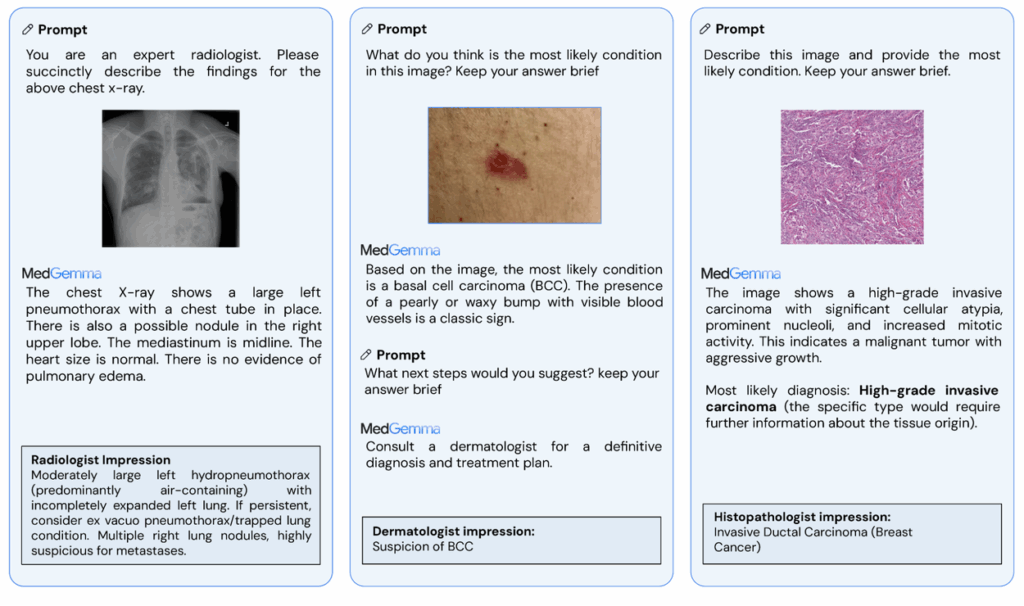
MedGemma’s greatest strength is its multimodality. This means the model can process information from multiple sources at once—in this case, text and images. A doctor might ask a question about a chest X-ray, and by analyzing the image, the AI will provide a text answer:

Capabilities of the MedGemma model from Google
Source: https://research.google/blog/medgemma-our-most-capable-open-models-for-health-ai-development/

The model can also independently generate radiology reports, interpret data from a patient’s electronic health record (EHR), or answer questions about complex clinical cases. One particularly telling study involved certified radiologists, who estimated that as many as 81% of chest X-ray reports generated by MedGemma were accurate enough that they would have led to the same treatment decisions as the original specialist-prepared reports. This shows just how close we are to real AI support in everyday diagnostics.

MedSigLIP—Even More Precise Image Interpretation

If MedGemma is a versatile digital assistant for healthcare professionals, then MedSigLIP is its specialized “eye.” It’s a lightweight (just 400 million parameters) encoder whose sole role is to perfectly understand medical images. It’s been trained on a vast amount of data—from X-rays to histopathological and dermatological images, all the way to retinal scans.

Simply put, MedSigLIP transforms a medical image into a mathematical representation (an “embedding”) that a computer can understand and compare with others. Thanks to this, it’s perfectly suited to tasks such as:

  • Image classification and instant detection of, for example, cancerous changes.
  • Semantic search, i.e., searching massive databases to find visually similar medical cases, which can assist in diagnosing rare diseases.
  • “Zero-shot” classification: categorizing images without prior, direct training on a specific image type—only by comparing the image to a text description of the category.

Why Are “Open” Models a Revolution in Medicine?

The key word in this announcement is “open” (open models). Unlike closed models available only via API, MedGemma and MedSigLIP can be downloaded, modified, and run by any institution on their own infrastructure.

Hospitals and research centers can process patient data on their own secure servers, without sending sensitive information to outside companies. This is absolutely fundamental for trust and regulatory compliance. Every facility can fine-tune the model to its unique needs—for example, for analyzing highly specific types of ultrasound images or rare diseases. What’s more, the behavior of an open model won’t change overnight with a silent update, as can happen with API services. This guarantees scientific reproducibility and consistency in clinical applications.

AI in Medicine—A Future Unfolding Before Our Eyes

Google’s models are already being tested worldwide. Chang Gung Memorial Hospital in Taiwan uses MedGemma to analyze medical literature in Chinese. DeepHealth in the US is exploring MedSigLIP to streamline patient triage based on X-rays. This is proof that we’re not talking about a distant future.

Initiatives like MedGemma and MedSigLIP showcase AI’s true potential. They shift the focus of the discussion from business optimization to saving human health and lives. And even though at Delante we most often talk about the former, we’re still curious how artificial intelligence will impact our lives—so stay up to date and sign up for our newsletter!

Source of information about MedGemma and MedSigLIP: https://research.google/blog/medgemma-our-most-capable-open-models-for-health-ai-development/

Author
Maciej Jakubiec - Junior SEO Specialist
Author
Maciej Jakubiec

SEO Specialist

A marketing graduate specializing in e-commerce from the University of Economics in Kraków – part of Delante’s SEO team since 2022. A firm believer in the importance of well-crafted content, and apart from being an SEO, a passionate music producer crafting sounds since his early teens.

Author
Maciej Jakubiec - Junior SEO Specialist
Author
Maciej Jakubiec

SEO Specialist

A marketing graduate specializing in e-commerce from the University of Economics in Kraków – part of Delante’s SEO team since 2022. A firm believer in the importance of well-crafted content, and apart from being an SEO, a passionate music producer crafting sounds since his early teens.