
GPT-5 is here: newest model launch by OpenAI – AI News – #2 August 2025

7min.

Comments:0

08 August 2025

GPT-5 is here: newest model launch by OpenAI – AI News – #2 August 2025d-tags
The AI world held its breath, and now we know why. OpenAI has officially unveiled GPT-5, and it's not just another update—it's a breakthrough that redefines the rules of the game. Imagine an AI that creates fully functional apps from a single sentence, writes with literary depth, and thinks using tools, outperforming human experts in benchmark tests.

7min.

Comments:0

08 August 2025

Everyone was whispering and speculating about it, waiting with anticipation. Rumors had been circulating for months, whetting the appetites of the entire tech industry. Today, we can officially confirm it: GPT-5 is here. OpenAI has just unveiled its newest flagship language model, and what we saw is not an evolution. It’s a true revolution that redefines our concept of artificial intelligence. Fasten your seatbelts, because we are entering a whole new level.

What is GPT-5 and why is it a milestone?

Forget everything you knew about previous models. GPT-5 is not just a “better GPT-4.” It’s a completely new architecture, designed for intelligence, versatility, and most importantly, practical real-world utility. OpenAI describes it as its “most intelligent system to date,” and after analyzing its capabilities, it’s hard to disagree.
The biggest change is that GPT-5 operates as a unified system. What does this mean in practice? No more manually selecting the right model for the task.
One mastermind, many talents

Inside GPT-5 works an intelligent “router” that acts like a lightning-fast project manager. When you ask a question, the router analyzes its complexity and context in a fraction of a second. A simple query? A super-efficient, fast model will answer it. Need a deep analysis or complex reasoning? A more powerful “thinking” model (GPT-5 thinking) steps in, dedicating more time to finding the best, expert-level answer.
This system learns in real-time based on user interactions, making it smarter at delegating tasks with each passing day. It’s a bit like having both a brilliant sprinter and a persistent marathon runner on your team, and knowing exactly which one to send for a specific leg of the race.

How to start using GPT-5?

Starting today, GPT-5 is being rolled out to all ChatGPT users, including those on the free plan! It replaces the older models by default.

Pro subscribers have unlimited access to GPT-5 and access to GPT-5 Pro – an even more powerful version with extended “thinking time,” designed for the most demanding tasks. Free users will be able to use the full power of GPT-5, and after reaching their limit, they will be automatically switched to the very capable GPT-5 mini model. Plus subscribers receive significantly higher usage limits.

Groundbreaking applications of GPT-5

GPT-5 is not just about impressive benchmark results. It is, above all, a tool that excels at tasks that previous generations of ChatGPT could only dream of. OpenAI has focused on three key areas: coding, creative writing, and health.

Coding

Developers, hold on to your seats. GPT-5 can create fully functional, aesthetic, and responsive websites, games, or applications from a single, simple prompt. Think about it: you describe your idea, and a moment later, you receive a ready HTML file with a working mini-game, a music visualizer, or a pixel art editor.
The model has an exceptional sense of aesthetics – it pays attention to details like typography, spacing, and overall design, which was the Achilles’ heel of earlier models. It can also handle complex debugging in large repositories, resolving intricate dependency conflicts that its predecessors failed to solve. It’s like having a brilliant full-stack developer on your team who never sleeps and doesn’t drink coffee.

Creativity: from poetry to reports

Do you remember how AI-generated texts sounded a bit… artificial? GPT-5 elevates creative writing to a literary level. The model uses metaphor, rhythm, and subtlety with much greater grace. It can sustain complex poetic forms, like unrhymed iambic pentameter, as well as create naturally flowing prose. This new capability, of course, translates to everyday tasks – from creating engaging LinkedIn posts and writing emails to editing complex business reports.

AI in health

OpenAI emphasizes that GPT-5 does not replace a doctor, but it can become an invaluable partner in managing health. The model is much better at analyzing medical questions, proactively asks additional questions to better understand the context, and can tailor its responses to the user’s knowledge level and geographical location. Most importantly, its tendency for hallucinations on health topics has been drastically reduced. It can help understand test results, prepare a list of questions for a doctor, or analyze different treatment options.

A revolution in AI interaction: GPT-5 “thinks with tools”

This might be the most important change that GPT-5 brings. Previous models used tools. GPT-5 thinks with tools. This is a fundamental difference that one of the early testers described as “the beginning of the stone age for AI agents.”
Human intelligence developed most significantly when we learned to create and use tools that extended our capabilities. GPT-5 does the same in the digital world. Instead of simple function calls (e.g., get_weather(location)), the model can conduct complex research processes, using available tools (like a web browser or code interpreter) as an integral part of its “thought process.” It can use them in parallel, plan multi-step tasks, and draw conclusions from failed attempts to intelligently iterate towards a solution.
To fully leverage this potential, we need to start thinking about prompting not as asking a model questions, but as instructing an agent. Instead of throwing a wall of text at it, it’s better to give it a compass: clear instructions, key files to analyze, and a definition of success.

The new personalities of GPT-5

Have you ever felt that ChatGPT is overly nice and agreeable? OpenAI noticed this problem (known as sycophancy) and has significantly reduced it in GPT-5. The model is more direct, subtle, and less euphoric. A conversation with it is meant to feel like a chat with a helpful but specific expert with a Ph.D., not with an overly enthusiastic assistant.
Additionally, four new optional “personalities” have been introduced to customize the AI’s communication style:

  • cynic
  • robot
  • listener
  • nerd

Thanks to this, you can match the tone of the response to your needs without having to write complex instructions in every prompt.

Even better personalization and deeper integrations in GPT-5

GPT-5 has not only gained new “personalities,” but it is also much better at understanding and remembering individual user preferences. The model is clearly more effective at following “Custom Instructions.” This means you can “teach” it your writing style, preferred response formatting, or specific domain knowledge even more precisely, and it will adhere to these guidelines more faithfully than ever before.
The real breakthrough, however, is the announcement of much deeper integration with external applications, such as Google services. Soon, ChatGPT will be able to automatically connect to your Gmail, Google Calendar, or Contacts. Imagine asking the AI to write an email proposing a meeting, and it independently checks your calendar to suggest available times and suggests the recipient’s email address by pulling it from your contacts. This is the vision of a truly personal assistant that operates seamlessly within your digital ecosystem.
Finally, a small but useful new feature in the ChatGPT interface itself – the ability to assign colors to individual chats. This is a simple solution that will significantly ease workflow organization and help you quickly find threads across many parallel projects.

Safety and honesty. GPT-5 is an AI that knows its limits

OpenAI has put a great deal of work not only into making GPT-5 smarter, but also more responsible. A new safety training paradigm has been introduced here, moving away from the simple “answer or refuse” scheme.
Instead of a hard refusal for potentially risky queries (so-called “dual-use,” e.g., in chemistry or virology), the model has been taught “safe completions.” This means it can provide a helpful response at a high, safe level, while refusing to provide details that could be misused. Furthermore, GPT-5 is trained to transparently explain why it is refusing a full answer and to suggest safe alternatives. This is intelligent navigation of difficult topics, not just slamming the door.
This is also accompanied by greater honesty. The model is far less likely to pretend it has done something when it actually couldn’t. In tests, when asked to perform an impossible task (e.g., physically unblocking a Wi-Fi radio from cloud-based software), GPT-5 was able to precisely explain its technical limitations instead of generating a false answer. This builds trust and shows that we are dealing with a tool that is aware of its own virtual environment.

GPT-5’s test results. OpenAI crushes the competition

Intuitive feelings and descriptions of new features are one thing, but the true measure of progress in the AI world is hard data. And here, GPT-5 takes no prisoners. OpenAI has published a series of results from academic and industry benchmarks that show we are dealing with a new performance leader that is setting records in key areas.

Expert-level maths & science

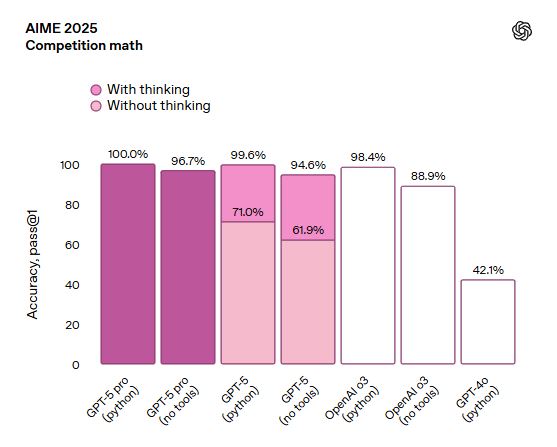
GPT-5 demonstrates astonishing proficiency in solving problems that, until now, were a challenge even for specialized models. In the AIME 2025 test, a high-level math competition for high school students, the model achieved an impressive 94.6% without using additional tools:

Wyniki GPT-5 w teście AIME 2025
source: https://openai.com/index/introducing-gpt-5/

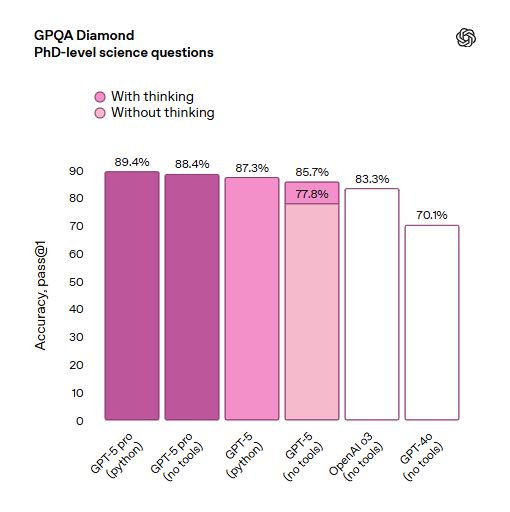
n the GPQA Diamond benchmark, which contains Ph.D.-level science questions, the GPT-5 Pro version scored an impressive 88.4%, demonstrating its ability for deep reasoning in complex fields.

Wyniki GPT-5 w teście GPQA
source: https://openai.com/index/introducing-gpt-5/

    The new king of coding

    As we’ve mentioned, GPT-5’s programming capabilities are revolutionary, and the numbers only confirm this.

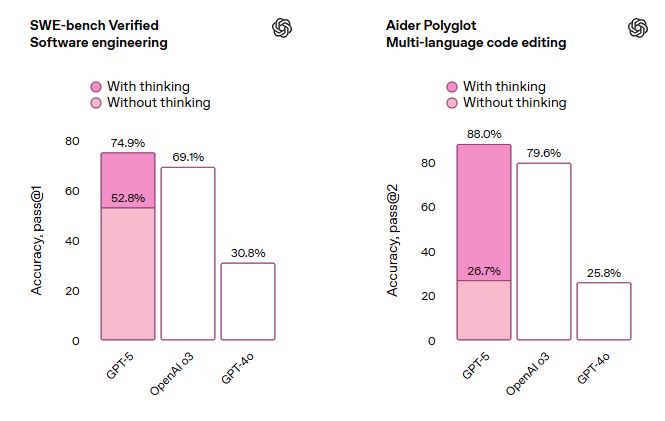
    In the SWE-bench Verified test, which simulates real software engineering tasks, GPT-5 achieved 74.9% accuracy – a huge leap compared to 30.8% for GPT-4o. In Aider Polyglot, a test that evaluates multi-language code editing, the 88% score crushes previous generations and shows what a reliable coding partner the new artificial intelligence has become.

    Wyniki GPT-5 w testach kodowania
    source: https://openai.com/index/introducing-gpt-5/

    More intelligence, less effort

    Crucially, GPT-5 achieves these sensational results more efficiently. In many tests, especially those requiring deep reasoning, the model was able to generate a better response while using 50% to 80% fewer tokens (i.e., computational units) than its predecessor, OpenAI o3. This means not only faster answers but also a more optimized and thoughtful operation “under the hood.”

    Ability to work in the real world

    Perhaps the most important test is the one OpenAI conducted internally, measuring the model’s performance on tasks of high economic value. GPT-5 faced complex tasks from over 40 different occupations, such as law, logistics, sales, and engineering. The results are clear: in almost half of the cases (47.1%), GPT-5 matched or outperformed human experts. This clearly shows that its intelligence has a direct impact on real-world, professional applications.

    Does the launch of GPT-5 mean AGI is just around the corner?

    GPT-5 is undoubtedly the biggest leap in quality since the launch of GPT-3.5. It’s a model that is not only “smarter” on paper but, above all, incredibly practical. Its capabilities in coding, reasoning, and using tools open the door to creating applications and solutions that were previously in the realm of science fiction.
    Is this a precursor to Artificial General Intelligence (AGI)? Perhaps not, but it is certainly the most significant step in that direction we have seen so far. GPT-5 teaches us that the future of AI is not just about raw computing power, but about intelligence manifested through the masterful use of tools. Just as it once happened with us. It seems a new era has just begun – follow it with us and subscribe to the Delante newsletter!

    Source: https://openai.com/index/introducing-gpt-5/

    Author
    Maciej Jakubiec - Junior SEO Specialist
    Author
    Maciej Jakubiec

    SEO Specialist

    A marketing graduate specializing in e-commerce from the University of Economics in Kraków – part of Delante’s SEO team since 2022. A firm believer in the importance of well-crafted content, and apart from being an SEO, a passionate music producer crafting sounds since his early teens.