Google is redefining generative imagery with the launch of Nano Banana Pro, powered by Gemini 3. Say goodbye to garbled text and inconsistent characters—this new tool delivers flawless typography, identity consistency across multiple shots, and photorealistic adherence to physics and history.
A few months ago, Google launched the Nano Banana model (based on Gemini 2.5 Flash), designed to democratize simple photo editing for regular users. Restoring old photos or generating simple figurines became much easier. However, the creative industry was waiting for more — a tool that could handle the toughest generative AI challenges: text, character consistency, and understanding the physics of the world.
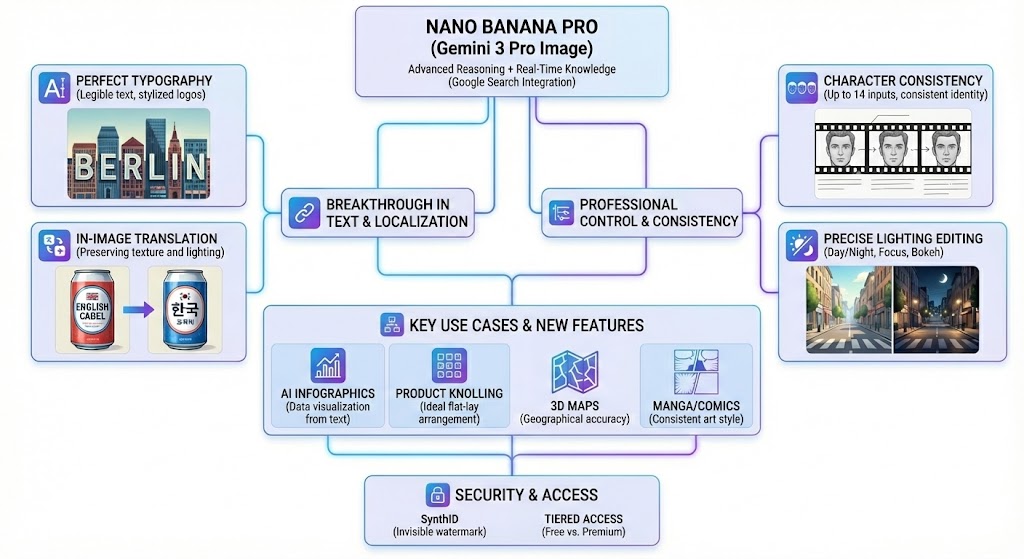
The answer to these needs is Nano Banana Pro (Gemini 3 Pro Image). This is not just an update; it is a new foundation for image generation, based on advanced reasoning and real-time world knowledge.
What sets Nano Banana Pro apart from the competition?
The key difference in the new model is its integration with the “brain” of Gemini 3 Pro. Nano Banana Pro doesn’t just combine pixels based on aesthetics; the model understands what you’re asking within a broader logical context.
Thanks to its connection with Google Search, the model can visualize information in real time. If you request a weather infographic, you won’t get random clouds and sun, but a graphic based on actual meteorological data for the specified location. This is a milestone toward creating “smart” content generation.
Breakthrough in typography and text editing
Anyone who has used Midjourney or DALL-E knows that generating captions is the Achilles’ heel of AI. Nano Banana Pro seems to solve this problem definitively.
No more garbled captions in Nano Banana
The model can render correct, readable text in many languages. It’s not just about short slogans. Nano Banana Pro can handle long paragraphs on posters, infographics, or mockups.
The model can generate text in a specific style (e.g., retro, halftone), where the letters are an integral part of the design, not an “added-on” element.
Users create images where architecture forms letters, while maintaining photorealism and the laws of physics.
Localization and translation within images
For the e-commerce industry, this is a game-changer. The model can translate text on an object (e.g., on a drink can) from English to Korean, preserving the original texture, lighting, and curvature of the object. This allows rapid localization of marketing materials for foreign markets.
Tools for professionals – consistency and control
Generating a nice single image is easy. Creating a whole series of coherent graphics for a campaign has been a nightmare until now.
Maintaining character consistency
Nano Banana Pro allows working with up to 14 input images. Practically, you can upload photos of 5 different people (or characters) and generate a new scene where everyone appears, while preserving their facial features and clothing.
Use case: creating film storyboards or fashion shoots where models look identical in every shot, only their poses and camera angles change.
Precise lighting and depth editing
Google puts “studio” level image control in the hands of creators.
Changing the time of day. You can switch lighting from sunny day to night, and the model correctly recalculates shadows and light sources without distorting objects.
Focus and bokeh, i.e., changing the focus point from the foreground (e.g., flowers) to the background (a person) is done with one command, simulating a real camera lens.
Business and creative use cases
Beyond standard graphics, the new model opens doors to automating many visual processes.
Infographics and data visualization
Instead of commissioning a graphic designer to create simple charts, Nano Banana Pro can turn raw text (e.g., notes, recipes, numerical data) into aesthetic diagrams and infographics. Remembering previous “quirks” of other graphic models, I decided to test how the new Google model performs… and here it beautifully summarized the article!
Source: generated with Nano Banana Pro
Knolling and product photography
The model perfectly understands the concept of “knolling” (arranging objects at right angles, parallel to each other). This is an ideal solution for online stores wanting to showcase set contents, unboxing videos, or product color variants in a neat, aesthetic way.
Maps and spatial visualizations
Thanks to understanding geography, the model can generate stylized 3D maps of specific regions (e.g., national parks), considering terrain relief and vegetation, which is useful in the tourism industry.
Manga and stylized comics
A dedicated feature for narrative creators. The model maintains line and character consistency across comic panels, allowing for faster creation of drafts and even finished manga-style publications.
Nano Banana Pro Features That Stir Emotions (and Controversies)
Some capabilities of Nano Banana Pro go beyond the standard understanding of an image generator and venture into the realm of reality simulation.
Hyperrealistic “Time Travel”
Testers noticed that by providing the model with precise geographic coordinates and a historical date (e.g., the year 33 AD), the AI generates an image that looks like a “photograph” from that period. The system takes into account the climate, architecture, and sun position of that era. The result resembles documentation more than an artistic vision, which has huge educational potential.
“Homework Completion” in Handwriting
This feature went viral on Platform X. The model can solve a problem from a photo (e.g., math) and then generate an answer that mimics the user’s handwriting style. Spacing, letter style, and “imperfections” of a human hand are preserved. While impressive, this tool will surely spark debate in the education sector.
Availability and Security (SynthID)
Google is aware of the risks associated with such realistic generations. Therefore, all images created by Nano Banana Pro are marked with an invisible digital watermark called SynthID. This allows verification of the image’s origin (whether it was AI-generated), even after editing or cropping.
Access to the model is tiered:
AI Premium/Ultra subscribers: no visible watermarks, full quality, and access to commercial tools.
Free users: limited number of generations, visible watermark on images.
Nano Banana Pro Summary
Nano Banana Pro is a clear signal that Google is back in the race for the throne in image generation. Combining high visual quality with deep understanding of text and context, it is currently one of the most versatile tools on the market — suitable for both marketers and artists. What’s next? Don’t miss the latest in AI and subscribe to the Delante newsletter!
A marketing graduate specializing in e-commerce from the University of Economics in Kraków – part of Delante’s SEO team since 2022. A firm believer in the importance of well-crafted content, and apart from being an SEO, a passionate music producer crafting sounds since his early teens.
A marketing graduate specializing in e-commerce from the University of Economics in Kraków – part of Delante’s SEO team since 2022. A firm believer in the importance of well-crafted content, and apart from being an SEO, a passionate music producer crafting sounds since his early teens.


 d-tags


 Loading...