
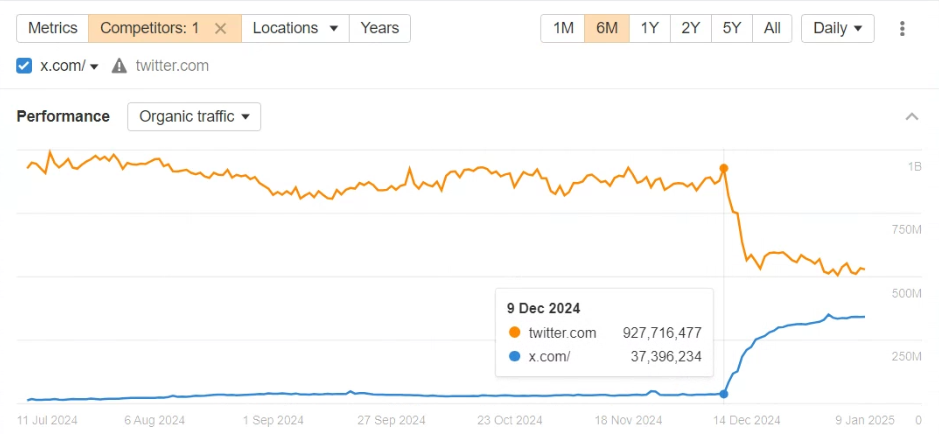
- twitter.com lost about 400 million hits from Google,
- x.com gained 300 million hits in that time.
SEO News January 2025

What's been going on in the SEO world in January?

In SEO news for January 2025, let’s start with Twitter/X to end with a bit of controversy around link building (yes, yes, again!).
There’s a lot of talk about how easy it is to mess up a migration, right? And how parties should apply themselves to it…. right?
After 1.5 years since Twitter’s rebranding and more than half a year since the X.com domain was made available, the migration process has picked up pace – in December 2024. Data from Ahrefs shows that as a result of the domain change:
This means that about 100 million organic visits “disappeared,” accounting for 13-14% of “Twixer’s” traffic in November. Even the largest platforms are not immune to the consequences of domain changes, and the migration may be more difficult than anticipated.
Google has significantly changed how search results are displayed on mobile devices. Starting in January, breadcrumbs, which are navigation paths indicating the hierarchy of a page, will no longer be visible in mobile search results in all languages and regions where Google search is available.
The company explains the decision because the element is not so useful for mobile users – it is often cut off on smaller screens, thus losing its informative function.
The change will not extend to computer searches – there, the breadcrumbs will remain as visible as before.
Source: https://developers.google.com/search/blog/2025/01/simplifying-breadcrumbs
New AI tools, such as Operator from OpenAI and systems from Anthropic, could completely change the way online advertising works. Why?
It remains to be seen how quickly the industry will adapt to this new reality.
Not long ago, it made a lot of noise that the DeepSeek AI team had found a way to reduce the cost of training AI models radically – instead of “more power,” they bet on smarter optimization. 8-bit calculations instead of 32-bit reduced memory usage by 75%, and analyzing whole phrases instead of single words increased performance by 90%. In addition, only the necessary parameters are activated: the model uses only part of its power. And the results?
Later, a publicly accessible DeepSeek database was discovered, allowing full access to the company’s internal data without any safeguards. The database, hosted at oauth2callback.deepseek.com:9000 and dev.deepseek.com:9000, was open and unsecured, which meant the possibility of complete control over the data and potential privilege escalation in the DeepSeek system.
What was leaked?
This severe vulnerability raises questions about the security of the company’s infrastructure and the protection of user data.
Source:
https://www.wiz.io/blog/wiz-research-uncovers-exposed-deepseek-database-leak
A new study of 1 million search results pages suggests that links are becoming less important in SEO. Patrick Stox analyzed historical changes (how the role of links has evolved over time), segmentation by search intent (local, branded, general) and the impact of links on both high and low search volumes. The conclusion is that links are still important, but Stox suggests that the impact is less than it once was, especially when it comes to local and branded queries. Is this really the case? Some suggest that such a study indicates that the opposite is true, while others point to an increase in the importance of links due to a decrease in the entry threshold for content creation. Does this mean the end of link building? As you can see: rather not, but SEOs must adapt – it’s just worth monitoring your results.