Campaign Total Budget & New Conversion Value Column in Google Ads – SEM News – #1 November 2025
d-tags
d-tags
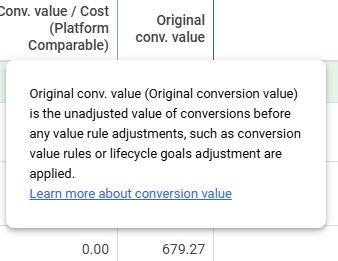
Google has added a new column called Original conversion value, which allows you to separate the actual conversion value from the value adjusted by Value rules or Lifecycle goals. Until now, Google Ads mainly showed adjusted values, making it harder to evaluate real performance.
source: Google Ads Panel
What does this mean for you?
You can now analyze performance far more accurately by comparing Google’s optimized values with your true business results.
Example: Let’s assume you run an online store and set a value rule in Google Ads: “new customer = +30% conversion value.” Someone buys a product for $100. Google checks whether this is a new customer. If it’s a returning customer, the conversion value remains unchanged: the original conversion value = $100 and the Google-adjusted value = $100. If it’s a new customer, the value rule adds 30%, meaning Google counts this conversion as $130. In reality, you earned $100, but in Google’s system the conversion value used for optimization is $130 because the system wants to reward traffic that brings in new customers (an artificially boosted value to help Google optimize campaigns more effectively). Thanks to the new “Original conversion value” column, you can finally see the true transaction value ($100), and right next to it the adjusted value — the one Google uses for optimization ($130).
Google has changed how video ads behave in Gmail on mobile devices. Now, when a user opens a video ad, the video starts playing immediately and the advertiser’s landing page automatically loads in the background — all inside the Gmail app.

source: PPC New Feed
What does this mean for you?
This update may inflate your reported clicks and traffic, because some users may land on your site without intending to visit it. As a result, remarketing lists may also grow artificially.
If you’re running Demand Gen campaigns, especially those optimized for click-based bidding strategies, you should closely monitor performance for the Gmail placement. Automatic page loads can distort traffic quality, increase costs, and make user intent harder to evaluate.
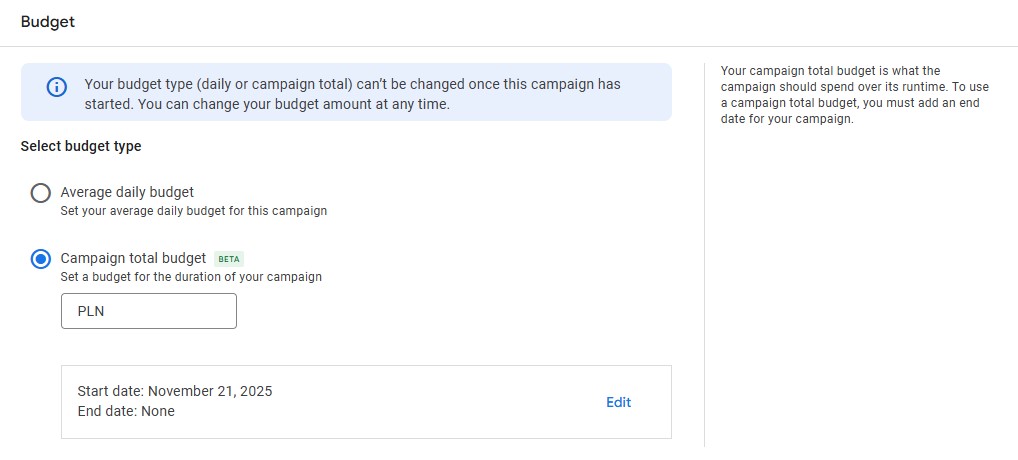
Google has introduced a long-awaited option to set a campaign total budget alongside the standard daily budget. The feature has started appearing in Performance Max campaigns in accounts outside the US and, according to Google, will also be available for Search and Shopping campaigns.

source: Google Ads Panel
What does this mean for you?
It’s a major improvement for advertisers running fixed-duration campaigns. You no longer need to manually convert a total budget into a daily average — Google will automatically distribute spend across the selected timeframe.
This makes planning easier, improves budget pacing, and gives more control for seasonal, promotional, and time-bound campaign setups.