Half the internet went down – an AWS outage halted global services (and marketers’ creativity)

3min.

Comments:0

20 October 2025

Half the internet went down – an AWS outage halted global services (and marketers’ creativity)d-tags
Monday morning started like any other - coffee, calendar, Slack, Canva... and then suddenly silence. Nothing loads, applications freeze, and half of the tabs in the browser only show an “error” message. Amazon Web Services (AWS), the giant infrastructure that supports a large part of the modern internet, has suffered a serious failure. The problem affected the US-EAST-1 region in Northern Virginia - the busiest and most strategic in the entire AWS network. When this region goes down, a domino effect is inevitable. In short: the world stood still for a moment, and marketers, gamers, and developers were left scratching their heads.

3min.

Comments:0

20 October 2025

Outage at AWS – Canva, Slack, Fortnite and Hundreds of Others Offline

It started innocently enough. Amazon reported “increased latencies and errors in services,” which very often means minor glitches. But this time a small hiccup turned into a global avalanche. Within hours, more and more platforms reported issues.

  • Users of Canva who couldn’t create or export graphic projects
  • Slack stopped delivering messages, effectively paralyzing communication in many companies
  • Fortnite, Roblox and Snapchat experienced login issues and lag, frustrating gamers and regular users
  • Shutterstock and Adobe Cloud prevented downloading or uploading files
  • Trello and Asana failed to sync tasks
  • Zoom and Microsoft Teams reported unstable connections

Issues also occurred in services like Netflix, Spotify, Discord, Perplexity AI, Notion, and even in McDonald’s systems, which use AWS to power their point-of-sale and ordering systems.

When AWS US-EAST-1 stopped working, a wave of consequences swept across hundreds of companies and services that rely on Amazon’s cloud every day.
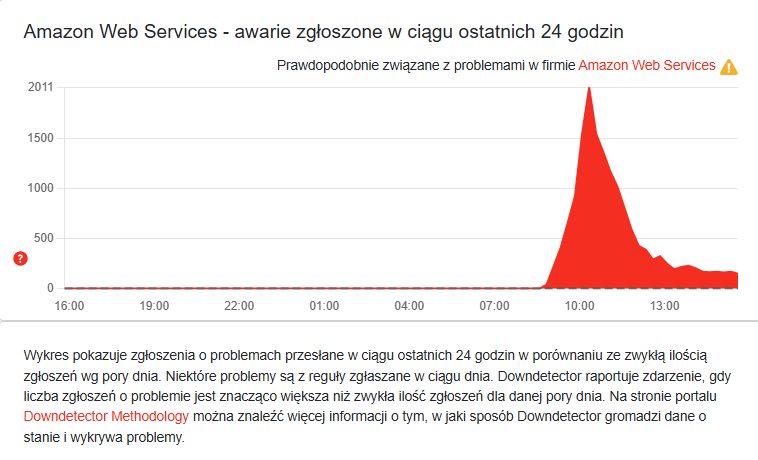
A clear confirmation of the event’s scale is the chart from the Downdetector portal, which collects problem reports in real time. The screenshot shows a sharp red spike after 10:00, when the number of reports surged to several thousand in a short time. That was the moment users around the world started reporting errors in Amazon’s services simultaneously. The chart literally illustrates the moment when the internet got a shortness of breath.

Downdetector report chart

Source: https://downdetector.pl/status/aws-amazon-web-services/

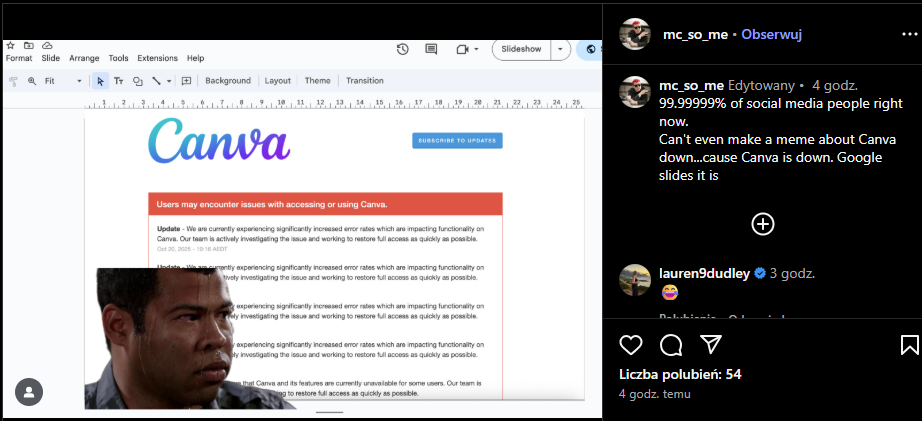
For users – an annoyance. For companies – work paralysis. Campaigns stopped, teams couldn’t communicate, and content creators were cut off from their tools. Online jokes spread quickly, like the one from a former Head of Social Media at Ryanair: “I wanted to make a meme about Canva being down… but Canva is down.”

Instagram meme about the AWS outage

What caused the outage? Amazon responds

AWS noticed many of their services in the US-EAST-1 region were slow and returning errors. Amazon confirmed the outage on its status page. The diagnosis? It was not a cyberattack, but a problem with DNS – the system that translates domain names into technical IP addresses. Servers could not correctly “find” the DynamoDB service, which cascaded into other services. When DNS fails, no server knows where to route requests. In practice: the internet begins to get lost.

What exactly failed?

  • DynamoDB – the database
  • EC2 – virtual servers (and therefore also RDS, ECS, Glue)
  • Lambda – on-demand functions
  • CloudTrail and EventBridge – logging and event services
  • IAM – access management (globally!)
  • Even creating support tickets was not working

After a few hours, engineers identified the root cause, applied fixes and gradually restored services. Around 13:00, Amazon announced that “the situation has been contained,” although some functions still experienced delays.

The internet on one leg – the strength (and weakness) of AWS

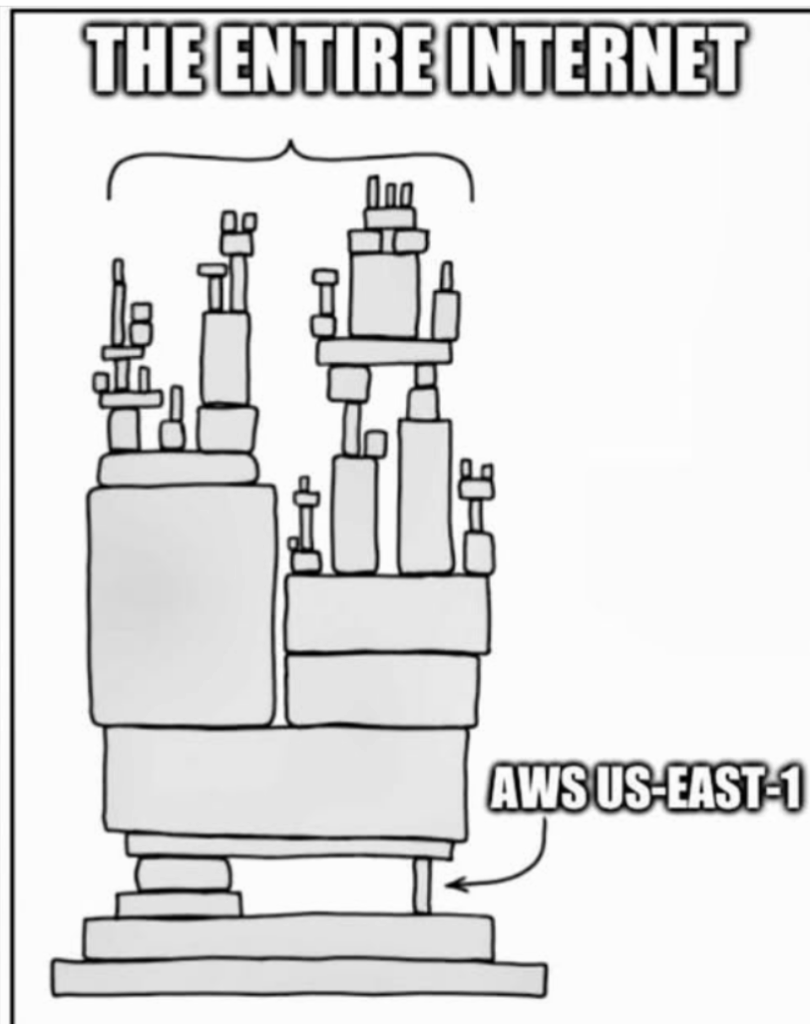
During the outage a meme circulated showing the “entire internet” balanced on a single block labeled AWS US-EAST-1. It’s hard to imagine a better illustration. Over the years, Amazon has built infrastructure used by millions of companies – from Disney+ to small online stores. But within this success lies a risk: dependency on a single provider.

Meme illustrating AWS dependency

According to Downdetector, problem reports came from across the globe – Europe, Asia, the Americas. Online games, payment systems, office apps and Amazon tools stopped working. Many hosting providers had to explain to clients that the issue wasn’t on their side, while users joked that “the internet stands on one leg, and that leg just broke.”

What lesson can we draw from all this?

When AWS sneezes, the internet runs a fever. But maybe such “digital colds” are necessary reminders that technology – while brilliant – remains a tool, not a guarantee of infallibility.

The outage lasted only a few hours, but its effects showed how fragile the digital reality supporting modern business really is. E-commerce stores lost sales, marketing teams lost campaign continuity, and users lost patience.

Today’s morning and early afternoon were moments when many companies realized that infrastructure diversification is not a luxury, but a necessity. Consider a multi-cloud model, backups in other regions and robust disaster recovery plans. In a world where a single second of downtime costs real money, it’s prudent to have a plan B (and C).

Author
Marcin Polak - Junior SEO Specialist
Author
Marcin Polak

Junior SEO Specialist

Junior SEO Specialist with experience in copywriting. He has been with Delante since 2023, where he combines creative writing with an analytical approach to SEO. A graduate of the Jagiellonian University (Journalism and Social Communication, Sports Management). Outside of work, he is an active fan of sports, cooking, and TV series.

Author
Marcin Polak - Junior SEO Specialist
Author
Marcin Polak

Junior SEO Specialist

Junior SEO Specialist with experience in copywriting. He has been with Delante since 2023, where he combines creative writing with an analytical approach to SEO. A graduate of the Jagiellonian University (Journalism and Social Communication, Sports Management). Outside of work, he is an active fan of sports, cooking, and TV series.