


Our client is an online store specializing in office products. The main target group consists of business customers, as they place the highest-value orders. From the store’s perspective, wholesale purchases are especially important, as they not only increase revenue but also improve profitability indicators.
Individual customers also appear in the store, but their orders are much smaller and rarely contribute significantly to overall revenue growth.
The goal of the marketing activities was therefore not just to increase the number of conversions, but above all to raise the average order value and achieve a higher return on ad spend (ROAS). These KPIs were the benchmarks for evaluating campaign effectiveness.
This could have been achieved at the expense of a lower number of transactions. In practice, this meant accepting a scenario in which the number of orders would fall, provided that the average basket value and overall revenue would increase significantly. The aim was therefore to reach decision-makers in companies who make regular and wholesale purchases.
This required not only proper targeting, but also the preparation of the entire marketing ecosystem. We knew that smart campaigns, such as Performance Max, work most effectively when the algorithm receives clear signals from the website.
SEO activities played a significant role in the SEM Boost project. By optimising business-critical subpages (including categories and product pages most frequently selected by companies), we were able to clearly indicate to Google what our ideal customer profile looks like. It was these signals that enabled Performance Max campaigns to learn more effectively and reach decision-makers in companies.
With clearly defined goals, we based our actions on three pillars: analytics, precise targeting, and flexible budget management.
The first stage was a detailed analysis of the advertising account and campaign history. We reviewed previous performance, identified product groups generating the most revenue, and examined the share of individual vs. business customers in overall sales.
We found that the greatest potential lay in Performance Max campaigns. To fully leverage this format, we decided to divide activities into three separate campaigns:
This approach enabled us to better manage the budget, allocate funds more precisely, and analyze results at a more granular level.
In parallel with the changes to the advertising account, we focused on providing Google’s algorithm with the best possible signals. We knew that the success of PMax depended on the quality of the data we ‘fed’ it.
As part of the SEM Boost project, we strengthened the content on the website, optimised the headlines, descriptions and structure of the site to emphasise the B2B offer and wholesale purchases. As a result, organic traffic was better profiled, and Google Ads algorithms received signals that allowed them to better identify and reach business customers.
Additionally:
In this way, we were able to build a strategy that increased the chances of reaching business customers without completely eliminating individual customers.
Our work did not end with a one-time configuration. We continuously analyzed which of the three PMax campaigns generated the highest conversion value and adjusted budgets accordingly.
By June, we observed that two of the three campaigns had already delivered significant improvements compared to May – a clear sign that the strategy was working.
The effects of the implemented strategy were highly satisfying. A year-over-year analysis of one of the key PMax campaigns perfectly illustrates the success of our approach, which can be summed up as “less spend, more profit.”
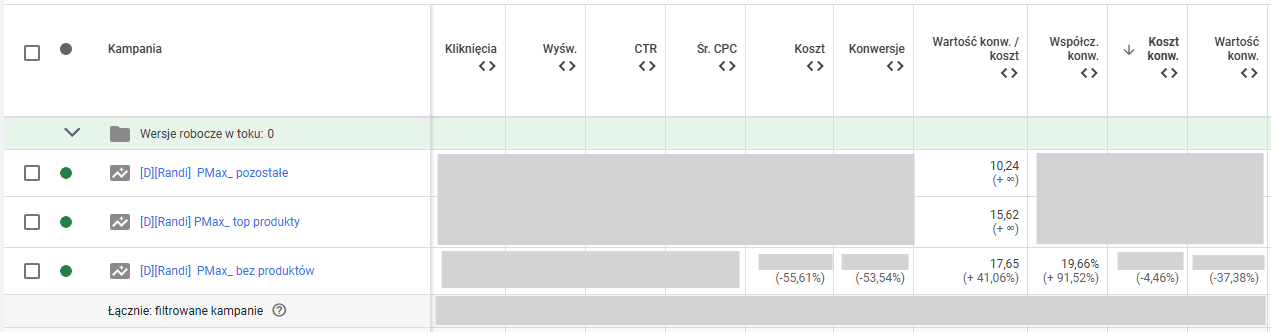
The most spectacular metric: conversion rate skyrocketed by 91.66% – confirming that precise targeting brought us to better-qualified audiences: companies ready to place large orders.
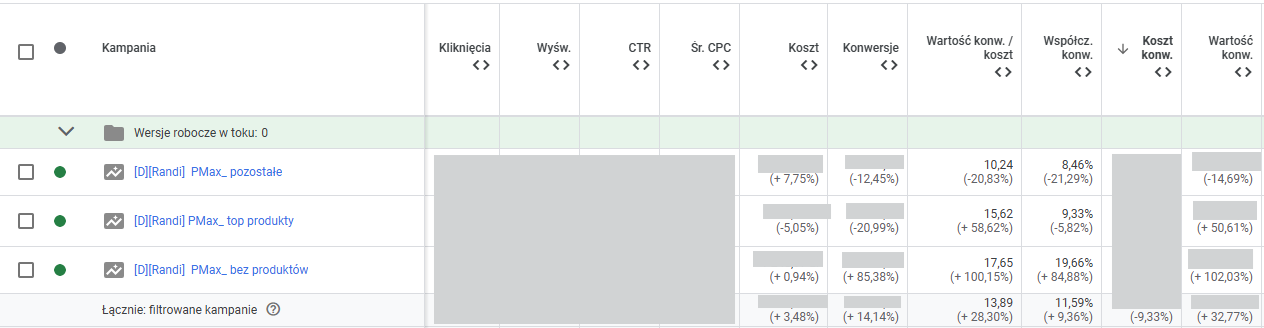
These results clearly show that strategic management of Performance Max, with a focus on traffic quality rather than volume, led to a significant improvement in campaign efficiency. Despite smaller budgets, we not only maintained but actually increased profitability – directly impacting the quality and value of acquired orders.
Importantly, the client emphasised that thanks to SEO optimisation as part of SEM Boost, Google Ads were better tailored to real business needs, which translated into a greater number of wholesale orders from companies.
Our client’s case proves that combining SEO and Google Ads brings the best results. The SEM Boost project provided algorithms with precise signals about who our ideal customer is, and PMax effectively used this data to scale results.
Precise targeting, flexible budget management based on hard data, and the synergy of SEO and Google Ads activities allowed us to achieve excellent results even with a limited budget.