
E-commerce Expansion in the UK: A Strategic Framework for Search Dominance

6min.

Comments:2

04 March 2026

E-commerce Expansion in the UK: A Strategic Framework for Search Dominanced-tags
What is SEO in English all about? What is the difference between Polish SEO and SEO in the UK? Why is it worth outsourcing international SEO to Polish companies and how to choose the best service provider? Let’s delve into this subject!

6min.

Comments:2

04 March 2026

For mature organizations, expansion into the UK market is not merely an opportunity to scale revenue—it is, above all, a high-risk operation. The United Kingdom is the world’s fourth-largest e-commerce market, a space where mistakes in Search strategy result not only in a lack of visibility, but in the very real burning of budgets and ceding ground to competitors who have been running professional SEO operations for decades.

At Delante, we understand that SEO in the UK functions as a system of interconnected elements. Here, every decision—from the choice of server infrastructure to region-specific purchase intent (Search Intent)—must be driven by hard business data rather than chance. Success in the UK does not depend on simply “creating content,” but on the quality of strategic thinking about the local Google and Bing ecosystem.

In this article, we analyze the foundations that determine whether your brand in the British market becomes a leader—or merely a backdrop for local players.

The United Kingdom as a Mature E-commerce Market — A Scale That Demands Precision

The UK market is the fourth-largest e-commerce economy in the world, surpassed only by China, the United States, and Japan. With projected revenues exceeding $160 billion in 2024 and expected to surpass the $260 billion mark by 2029, the UK represents an ecosystem with a level of competitive density fundamentally different from that of the Polish market.
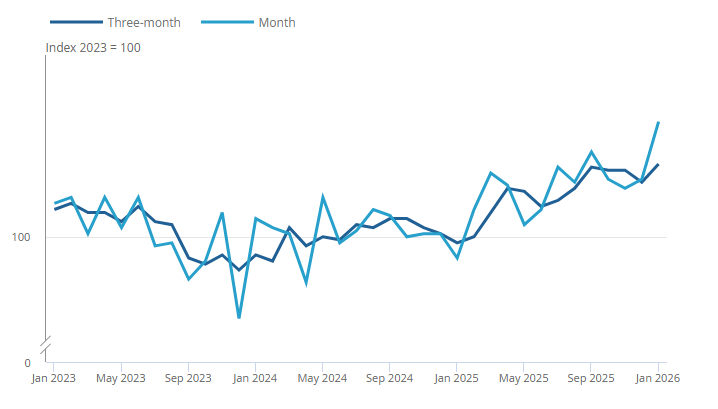
Retail sales in January UK

source: https://www.ons.gov.uk/businessindustryandtrade/retailindustry/bulletins/retailsales/january2026

For a Polish Marketing Manager, the key factor is not only the market volume itself but also the degree of digitalization within society. Nearly 30% of total retail sales in the UK already take place online, and this share continues to grow steadily. It is a fully developed market where companies are not competing to “educate the customer,” but rather to capture market share from established leaders who have been investing in Search for more than two decades.

The growth dynamics observed after 2024 have demonstrated that the shift in British consumer purchasing behavior is both lasting and structural. Entering this market is therefore a strategic move with one of the highest potential returns—provided there is a clear understanding that at this scale of operations, the margin for error in selecting an SEO strategy is virtually nonexistent. Expanding into the UK requires not only budget, but above all flawless technical and analytical execution.

UK Search Engine Market Share

source: https://gs.statcounter.com/search-engine-market-share/all/united-kingdom


Search Channel Diversification

Google’s dominance in the United Kingdom is undeniable; however, a modern marketing mix in this market requires moving beyond a single ecosystem. According to market data, Google handles around 86% of traditional search queries, but Bing (with nearly a 10% share) and rapidly growing AI search engines (such as Perplexity or SearchGPT) are becoming increasingly important in building brand trust.

For mature organizations, diversification today primarily means AISO (AI Search Optimization). British consumers are increasingly skipping traditional search result pages in favor of direct answers generated by LLMs (Large Language Models). If your brand does not appear in an expert context within responses generated by tools such as ChatGPT or Claude, you are losing share in what is increasingly referred to as the “Share of Answer.”


Is your Google traffic growing while your brand disappears from AI-generated answers?

The way people search for information is changing irreversibly. Ignoring optimization for AI-driven engines (AISO) creates a significant risk of technological debt. Ensure your visibility where today’s purchasing decisions are actually made.

Mobile-First Economy

The United Kingdom is a market with one of the highest mobile device penetration rates in the world. Currently, more than 60% of e-commerce revenue is generated through smartphones. In this context, mobile optimization has ceased to be a “best practice” and has become a fundamental driver of profitability.

The Mobile-First Indexing framework introduced by Google is only the tip of the iceberg. The real growth barrier lies in UX errors and a lack of accessibility. Every second of delay or any unreadable interface element on a mobile connection in cities like London or Manchester directly increases the bounce rate and reduces the ROI of SEO campaigns.

If your bounce rate in the UK market is increasing despite high rankings, the cause may be a lack of digital inclusivity—an issue that can be identified through a professional UX Consulting for SEO.

The Profile of the British Consumer

A strategic mistake made by many brands entering the UK market is focusing exclusively on Generation Z. E-commerce demographic data reveals a unique balance: the age groups 25–34, 35–44, and 45–54 account for almost identical market shares (approximately 22–23% each). Importantly, the 55+ segment often has greater purchasing power and demonstrates higher brand loyalty than younger consumers.

From a product category perspective, the dominance of Fashion (60%) and Electronics (36%) sets extremely high standards for trust-building and User Experience. Understanding that your customer is often a mature individual who makes purchasing decisions based on thorough research fundamentally changes the approach to content creation. Instead of generic content, the focus shifts toward expertise and transparency, which are crucial factors in the decision-making process of the premium British consumer.

The Architecture of Success in the UK — Key Determinants of Your Search Strategy Performance

Launching a brand in the British market requires making critical infrastructure decisions from the very beginning. In an ecosystem with such high competitive density, technical geolocation signals determine how Google and AI algorithms classify your business in relation to local market leaders.

1. ccTLD Domain and Geolocation Signals

One of the fundamental elements of building both algorithmic and consumer trust is the choice of a .co.uk domain (ccTLD). Using subdomains or directories within a global domain (.com) is technically acceptable, but in the UK market the country-specific domain extension remains the strongest signal of locality.

It allows Google to immediately associate the website with a specific market, reducing the risk of misinterpreting the site’s regional intent.

Tip: n the UK market, the best choice is a .uk or .co.uk domain extension. The .gb extension is no longer in use.

A properly selected domain will support SEO targeting the UK market from Poland by clearly signaling the geolocation of your intended audience and helping your website rank more effectively within the chosen market.

If your website operates under a .co.uk domain, Google will automatically recognize it as targeting the UK market, eliminating the need for additional configuration on your side.

2. Search Intent and Cultural Differences

Successful SEO in the UK goes beyond linguistic correctness—it requires understanding the specific Search Intent of the British consumer.

  • British English vs. American English: Differences in spelling (colour vs. color, realise vs. realize) and vocabulary (flat vs. apartment) are crucial for keyword research. Mistakes in this area are not merely a faux pas—they mean completely missing how customers actually phrase their search queries.
  • Operational standards: Prices displayed in GBP, British postcode formats, and local time zones are all elements that contribute to brand credibility. A website must feel native to the UK market in order to compete effectively with local businesses.

We don’t deliver content. We deliver arguments for your sales.

A service for brands that understand that the quality of thinking behind content determines both Share of Voice and the quality of leads.

Let’s talk!
Ania Bitner
Ania Bitner Content Team Leader

3. Outreach i autorytet zewnętrzny

Budowanie bazy linków na rynku UK wymaga strategii opartej na jakości, nie ilości. Kluczowy jest Outreach Marketing – nawiązywanie relacji z liderami opinii i lokalnymi portalami tematycznymi w domenie .co.uk. W Delante stawiamy na pozyskiwanie linków z platform, które realnie kształtują decyzje zakupowe Brytyjczyków. Wartościowy link z brytyjskiego portalu to nie tylko „paliwo” dla algorytmu, to transfer zaufania (Trust Flow) do Twojej marki.

Tip: it is important that backlinks also come from websites within the .co.uk domain.

4. Technical Optimization of Your Website

Even the most visually appealing platform will fail to deliver results if its code generates errors that block proper indexing. In the UK market, your priority should be meeting the rigorous Core Web Vitals standards.

The most common barriers to growth include:

  • Inefficient mobile architecture (Mobile-First Indexing).

  • Errors in the code structure that prevent proper content rendering.

  • Render-blocking resources and unoptimized image formats.

  • Lack of digital inclusivity (Accessibility).

5. Local Hosting and Server Response Time (TTFB)

For rankings in UK search results, hosting your website on a server with a local IP address is crucial. This shortens the physical distance a request must travel, directly improving Time to First Byte (TTFB).

In mature e-commerce environments, every millisecond of delay translates into a measurable increase in the bounce rate. Local hosting is therefore not only an SEO consideration—it is the foundation of a smooth purchasing experience that protects your ROI from user impatience.

6. Multi-Channel Optimization — Bing as a Visibility Foundation in the AI Era

In a mature strategy for the UK market, presence in Bing is no longer an optional addition. It is a strategic choice driven not only by its consistent market share (around 10%), but also by the role Bing plays in the Microsoft Copilot ecosystem.

For your business, optimizing for Bing is now the first step toward visibility in AI-driven search. The language models powering Copilot draw their data directly from the Bing index. This means that by ignoring Bing, you effectively become invisible to users who no longer type traditional search queries but instead expect ready-made product recommendations from AI systems.

Want to compete for visibility in the UK market?

We’ll help you develop an effective international SEO strategy.

Let’s talk!
Bartek Kubala Senior SEO Specialist

Strategic Expansion in the UK — Take Control of Your Growth Process

Success in the British market is not the result of simply “doing SEO.” It is the outcome of precise management of technical infrastructure, content authority, and visibility within emerging AI ecosystems. In an environment with such a high density of competition, the only effective strategy is a systemic approach—one that combines rigorous analytics with a deep understanding of local Search Intent.

At Delante, we do not offer standard service packages—we provide Senior Expertise that enables Polish brands to compete with global leaders on their own turf. If your organization has a mature marketing structure and is looking for a partner who takes responsibility for the quality of strategic thinking, not merely the volume of delivered content, we are ready to start the conversation.

Stop adapting to change. Start staying ahead of it. 🚀

Author
Bartosz Kubala - Senior SEO Specialist
Author
Bartek Kubala

Senior SEO Specialist

He is passionate about SEO and has been successfully working for e-commerce clients since 2019. At work, he is characterized by attention to detail and a comprehensive approach to the process of building online visibility of websites. He is constantly on the lookout for new improvements to implement, and at work, his greatest pleasure comes from seeing visibility increases and the opportunity to compete for top spots in search results. After work, a bass player, Formula 1 fan, avid board strategy player and pasta lover.

Author

Paulina holds a degree in Information Management and Digital Publishing, as well as a Master’s in Social Economics. During her studies, she was actively involved in the Scientific Circle of Information Architects, where she explored the fields of UX and UI.

Table of Contents

Author
Bartosz Kubala - Senior SEO Specialist
Author
Bartek Kubala

Senior SEO Specialist

He is passionate about SEO and has been successfully working for e-commerce clients since 2019. At work, he is characterized by attention to detail and a comprehensive approach to the process of building online visibility of websites. He is constantly on the lookout for new improvements to implement, and at work, his greatest pleasure comes from seeing visibility increases and the opportunity to compete for top spots in search results. After work, a bass player, Formula 1 fan, avid board strategy player and pasta lover.

Author

Paulina holds a degree in Information Management and Digital Publishing, as well as a Master’s in Social Economics. During her studies, she was actively involved in the Scientific Circle of Information Architects, where she explored the fields of UX and UI.

FAQ

1. What are the characteristic features of international SEO?

One can be stated for sure – every country is different. If you want to expand your business and go international, it’s crucial to keep in mind all the language, cultural, shopping or customer service discrepancies. Furthermore, there are numerous technical aspects like hreflang implementation, URL structure or international targeting which may significantly hinder the SEO process, mainly due to the fact that these elements are slightly different in every country. The key to succeeding abroad is getting to know the local market.

At Delante, we run SEO processes for foreign websites and we pay special attention to specifications of given markets and industries our clients operate in. If you need any help with your international SEO strategy, don’t hesitate to contact us!

2. Is it worth doing international SEO with the help of a Polish SEO agency?

Of course! You don’t need to look for foreign agencies to ensure that your website visibility increases. The only condition necessary to succeed is to find an SEO agency that has experience in operating on a given market and knows what to do (keep in mind that the UK market isn’t a piece of cake and local competition never sleeps).

Choosing a Polish SEO agency may turn out to be a much cheaper and more efficient solution. What’s more, cooperating with a company located in the same country or closer to your place of residence may be an extra asset that enables establishing closer business relationships.


3. Does Delante have any experience in operating on the British market?

We’re proud to say that during 5 years of Delante’s operation on the market, we’ve managed to reach 21 countries! We successfully run SEO processes for numerous websites targeting diverse foreign markets, including the British one. If you want to see how in 6 months we increased monthly website traffic from 0 to 700 on the British market, check out the case study of FarettiShoes.co.uk.

4. What to keep in mind when doing SEO in the UK?

If you want to conquer the British sales market, focus on elements such as:

  • the necessity to adjust all website elements to a given location (phone numbers, addresses, time zones, currencies, etc.),
  • linguistic correctness,
  • ccTLD compatibility with the domain of your target country (in the UK it’s the .uk extension),
  • website code,
  • local IP address,
  • a database of valuable external links – preferably from local English websites.