Google changes search results: fewer views, more expensive monitoring, and the fight against AI bots

3min.

Comments:0

16 September 2025

Google changes search results: fewer views, more expensive monitoring, and the fight against AI botsd-tags
Removing the &num=100 parameter from Google is a seemingly minor technical change, but one with major consequences. Google Search Console shows fewer impressions and artificially inflates average positions, rank trackers have to rebuild their systems, and AI language models lose one of their convenient data sources. Learn more in the article!

3min.

Comments:0

16 September 2025

What is happening to the &num=100 parameter in Google Search?

For many months Google tested restrictions related to the &num=100 parameter, which allowed users and SEO tools to display 100 search results at once. Until now, this parameter was the basis for most rank-tracking systems, visibility analyses, and activities based on scraping Google search results. In September 2025 the changes became noticeable on a large scale.

Currently, even when using it, Google often shows at most two pages of results and then blocks access to further ones.

Our Senior SEO R&D Specialist, Wojciech Urban, has also commented on the disabling of the &num=100 parameter:

Disabling &num=100 and the drop in impressions in Google Search Console

At first glance, disabling the &num=100 parameter might seem like a minor technical detail. Far from it. In practice, it affects reporting in SEO tools.

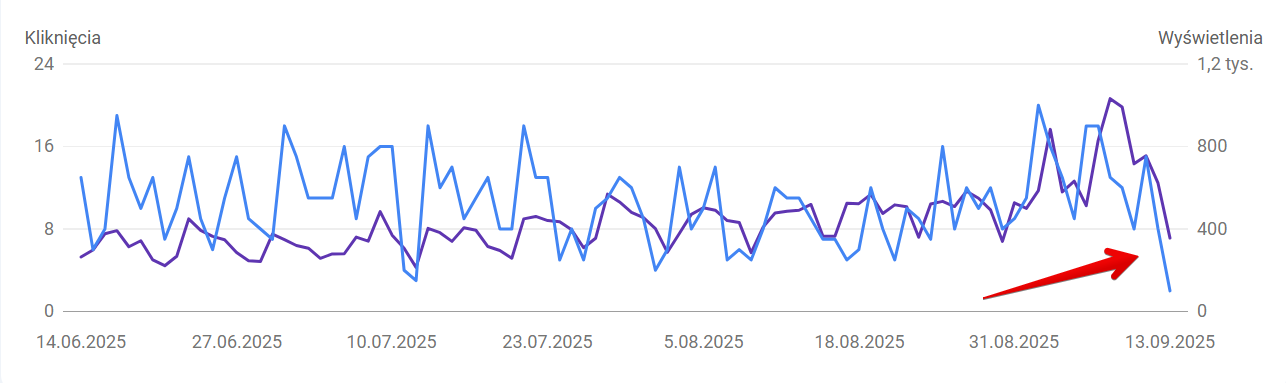
Google Search Console has started reporting lower impression counts, especially for desktop results. Many specialists noticed sharp declines from around September 10, 2025. That raised a wave of questions — does this mean a loss of site visibility? In many cases the culprit is the lack of full support for &num=100, meaning fewer results are recorded in reports.

drop in impressions in GSC after disabling &num=100

At the same time as impressions fall, average position in GSC reports increases. This is because many pageviews for results further down — 70th, 80th, or 95th positions — are no longer recorded. As a result, the system shows only data from the first pages of results, which inflates the average position. This artificial distortion can mislead SEOs and site owners.

How disabling &num=100 will affect rank trackers?

The consequences for SEO tools are even more serious. The withdrawal of the &num=100 parameter means that every tool now has to perform 10 separate queries to obtain the same pool of results it previously received in one request.

The effect? Increased costs and longer data collection times. In practice this means rank monitoring becomes more expensive and less efficient. Smaller tools may struggle to adapt to the changes, and users should expect higher subscription prices.

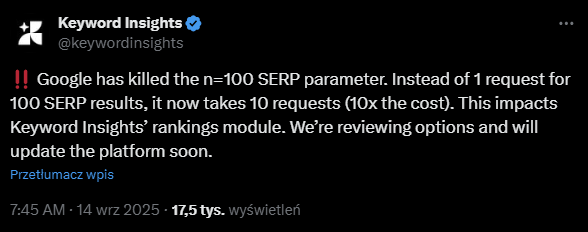
The situation has already been commented on by the platform Keyword Insights, which admitted that “the change affects their ranking module and they are considering available options.”

Keyword Insights on disabling the &num=100 parameter

Disabling &num=100 and the impact on language models

The change to the &num=100 parameter also affects AI, particularly language models such as ChatGPT. In the past, access to 100 results at once made it easier for AI systems to quickly fetch and analyze a larger amount of content from Google. This allowed models to rely on a broader context of information, improving the quality of responses.

When the parameter was restricted, language models that rely on scraping have fewer sources available per query. This not only slows down data collection but also reduces the diversity of accessible content. That means AI systems will have to rely on more fragmentary results, which may affect the quality of generated answers.

What this means for the SEO industry and site owners — summary

So far Google has not publicly commented on the situation. Disabling the &num=100 parameter is not only an issue for tools but also a signal of changing philosophy regarding access to data. For rank-tracking providers the change can be particularly costly — more server load, higher expenses, and longer processing times.

The most important point in the current situation is that a drop in impressions in GSC does not necessarily mean a loss of visibility. The business impact — sales, leads, and user retention — matters most.

What will happen next? As soon as there is more news and, most importantly, a comment from Google, we will inform you.

Author
Marcin Polak - Junior SEO Specialist
Author
Marcin Polak

Junior SEO Specialist

Junior SEO Specialist with experience in copywriting. He has been with Delante since 2023, where he combines creative writing with an analytical approach to SEO. A graduate of the Jagiellonian University (Journalism and Social Communication, Sports Management). Outside of work, he is an active fan of sports, cooking, and TV series.

Author
Marcin Polak - Junior SEO Specialist
Author
Marcin Polak

Junior SEO Specialist

Junior SEO Specialist with experience in copywriting. He has been with Delante since 2023, where he combines creative writing with an analytical approach to SEO. A graduate of the Jagiellonian University (Journalism and Social Communication, Sports Management). Outside of work, he is an active fan of sports, cooking, and TV series.