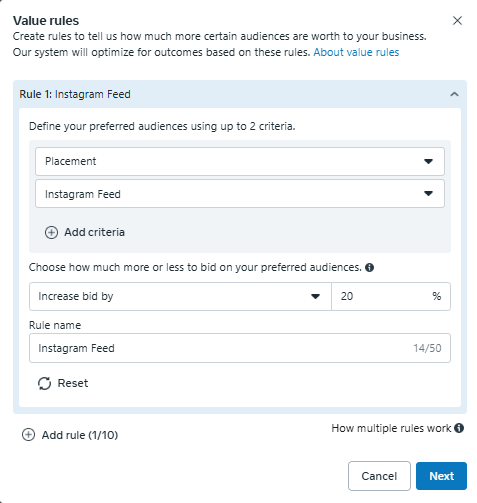
Meta has expanded the Value Rules feature, which previously allowed advertisers to adjust bids based on factors like age, gender, operating system, or location. Now, you can also increase or decrease bids for specific placements such as the Facebook Feed or Instagram Reels. These rules can be set in the Advertising Settings tab, and Meta will optimize conversions based on the value you assign to different audiences and placements.
source: Meta Ads Panel
What does this mean for you?
This update makes it easier to focus budget on the most valuable audiences and placements without creating multiple ad sets. It may improve campaign performance, but it could also drive up cost per result since the system will invest more aggressively in high-value segments. It’s worth testing different configurations to see which setup best supports your business goals.
New Experiment Type for AI Max in Google Ads
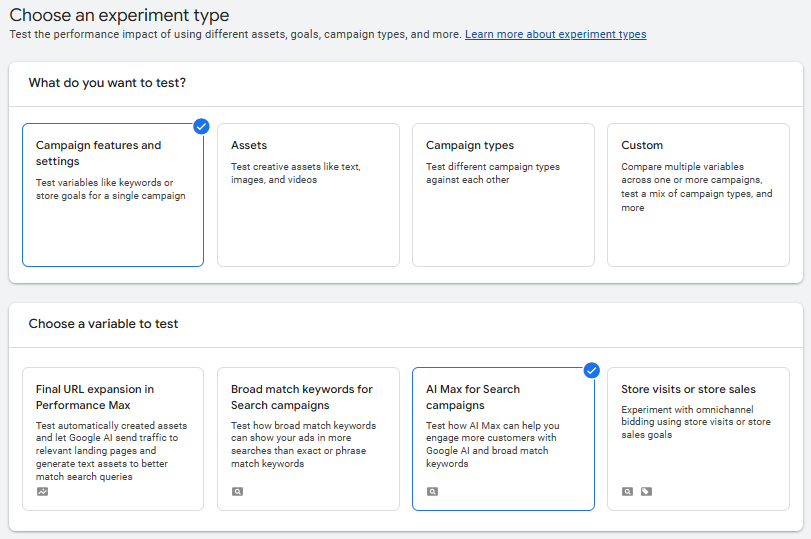
Google Ads has introduced a new type of experiment designed to simplify testing of AI Max features in Search campaigns. Instead of duplicating campaigns, experiments now run within a single campaign using a fixed 50/50 budget split, enabling faster and statistically valid results. By default, features like Search Term Matching and Asset Optimization are enabled at the campaign level, but they can be adjusted at the ad group level.
source: Google Ads Panel
What does this mean for you?
This new method streamlines the testing process for AI Max and makes it easier to evaluate its impact on campaign performance. You no longer need to duplicate campaign structures, and results can be directly compared within the same campaign. It’s a practical way to assess whether AI Max automation improves performance before committing to broader adoption.
New Conversion Type in Google Ads
Google has rolled out a new beta conversion type called Branded Searches, which measures the impact of campaigns on brand awareness. This metric shows how many users search for your brand on Google or YouTube within 7 days of seeing your ads in YouTube, Performance Max, or Demand Gen campaigns. To enable this feature, you’ll need to work with your Google account representative to set up brand mapping in your account. More details are available on the official Google Help page.
What does this mean for you?
This is a simpler and more cost-efficient way to measure brand consideration. Instead of running expensive Brand Lift studies, the metric will be available natively in Google Ads. It allows you to easily track whether video and multichannel campaigns are driving more branded searches and supporting your brand-building efforts.
Graduate of Marketing and Communication at the Cracow University of Economics. He started working at Delante in 2023. Privately, he is interested in traveling and discovering new music, as well as enjoys watching a good thriller and a football game.
Graduate of Marketing and Communication at the Cracow University of Economics. He started working at Delante in 2023. Privately, he is interested in traveling and discovering new music, as well as enjoys watching a good thriller and a football game.


 d-tags


 Loading...