d-tags



 (4 votes, average: 4.75 out of 5)
 Loading...
The characteristics of the Canadian market
Canada, often referred to as the country of the maple leaf, is the second-largest country in the world by area and one of the most multicultural markets globally. It is a vast, affluent and highly developed economy, offering strong potential for online services and digital commerce. Canada consistently ranks among the world’s wealthiest countries, with an above-average standard of living and high purchasing power.
An important milestone in economic relations between Canada and the European Union was the Comprehensive Economic and Trade Agreement (CETA), which entered into force provisionally in 2017. The agreement significantly reduced trade barriers by eliminating approximately 98% of tariffs on goods, facilitating easier market access and creating new opportunities for European companies looking to expand into the Canadian market.
SEO in Canada – What to take into consideration operating on the Canadian internet?
As of 2025, Canada has a population of approximately 41.5 million people, and over 75% of internet users regularly shop online, making e-commerce a well-established and rapidly growing channel. The way Google operates in Canada is largely the same as in other European markets, including Poland. However, there are several important factors to consider, such as high market competitiveness and the presence of two official languages: English and French. Understanding these specifics is essential when planning expansion and online visibility in the Canadian market. Below are the key aspects to take into account when entering Canada.
Language – a significant factor that affects SEO in Canada
Canada is a bilingual country with English and French as its official languages, and linguistic diversity plays a significant role in online visibility. According to the latest census data, over 20% of Canadians are bilingual, while more than 85% speak English and around 29% have knowledge of French. As a result, language strategy should be a conscious part of any SEO and market entry plan.
Many companies see bilingualism as a challenge, mainly due to higher costs associated with content creation and marketing in multiple languages. However, effective SEO in Canada does not necessarily require duplicating entire websites. While creating separate language versions or dedicated structures often delivers better targeting and clearer signals for search engines, multilingual websites hosted under one domain can still be a practical and cost-efficient solution when implemented correctly.
It is also worth noting that websites with distinct language versions and clear regional targeting tend to offer better link-building opportunities and more precise audience reach. Additionally, using a country-specific ccTLD (.ca) can further strengthen local relevance and trust signals in Canadian search results.
In Canada, the default language version of the majority of websites is English. The French version, however, is often seen as an addition. You can find the examples of such websites below:
| French version of a Canadian website | English version of a Canadian website |
| https://thegreattrail.ca/fr/ | https://thegreattrail.ca/ |
| https://swimming.ca/fr/ | https://swimming.ca/en/ |
| https://www.canadiantire.ca/fr.html | https://www.canadiantire.ca/en.html |
| https://www.als.ca/fr/ | https://www.als.ca/ |
Quebec is the largest province in Canada in terms of size. It matters since French is the only official language there – even though half of the population also knows English. Still, local websites are bilingual, with the French version being the default one, and the English is only the addition. The best examples of such websites are those of local service companies and restaurants.
| French version of a website | English version of a website |
| https://www.quebec.ca/ | https://www.quebec.ca/en/ |
| https://www.lapinsaute.com/#/ | https://www.lapinsaute.com/#/english |
| http://laplanquerestaurant.com/ | http://laplanquerestaurant.com/en/ |
SEO in Canada – Is it worth using Social Media?
Both in Poland and in Canada, social media play a significant role in users’ daily online activity. At the beginning of 2025, over 31.7 million people in Canada were active social media users, representing approximately 79% of the total population. For marketers, detailed platform-level data is also important — for example, Instagram had nearly 20 million users in Canada, while LinkedIn exceeded 27 million members, highlighting the strong potential of these channels.
In Canada, the number of active social media users continues to grow alongside the market’s increasing digital maturity. According to the Digital 2025: Canada report published by DataReportal in January 2025, Canada recorded 31.7 million social media users, accounting for 79.4% of the population. This confirms that social media are among the key channels for reaching users in the Canadian online environment, making investment in brand visibility on these platforms essential for increasing brand awareness and audience engagement.
According to the latest StatCounter GlobalStats data (November 2024 – November 2025), Facebook remains the most popular social media platform in Canada, maintaining a market share of approximately 50–60% throughout most of the year. Pinterest, which in previous years had approached Facebook in terms of popularity, has significantly declined, with its share dropping to around 17–18%.
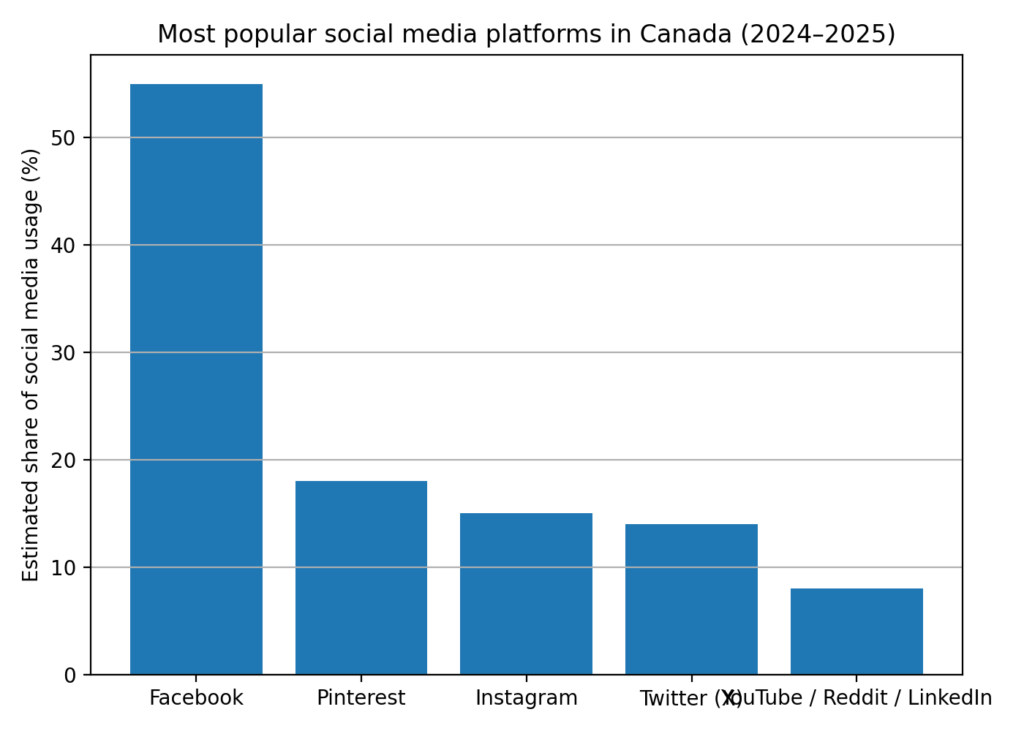
source: https://gs.statcounter.com/social-media-stats/all/canada/#monthly-202411-202511
At the same time, platforms such as Twitter (X) and Instagram show stable usage levels, each maintaining shares in the mid-teens. YouTube, Reddit and LinkedIn play a complementary role in the Canadian market but can still provide valuable support for marketing and brand-building activities.
According to Statcounter GlobalStats, Pinterest was almost as popular in Canada as Facebook back in March. It’s particularly interesting since the trend is completely different from the situation in Poland, where Facebook is far ahead of the competition. It’s also worth taking into account Twitter, Instagram, YouTube, and Reddit, even though they might bring less significant results than the most popular social networks.
Where to build links?
Link building can bring a lot of benefits, provided that you build quality links in the process. Google takes into account factors such as valuable and comprehensive content, site optimization, as well as the number and quality of backlinks. That’s precisely why links should be built from relevant and secure websites. Their types should vary as well – with different anchor texts, including the address of the domain itself. As for Google – the links should be natural and bring some value to the users. With its algorithms, Google strives to provide the most relevant and useful answers to what search engine users might be looking for.
Even though the SEO in Canada is done “in a standard way”, link building is a slightly different story. Many SEO agencies use the same approach to link building worldwide – but it’s not a good way to go. Link building in Canada is essential… building links in Canada, not in any other country. It would be a big mistake to build links only from the US websites – that’s why it should be avoided, along with the .com domains. Canada is an independent country that has thousands of relevant websites with a .ca domain, which should be taken into account when building links. This rule should not be taken too seriously, though – building ‘dofollow’ links from org., .com, or .edu won’t hurt that much. It’s also worth sticking to the sites of Page Authority between 4-8 and avoiding catalogs that Google sees as spam. It’s essential, however, to create unique and high-quality content.
SEO in Canada – what are the most popular search engines in Canada?
When starting the SEO process in Canada, it is essential to understand which search engines are most commonly used by local users. While the general principles of SEO remain similar across markets, search engine preferences and market shares can influence optimisation priorities. According to the latest data from StatCounter GlobalStats (November 2024 – November 2025), Google continues to dominate the Canadian search market.
Google accounts for approximately 87–90% of all search queries in Canada, which clearly confirms that SEO efforts should primarily align with Google’s guidelines and ranking factors. Bing ranks second, with a market share of around 8%, making it a relevant secondary platform—especially given its growing importance as a data source for AI-powered search tools. Other search engines play a much smaller role, including Yahoo! (around 2–3%) and DuckDuckGo (approximately 1–2%), while platforms such as Baidu or Yandex have a negligible presence in the Canadian market.
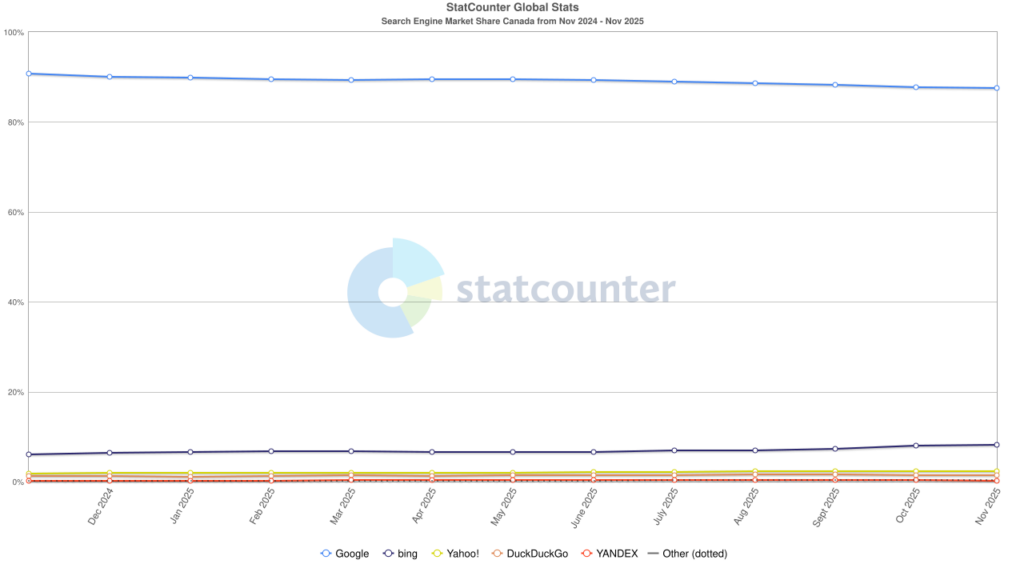
source: https://gs.statcounter.com/search-engine-market-share/all-globe/canada/2024
This distribution highlights the importance of a Google-first SEO strategy in Canada, complemented by selective optimisation for Bing in specific industries or campaigns.
What domain to choose when for better SEO in Canada?
When dealing with international SEO services and choosing a domain, it’s recommended to go for multiregional domains. To put it simply, it’s a website meant specifically for the users from a given country. Multilingual websites, on the other hand, offer content in multiple languages. Multilingual websites might be cheaper for entrepreneurs but are not the best way to go. In Canada, its .ca domain is an asset when it comes to site optimization. Actually, your website might not be added to a local catalog otherwise. It’s also worth remembering that if you want to have your images displayed in Google, you should have different pictures for each version of the website.
The sites with the .ca domain can be bought by Canadian citizens, permanent residents, and companies registered in Canada. Plus, such a domain can only be registered if it has a trademark that is compatible with its name, which has to be valid in Canada.
The E-commerce market in Canada
According to the previously mentioned Digital 2025: Canada report, the e-commerce market in Canada continues to grow, driven by the rapid adoption of mobile services and B2C commerce. In 2025, e-commerce remains one of the fastest-growing segments of the digital economy, characterised by strong competition from global platforms and increasing demand for mobile shopping and cross-border e-commerce.

source: https://gs.statcounter.com/platform-market-share/desktop-mobile-tablet-/united-states-of-america
The Canadian e-commerce market continues to expand and reach new milestones. According to Statistics Canada, retail e-commerce sales revenue reached approximately CAD 67.7 billion in 2023, representing a year-over-year growth of around 7% and confirming a stable long-term shift toward online shopping. It is also worth noting that e-commerce accounts for an increasing share of total retail sales, with its contribution expected to continue growing in the coming years.
What do Canadians buy online the most?
The Canadian e-commerce market has grown significantly over the past few years and now generates tens of billions of dollars in annual revenue. According to recent industry data, Canadians most frequently purchase clothing and footwear, consumer electronics, beauty and health products, and home goods online. Digital services also play an important role, with strong demand for event tickets, travel services, and accommodation bookings, which confirms the solid position of the services sector within Canadian e-commerce.
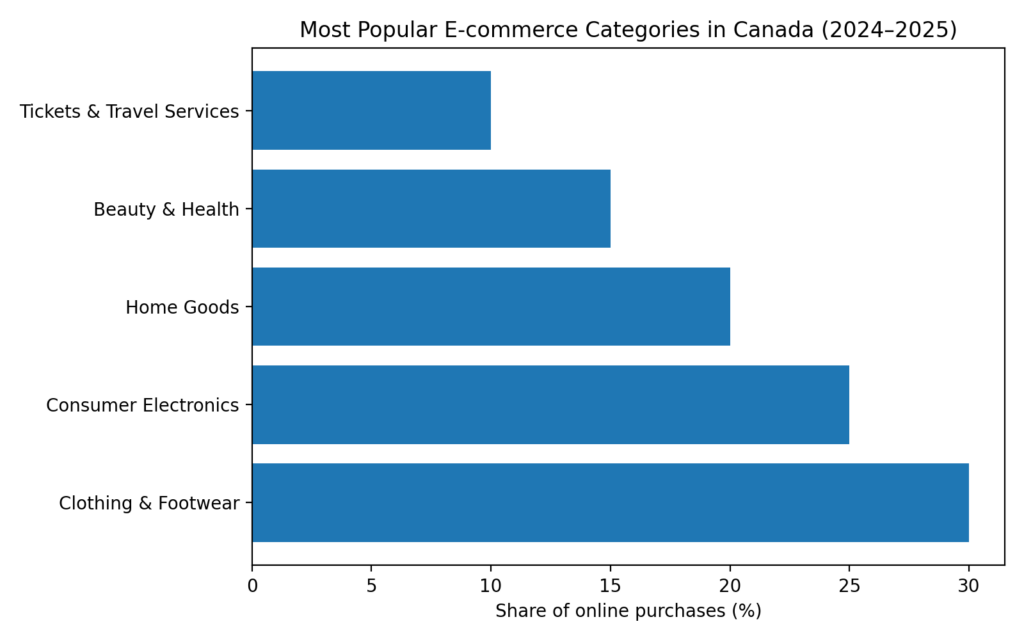
source: https://www.payments.ca/canada-analysis-payments-and-e-commerce-trends
The market is dominated by major global platforms such as Amazon, eBay and AliExpress, alongside strong local brands like Indigo (Chapters-Indigo). As a result, competition in Canadian e-commerce is intense, making it more challenging for smaller online stores to stand out without a well-planned SEO, content and performance strategy.
Consumer behaviour has also evolved in terms of technology and devices. Voice assistants and AI-powered search tools are increasingly used at the research stage of the purchase journey, particularly for product comparisons and local queries, which makes optimisation for conversational and voice-based search an important consideration. At the same time, shopping habits have shifted toward mobile. In recent years, smartphones have overtaken desktops as the primary source of e-commerce traffic in Canada, while desktop devices still play a significant role in finalising purchases. This makes mobile-first design, fast-loading pages and responsive websites essential for effective online sales.
For companies planning to sell online in Canada, it is also important to understand how customers discover products. Brand websites and mobile apps remain the main starting points for online purchases, supported by search engines and social media platforms. Blogs and informational content continue to influence buying decisions, particularly in categories that require comparison, trust and user education.
Brand visibility in AI-generated answers
The way people search for information is evolving rapidly in Canada as well. An increasing number of users are asking questions not only in Google, but also in AI-powered tools such as ChatGPT, Gemini and Perplexity. This is often where the first stage of research begins — comparing companies, products and services.
AI Search Optimization (AISO) complements traditional SEO by focusing on making brands visible and cited in AI-generated answers, as well as in Google AI Overviews. For companies operating in or planning to expand into the Canadian market, this creates an additional channel to reach users at a very early stage of the purchasing decision process.
If you are planning to expand into the Canadian market or want to increase your brand’s visibility in Canada, it is worth taking a comprehensive approach to SEO. Contact us to discuss how your SEO and AI search strategy can be tailored to the specifics of your business.
Sources:
- https://www.statista.com/outlook/emo/ecommerce/worldwide?currency=USD,
- https://www150.statcan.gc.ca/n1/daily-quotidien/250304/dq250304a-eng.htm,
- https://www150.statcan.gc.ca/n1/daily-quotidien/250304/dq250304a-eng.htm,
- https://datareportal.com/reports/digital-2025-canada.