AI in GSC, schema and LLM models, and the importance of domain names – SEO News – #1 – January 2026

3min.

Comments:0

09 January 2026

AI in GSC, schema and LLM models, and the importance of domain names – SEO News – #1 – January 2026d-tags
We have just entered 2026, and Google is already serving up more revelations. It is developing a new AI-based feature in Search Console, clarifying the rules for collecting reviews, and reminding us how important a website's name can be. SEO specialists are off to a hot start this year. Read on for our SEO News!

3min.

Comments:0

09 January 2026

Google Testing AI-Powered Report Configuration in Search Console

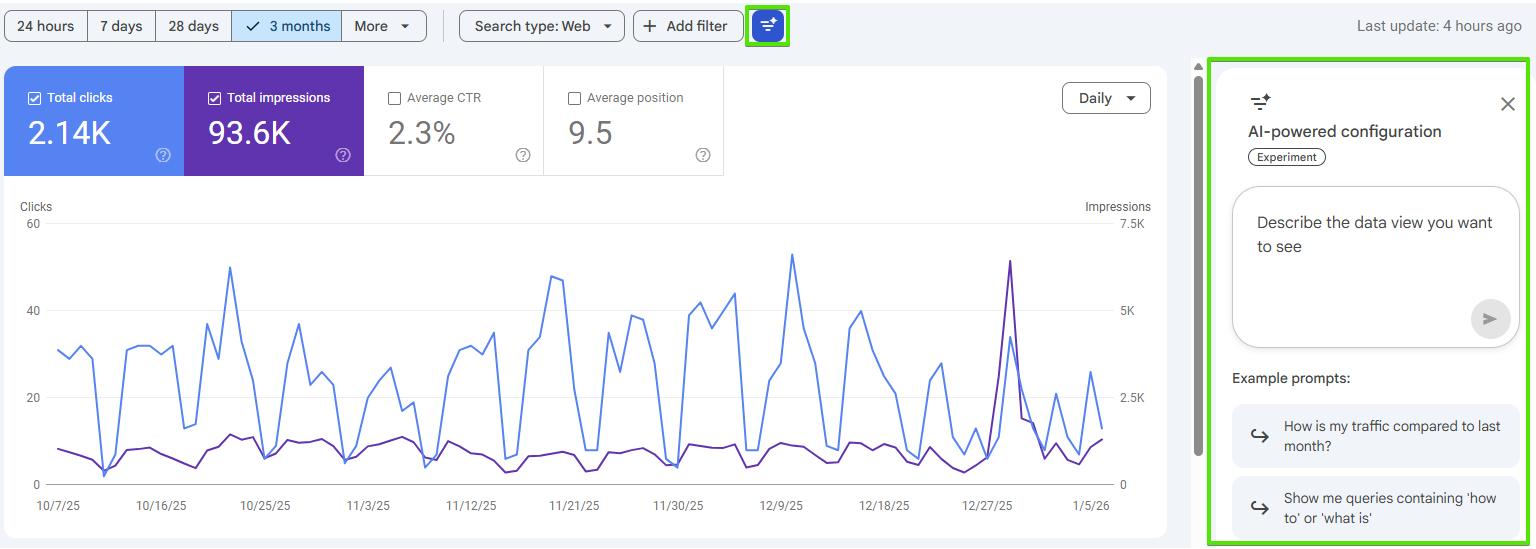
Google has begun testing a new feature in Google Search Console aimed at simplifying the workflow within the Performance report. The new configuration tool leverages artificial intelligence to generate reports based on natural language queries.

Google Search Console AI

This new solution allows users to describe the data analysis they wish to see without manually setting up filters and comparisons. The AI assistant interprets the user’s command and automatically configures the performance report.

How does the feature work?

Once access to the tool is granted:

  1. The user clicks the filter icon in the Performance report,
  2. In the side panel, they enter a query in natural language,
  3. The AI suggests a set of filters, comparisons, and metrics,
  4. Upon approving the suggestions, the report is automatically configured.

Access to this solution is currently very limited. Google is making it available only to selected sites and plans to expand the tests gradually. Additionally, a daily limit of 20 queries applies.

The company also notes that as an AI-based feature, the tool may make interpretational errors. Generated filters may not always perfectly match the user’s intent; therefore, Google recommends double-checking the applied settings before drawing conclusions from the data.

Which report elements does the AI support?

The AI configurator is designed with three areas in mind:

  • Automatically applying filters (e.g., by queries, pages, countries, or devices),
  • Creating comparisons (e.g., custom date ranges),
  • Selecting appropriate metrics.

At the same time, the feature does not allow for table sorting or data export and works exclusively within the Search results report—it does not cover Discover or Google News reports.

John Mueller on Structured Data and LLMs: “It depends on how they are used”

John Mueller addressed a question regarding whether extensive schema markup helps Large Language Models (LLMs) better understand entities and content, or if its role is limited solely to displaying rich results in Google. In his response, he emphasized that he was providing a personal viewpoint rather than official Google guidelines.

Mueller’s answer was nuanced. As he stated, this topic will likely persist for a long time, and the shortest possible answer is: “yes, no, and it depends.”

When does structured data truly matter?

According to John Mueller, the effectiveness of structured data depends primarily on:

  • The specific search engine function or AI system,
  • How that function utilizes machine-readable information.

In certain areas, structured data is actually essential. This applies to, among others:

  1. Product results,
  2. Information such as price, availability, or shipping costs,
  3. Data that cannot be reliably and precisely extracted solely from page content.

In such cases, schema markup serves as a source of unambiguous, easy-to-process information.

Google Organizes Rules for Collecting Reviews via Link and QR Code in Business Profiles

Google has published an official help page detailing how to properly collect customer reviews using a direct link or QR code in a Business Profile. The feature itself has been available for several months, but only now has Google clearly described its application and rules, aiming to help businesses use this solution in compliance with guidelines.

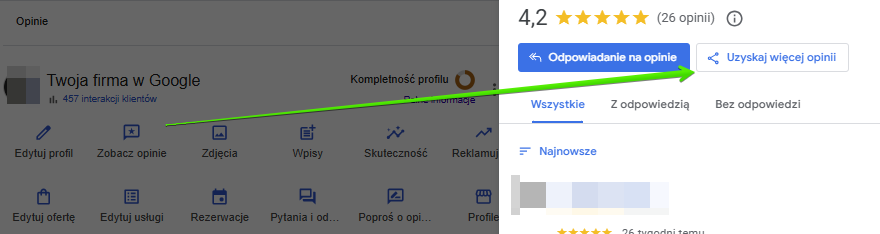
In the Business Profile panel, you can generate:

  • A direct link leading to the review submission form,
  • A QR code that a customer scans with their phone to go directly to the review section.

Where to find the QR code in Google Business Profile

QR code in Google Business Profile

Where does Google recommend sharing the link or QR code?

In the documentation, Google explicitly suggests using these tools in daily communication with customers, for example:

  • On receipts and invoices,
  • In emails sent after service completion or purchase,
  • At the end of a chat conversation,
  • As a printed QR code placed within the premises.

The goal is to eliminate situations where a customer has to manually search for a business profile on Google Maps to leave a review.

Google simultaneously issues a strong reminder regarding review policies. Reviews must be voluntary, authentic, and based on real customer experiences.

John Mueller: Site Names Should Make Sense in Search Results

Once again, insight from John Mueller. His comments clearly show that the choice of a site name has a direct impact on how easily it can be found in search results.

Mueller pointed out that the concept of “searching for a site name” can be misleading. It all depends on whether the name truly uniquely identifies the website. If a site has a unique name and its homepage is correctly indexed, the search engine has no trouble matching the query to the specific site. In such a situation, a user typing the name will almost certainly see the site in the search results.

A problem arises when the site name consists of very generic and competitive words – for example, “dinner-ideas.com”.

In Google’s assessment, such queries do not look like an attempt to find a specific brand, but rather like informational or comparative queries. Consequently, the search engine assumes the user is looking for general content on the topic rather than a specific homepage, even if it is correctly indexed.

There is no point in expecting a site with a very generic name to automatically rank high for a phrase that describes an entire category of services. Choosing a name should therefore take into account search realities and the competitiveness of queries.

Would you like me to translate any more articles or help you with your SEO strategy?

Author
Marcin Polak - Junior SEO Specialist
Author
Marcin Polak

Junior SEO Specialist

Junior SEO Specialist with experience in copywriting. He has been with Delante since 2023, where he combines creative writing with an analytical approach to SEO. A graduate of the Jagiellonian University (Journalism and Social Communication, Sports Management). Outside of work, he is an active fan of sports, cooking, and TV series.

Author
Marcin Polak - Junior SEO Specialist
Author
Marcin Polak

Junior SEO Specialist

Junior SEO Specialist with experience in copywriting. He has been with Delante since 2023, where he combines creative writing with an analytical approach to SEO. A graduate of the Jagiellonian University (Journalism and Social Communication, Sports Management). Outside of work, he is an active fan of sports, cooking, and TV series.