
Why AI Search is a must-have in marketing budgets for 2026

5min.

Comments:0

25 September 2025

Why AI Search is a must-have in marketing budgets for 2026d-tags
The year 2025 has already clearly shown that AI search is not a passing trend, but a new reality. Models such as ChatGPT, Gemini, and Perplexity have become the primary source of information about products and companies for many users, and their popularity continues to grow rapidly. Find out if you should also invest in AISO (AI Search Optimization) and how to include it in your 2026 marketing budget—and what your brand can gain from it.

5min.

Comments:0

25 September 2025

How is AI changing consumer behavior and the B2B customer journey?

In both the B2C and B2B sectors, we are seeing changes in the online behavior of potential customers. Until now, for most of them, the first step in searching for information about a brand or its products was Google. Although Google still has the lion’s share of the search market, AI models are increasingly making their presence felt in search (often even appearing in the user’s path before they perform a Google search).

Instead of doing research on a well-known search engine and checking individual websites, users prefer to turn to AI assistants. This is where the customer journey often begins now. With tools such as ChatGPT, users get answers to every query “served on a plate,” without having to spend time doing their own research and browsing dozens of subpages. Consumers often turn to LLMs for product or service recommendations and comparisons, and they may also ask for opinions on a particular brand.

“What 55-inch TV should I buy for a small living room? “Does brand X offer free delivery to Germany?” – these are examples of what questions typed into AI models might look like. If you don’t manage your visibility in these tools, you may lose many potential customers.

Below is an example of ChatGPT’s response to the question: “What 55-inch TV should I buy for a small living room?” In response, the user receives suggestions for specific models from Hisense, Samsung, and Sony. These are highly trusted brands that are already actively running SEO and AISO campaigns and have good customer reviews. As a result, the models are eager to recommend them and treat them as a highly authoritative source.

Philips, Panasonic, and LG are not yet included, which means they are missing out on the potential to be selected in this category.
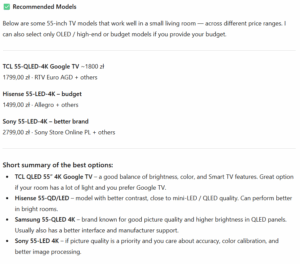
ChatGPT product recommendations

Source: ChatGPT

Customers now often make purchasing decisions without Google, relying solely on AI responses. For brand managers, CFOs, and CMOs, this means that without implementing an AISO strategy, the brand will be dropped from the list of possible options at the stage of gathering information and comparing competitors. If the brand does not appear in the AI response, it will not be present in the potential customer’s mind.

Global brands already present in AI

The world’s largest brands are already working on visibility strategies in AI tools. Let’s take a look at how they do it:

1. IKEA – on the IKEA website, we can find numerous guides and ready-made inspirations for interior design in various styles. The brand also focuses on diversifying content to reflect local markets and preferences, depending on the country where it is published. All content is optimized for AI and technically prepared for accurate interpretation by artificial intelligence models. They take a comprehensive approach to covering interior design (building topical authority and semantic connections between content) and ensure visibility in SEO and AI. As a result, AI readily quotes their guides or FAQs when asked about interior design. Regardless of industry, every business should ensure expert content is published appropriately within its given niche.

2. Tesla – one of the leaders in the electric car industry. Thanks to its building authority and numerous media mentions, as well as its focus on AI models, Gemini and ChatGPT often recommend Tesla and treat it as an example of a trusted brand.

3. Salesforce – a brand presented in AI in the context of CRMs and sales systems, which, thanks to strong expert content and AI Search activities, is recommended in tools as the number one in its niche.

The difference in lead acquisition costs: SEO vs. AISO

SEO is still the main channel for customer acquisition for many businesses (followed by advertising campaigns, direct, social, and email). Still, competition is fierce, and the costs of running campaigns are constantly rising. More content is needed; it is more challenging to obtain inbound links to the website, and mentions in reliable sources are becoming increasingly expensive. SEO is still and will continue to be necessary, but it is worth considering additional AI channels for customer acquisition and visibility building, thanks to the AISO strategy.

AI positioning is a new opportunity with a low barrier to entry. The first brands to “teach” AI about their brand will gain an advantage that will be difficult to catch up with – especially since many predictions (including Semrush research) show that within 5 years, AI traffic and searches will equal organic SEO traffic.

How does SEO compare to AISO in terms of customer acquisition costs? SEO usually lowers the cost of customer acquisition, or CAC, over a 12-18 month period. Adding AISO activities to your marketing strategy can help shorten the path and capture leads earlier. If, after AISO activities, AI recommends the brand, this can reduce CAC by as much as 20-40% compared to a strategy based solely on SEO – and at the same time accelerate the results (the first effects of AISO can be seen after just 30 days of activity, and we managed to achieve responses in chatgpt with our client’s product after a record 3 hours).

Conclusion? SEO and AISO work best in tandem. SEO helps build authority, while AISO accelerates results and allows you to gain visibility in a high-conversion source, helping you acquire customers more cheaply and quickly.

Learn more: How to reduce customer acquisition cost (CAC) with SEO and AISO?

How to prepare your company for AI-first search?

You already know that your brand’s presence in AI tools can be profitable for your business. Below, we have prepared a few steps that will be useful in building visibility in AI:

  1. AI-Ready audit and brand presence in AI – first, check whether ChatGPT, Gemini, and Perplexity mention your company and what they know about it. This will allow you to assess the current situation and plan your actions.
  2. AI-friendly content – when preparing a content plan or planning to optimize existing content on your website, consider content formats that AI likes. You can find more on this topic here: Content types preferred by AI: comparisons, lists, “top X” lists, checklists.
  3. FAQs and structured data – questions and answers and schemas—make it easier for AI bots to understand a website’s content. Make sure your website includes them.
  4. Building brand authority – for AI tools to quote a brand, they must consider it credible. Media citations, publishing case studies, and expert blog content will help with this. Also, make sure they are indexed in Bing and presented in a form that is readily citable by AI (divide them into content chunks, distribute them on social media, and ensure they are in feeds and RSS).
  5. Monitoring visibility in AI – visibility in AI is a new metric (AI Visibility) that is worth tracking and reporting on now. Based on this, you can verify what works for your domain.

Suggested KPIs for AISO

What KPIs can be used for AI positioning? Below, we have prepared a list of useful metrics:

  • AI Visibility Score – % of questions in AI tools in which the brand is mentioned.
  • AI Share of Voice (AI SoV) – share of recommendations about the brand compared to competitors in a given industry.
  • AI-driven Leads – number of leads that come from AI recommendations.
  • AI-assisted Conversion Rate – conversions coming from AI tool domains.
  • Brand Authority Signals in AI – number of brand citations in AI responses, summaries, reports.
  • AI Content Coverage – % of topics/keywords covered by AISO-optimized content.
  • AI Traffic – website traffic from various AI models.
  • ROI from AI – return on investment in AISO activities, taking into account sales and expenses for these activities.

Summary

2026 will definitely be the year of AI-first Search dominance. Companies that do not include AISO in their marketing budgets risk losing customers at the very first stage of the customer journey. AISO is not a nice-to-have, but a must-have – today it is one of the most cost-effective ways to acquire customers on new channels, and CMOs and Marketing Managers should make room for AI positioning in their brand’s marketing strategy.

Author
Mateusz Calik - CEO
Author
Matt Calik

CEO

CEO, has been building Delante since 2014. Responsible for international SEARCH strategies. He has a strong analytical approach to online marketing backed by more than 12 years of experience. Previously associated with the IT industry, as well as the automotive, tobacco, and financial markets. Has experience in creating scaled processes based on agile methodologies.

Author
Mateusz Calik - CEO
Author
Matt Calik

CEO

CEO, has been building Delante since 2014. Responsible for international SEARCH strategies. He has a strong analytical approach to online marketing backed by more than 12 years of experience. Previously associated with the IT industry, as well as the automotive, tobacco, and financial markets. Has experience in creating scaled processes based on agile methodologies.