10 Myths About SEO in AI
d-tags
d-tags
AISO (AI Search Optimization) is not the same as SEO. But why? LLM models like ChatGPT or Perplexity don’t operate in the same way as Google. Google’s mechanism relies on bots crawling websites, evaluating them based on a variety of ranking factors, and then arranging them accordingly in search results. AI models, on the other hand, rely on their own knowledge bases and often pull real-time data from the web to generate responses.
That’s why AISO is essentially an extension of SEO into a new territory. It calls for different considerations, a dedicated process, and a distinct strategy for building visibility.
So, if you want to succeed in search and show up when users ask about your brand or offer, AISO and SEO need to go hand in hand.
We already know that AISO differs from traditional SEO. But does that mean it interferes with it? Can focusing purely on AI optimization harm your visibility on Google?
The short answer: yes, but only if you focus solely on AISO. These efforts must go hand in hand.
If you dedicate 100% of your efforts to AISO and completely abandon traditional SEO, it can indeed hurt your performance, and you may lose the results you’ve built up so far. That’s because different elements matter when optimizing for AI versus Google—and some of them even contradict each other. You should think of AI search optimization as a separate process that runs in parallel with standard SEO. Traditional SEO is still key to gaining visibility in Google, attracting clicks, driving organic traffic, and generating conversions from that channel. AISO, on the other hand, helps get your brand, product, or service mentioned by various AI models—and that can lead to additional traffic, for example from referral channels like OpenAI or ChatGPT.
You can read more about this in our article: AI SEO – What Is It and How Will It Impact Your Business.
Although AI search is gaining momentum, Google still dominates the search market. What does that share look like in percentage terms? According to research (1), in the first half of 2025, Google held around 92% of the European market, while AI search accounted for only 0.12%. That number might not seem impressive at first glance—but in 2024, it was just 0.01%, meaning it grew more than tenfold in a single year.
So if AI currently holds just a sliver of the search pie, why should we care at all?
The reported share of AI traffic is an average across all industries. But there are specific sectors where AI plays a much bigger role—and where people are turning to tools like ChatGPT much more often for purchase advice.
Experts are already talking about the high level of trust users place in AI agents. People ask ChatGPT for recommendations on all kinds of products—from refrigerators and cars to bicycles, software, and other digital goods. Just as many are willing to act on the advice of a journalist or influencer, more and more people are now relying on suggestions from LLMs.
Traffic coming from LLMs is also far more likely to convert than traditional organic traffic. A case study from Seer Interactive illustrates this well: the conversion rate from ChatGPT traffic was an impressive 15.9%, compared to just 1.76% for standard organic traffic from Google (2).
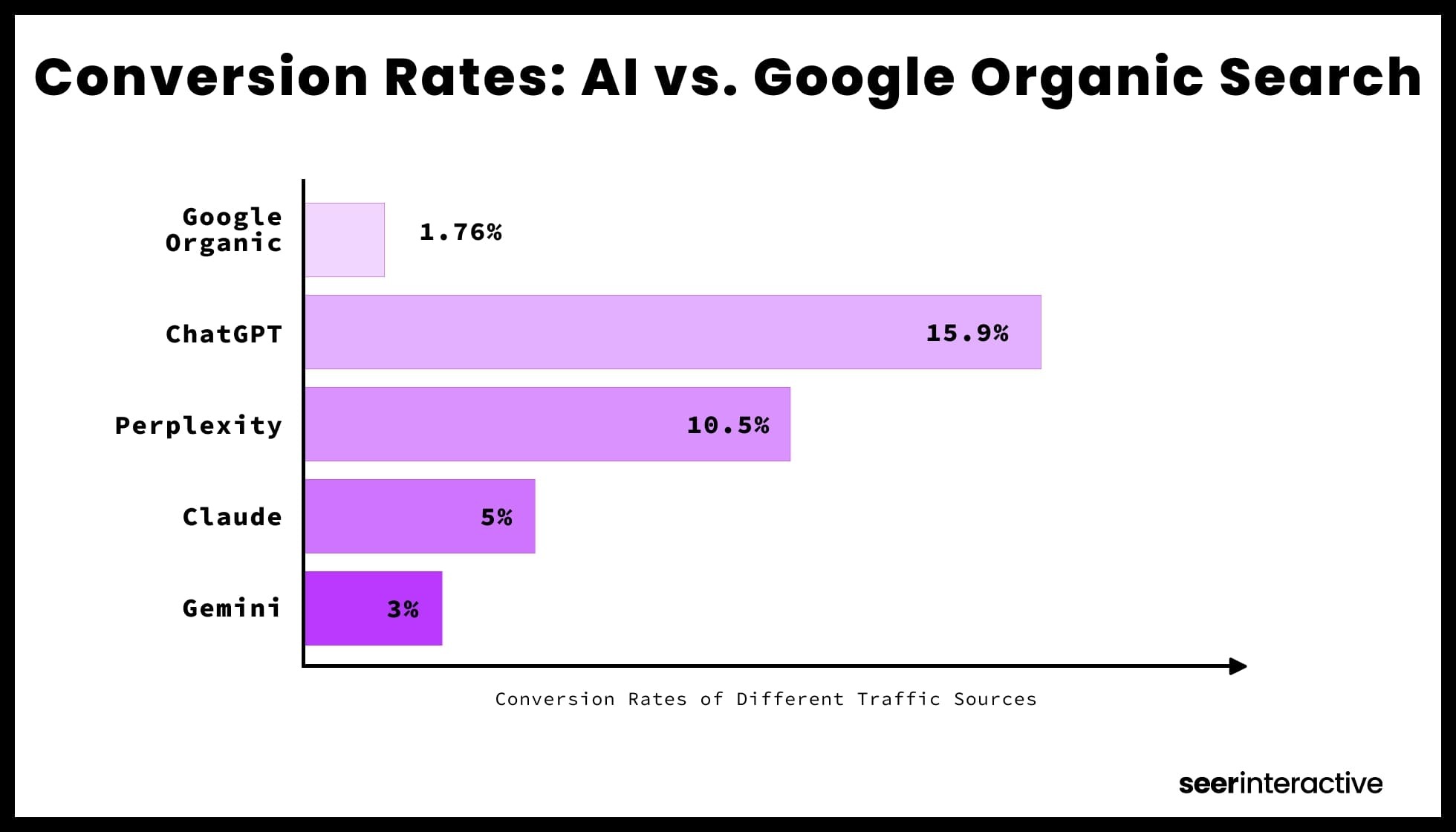
Source: Seer Interactive
What does it mean for you and your business? AI traffic already converts better, so it’s worth appearing in AI searches.
High conversion rates from AI models aren’t service-sector-exclusive. OpenAI has already launched shopping features for ChatGPT—and announced plans for further development.
More and more users are choosing this method of online shopping because it simply saves a lot of time. Instead of clicking through dozens of product listings on Google and then on various store pages, users ask an AI model for a curated list of recommended products—and make their purchase based on that. That’s why, if you run an e-commerce, it’s essential to adapt to these rapidly evolving search behaviors and ensure your brand is visible in AI-powered search engines.

Source: ChatGPT
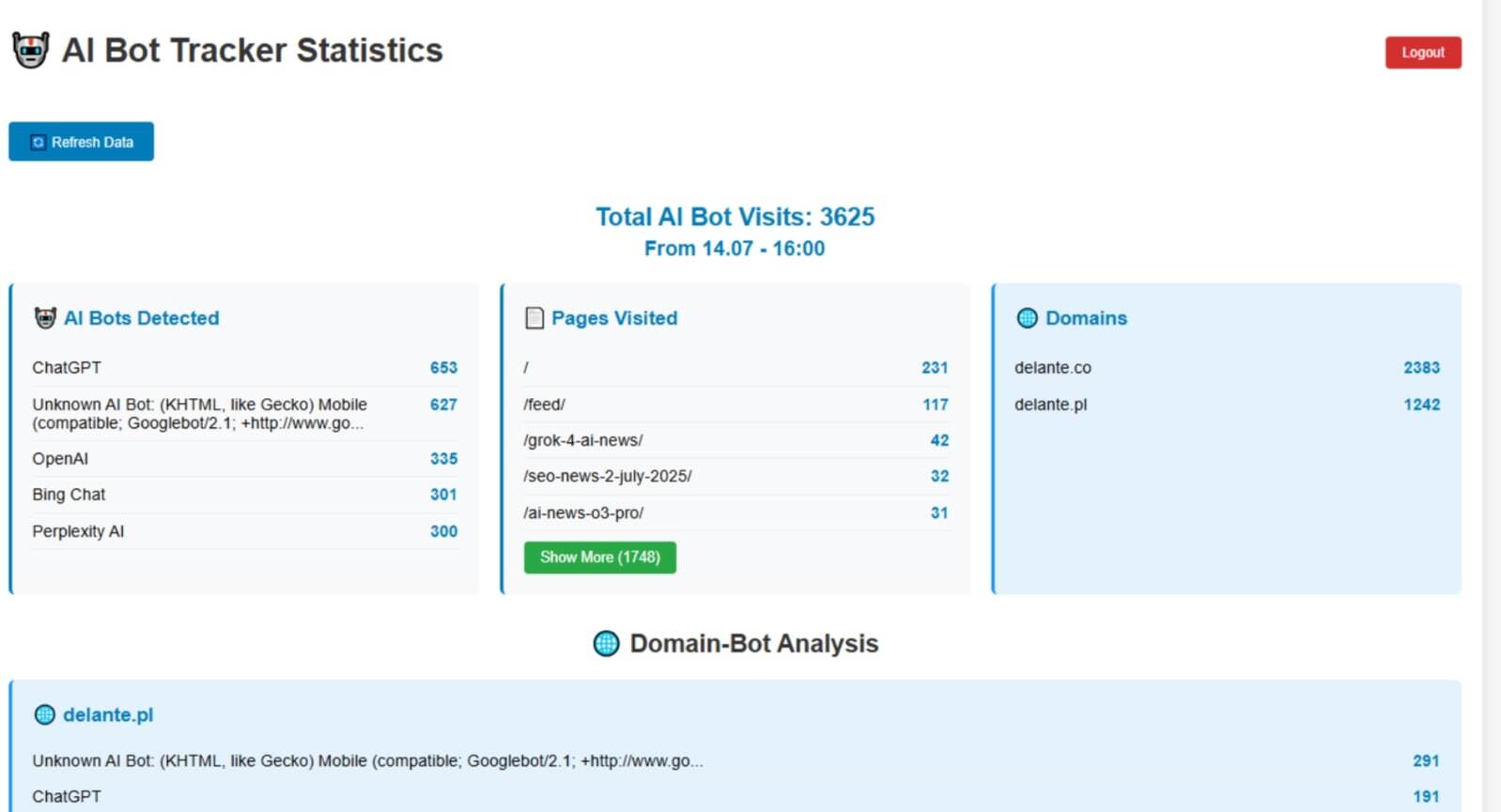
Let’s put it this way—where there’s a will, there’s a way! There are several effective methods for tracking the performance of AISO.
Source: Cerber AI, Delante’s propietary AI monitoring tool
Although the evolution of search largely began with ChatGPT, today even Google has become an AI-powered search engine. Google now uses its Gemini AI model to deliver answers directly in the search results. In the U.S., some of our clients already have access to AI Mode—a conversational interface that helps users search without needing to visit any websites. This marks a shift not only in how results are presented, but also in how users search. Answers delivered by AI offer a level of convenience that people aren’t willing to give up. We’re already seeing a significant drop in click-through rates (CTR) for Google searches, as many users are satisfied with the answers provided directly by AIO (AI Overviews) and don’t feel the need to click through to websites.
That’s why, as an online business owner, you shouldn’t treat AI as just a passing trend. Sure, people still use Google in the “traditional” way, and AI Overviews doesn’t yet cover every query type—but AI is quickly establishing itself in the search landscape, and its growth is accelerating at a remarkable pace.
Search isn’t ending—it’s evolving. AI isn’t replacing SEO, but it is rewriting the rules of the game. And it’s best to understand those rules before your competitors do.
Are you sure? Search has long outgrown Google alone! Users now look for service recommendations similar to yours on TikTok, Facebook—and increasingly through AI models. What makes AI results especially powerful is that they deliver ready-made, in-depth answers on a silver platter—who wouldn’t want to take advantage of that?
LLMs have become a new touchpoint in the buyer’s journey, and your presence in those results isn’t just a chance for additional conversions—it’s a crucial step in building brand awareness.
When it comes to AISO, elements like FAQs—nothing new in the world of SEO—and schema markup, a staple for every SEO specialist, are often listed as essentials. And yes, they’re definitely must-haves. But are they the only things you should focus on?
Absolutely not. AISO requires a much broader perspective. So what else should you pay attention to beyond those two?
Many people believe that AI shows results randomly, picking whatever it wants—so the whole idea of AISO must be a myth and a waste of time. Nothing could be further from the truth!
Just like in traditional SEO, AI models also operate based on algorithms—and while the mechanics differ, we can influence the results. LLMs pull from specific online sources in real time. They reference sites they can understand and that they consider trustworthy, reliable, and authoritative in a given field. That’s why a well-executed strategy and strong brand presence can significantly increase your chances of being featured in AI-generated responses.
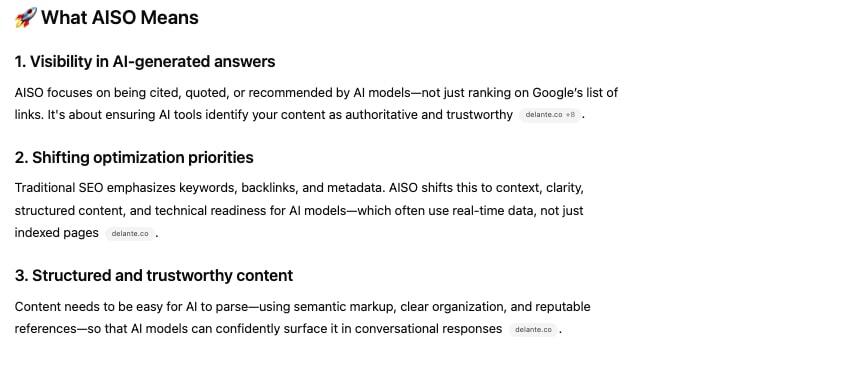
Do you really have to wait a long time to see the results of AISO efforts? We put it to the test ourselves—and we’re happy to share the outcome! We added a definition of AISO to our website, making sure to cover all the key elements needed for AI-driven visibility: structured data, Bing indexing, and targeted mentions to train the AI model. The result? ChatGPT showed our site as the source for this query the very next day.

Source: ChatGPT
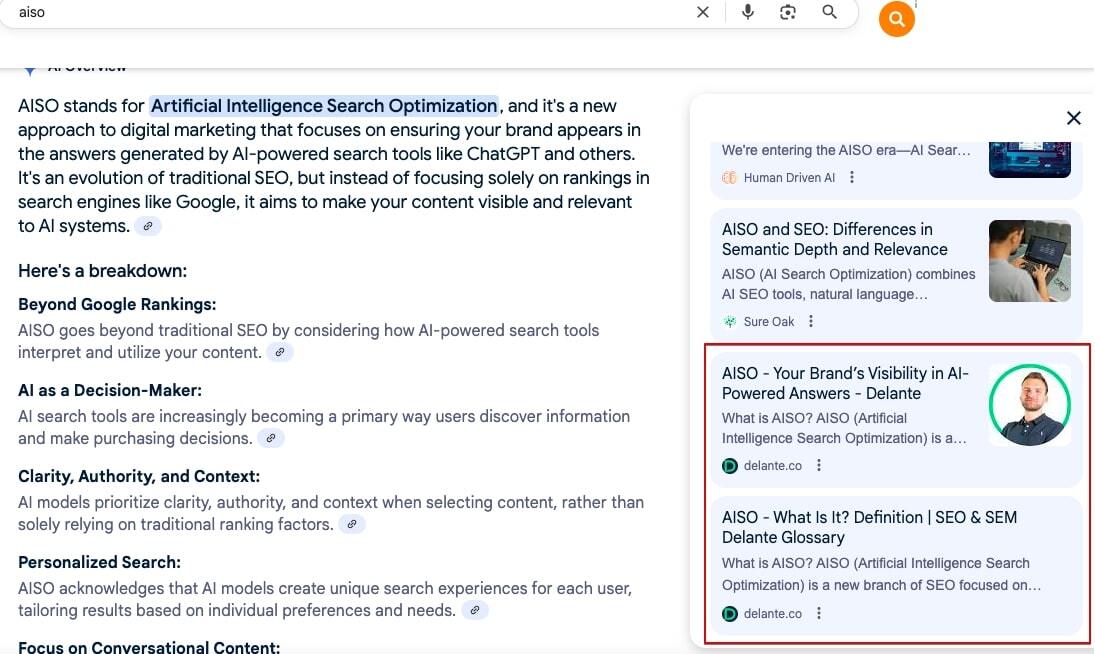
In the following steps, we continued to build mentions around this topic—and soon our definition also appeared in Google’s AI Overview for the query “AISO.”

Source: Google
We’re now applying the same strategy to our clients, and as of June 2025, 87% of them receive traffic from AI sources. With AISO, our focus is to make sure products, services, and brands are recommended by ChatGPT, Perplexity, and Gemini, because these mentions play a key role in the customer decision-making process—and they drive higher conversion rates.
Searching via AI models is neither black magic nor a passing trend—it’s the new reality.
And anyone who wants their business to stay visible online needs to adapt. Just like Google and social media search became essential over time, AI Search is now joining the game, and it requires its own strategy and process to be effective.
References: