The rapid rise in popularity of AI tools—primarily chatbots based on Large Language Models (LLMs) and their ability to search the internet—has created a new marketing channel for many companies.
Which websites, brands, and products LLMs recommend to users is no accident; it is the result of hard work (if you are interested in services in this area, check out our AISO offer).
The question isn’t whether to optimize for AI—that’s a given. The real question is: which artificial intelligence models should you optimize for?
With SEO, there was no such dilemma. Google held over 95% of the market; Bing, Yahoo, and other search engines were more of an anecdote.
In the case of AISO (AI Search Optimization), the scenario is more like social media, where there are more platforms to choose from: there’s Facebook, of course, but also Instagram, which belongs to the same company. There’s TikTok, there’s the-former-Twitter, X, there’s LinkedIn, there’s Pinterest, and finally, there’s YouTube, which is also a social medium.
When it comes to language models, we can identify nine major global players:
- ChatGPT from OpenAI
- Gemini from Google
- DeepSeek, a Chinese language model that made a big splash in early 2025, presenting itself as a solution as good as, but much cheaper than, ChatGPT
- Perplexity, an AI-based tool whose default function is to be an AI-powered search engine, and in which Amazon is heavily investing
- Grok, linked to X (formerly Twitter)
- Claude from the French company Anthropic
- Qwen, another Chinese model backed by the giant Alibaba
- Meta AI from Mark Zuckerberg
- Mistral, another French model
This list represents company names more than specific models. I am also only considering those that function as chatbots. The AI technology landscape is far more complex and diverse. Many models are used via API, for example, in automation or other custom solutions.
Here, I am only considering those that serve as an alternative to classic search engines—meaning the average Joe will have no trouble logging in and searching for what they need. You just go to the website, type your question into the box, and get a result. In other words: AI chatbots. When I refer to AI later in this text, I will always mean these chatbots.
What Does This Data Actually Mean?
I based the comparison of these AI models on data from the Similarweb platform. Importantly, I am looking at the total traffic for each chatbot. The first, unpublished version of this text was based on Ahrefs data, which only shows organic traffic. As a result, the values for most models were overestimated, while the leader, ChatGPT, was severely underestimated.
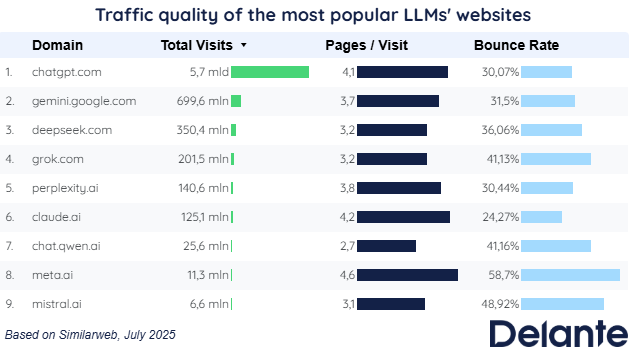
Similarweb shows data not just for organic traffic, but for all visits (though it is still an estimation). It also has the advantage of providing data on traffic quality—how long users stay on the site, how many subpages they view, and the resulting Bounce Rate. These are very general metrics, but in this context, they are sufficient to draw meaningful conclusions.
The data is for July 2025. I recommend bookmarking this post and checking back periodically, as we will be updating the comparison in the coming months.
Key Takeaways from the AI Platform Market Share Data
Market Share and Trends
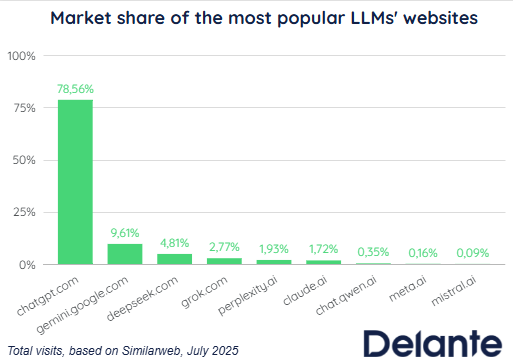
Without a doubt, the leader here is ChatGPT. With a market share of 78.56%, it attracts three times more users than all other models combined. Mistral’s last-place position is not surprising—it is one of two French models, less popular than Claude, which enjoys a very good reputation, especially for working with code.
The second platform of little significance for marketing efforts is Meta AI. Mark Zuckerberg’s consortium is clearly lagging in popularizing its achievements in artificial intelligence. However, to their credit, Meta has long focused on developing the Llama models, which perform quite well in benchmarks. They are not included here, however, because Llama models are open-source and can only be run on your own server (or computer).
Perplexity’s low market share is puzzling. When this search engine saw the light of day, it was a technological breakthrough. At the time, ChatGPT couldn’t browse the internet, and Google had not yet released Bard (the predecessor to Gemini). Perplexity was the first tool to combine the advantages of an organized web index with AI-generated summaries of the information found there. Despite this, its market share is below 2%.
The answer may lie in the fact that Perplexity—alone among all the compared platforms—is only a search engine. You can use any other tool for commands like: “Improve this email,” “Translate this for me,” or “Summarize this contract.” Perplexity won’t do that; its use case is limited to finding information on the internet.
Meanwhile, in my opinion, Grok and DeepSeek have a relatively high market share. True, the data is for the global market. Breaking it down by individual countries shows that DeepSeek is much more popular in China and Russia, and since these are countries with relatively large populations, it inflates their share in the global overview.
Nevertheless, Grok and DeepSeek were launched when ChatGPT already had a strongly established position in users’ minds, yet they still managed to carve out a piece of the pie for themselves.
And finally, Gemini—the chatbot from Google, the former monopolist of the search engine market, has almost 8 times fewer users than OpenAI’s chatbot.
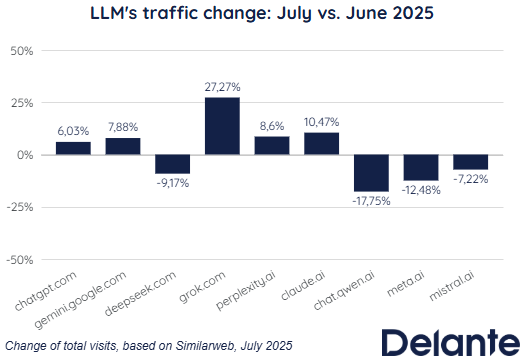
If we compare the traffic data for July with the previous month, the landscape changes a bit. DeepSeek, Meta AI, and Mistral saw large drops in total visits, while the other platforms saw growth—Grok’s growth was particularly significant. Was this the effect of the controversy this language model caused in early July? As a reminder, the model, which is integrated with the X platform (formerly Twitter) and can reply to user comments there, had its built-in safeguards and self-censorship disabled.
As a result, Grok publicly posted controversial comments under the posts of famous people. This certainly generated a lot of marketing buzz, which could have translated into greater user interest in the platform—whether this is just a temporary spike, we will see next month.
Mobile vs. Desktop Share
When interpreting traffic data, it is also important to break it down by mobile and desktop devices. Why does this matter? Because LLMs are often used for what I’ll call “task-based” applications. That is, the user isn’t so much looking for information as they want the model to perform a task: correct a text, summarize something, etc. These types of uses are generally not the focus of marketing efforts; there is little opportunity here to improve a company’s visibility. And these types of uses more often take place on desktops.
A large share of mobile traffic on a given platform will therefore suggest a relatively higher amount of “search” traffic—that is, traffic where the user is looking for information, including information about brands, products, or services. And it is this type of traffic on AI platforms that we can target with AISO activities.
So, what does this look like for the individual platforms?
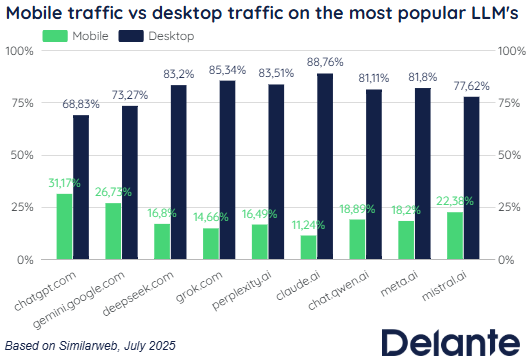
As you can see, the largest share of mobile traffic belongs to ChatGPT (31.17%) and Gemini (26.73%). In contrast, the smallest share of mobile traffic is on Claude (11.24%), a model highly praised for its code-writing capabilities, which falls under task-based prompts.
Similarweb Data vs. Google Analytics
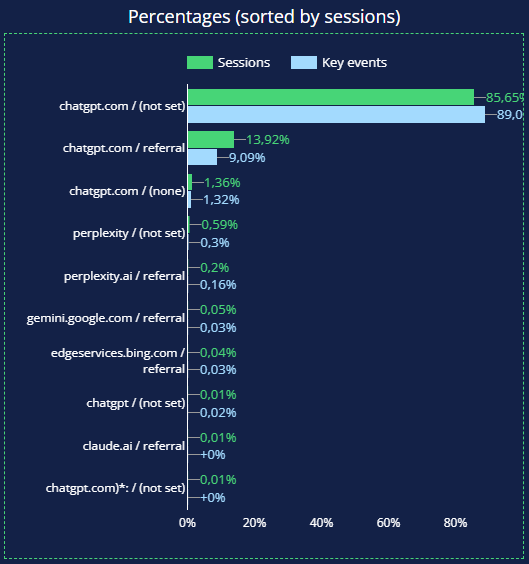
This data resonates very strongly with what I see in Google Analytics for our clients’ accounts. Of course, there are many differences in how the data is sourced. For example, I take data from Similarweb about traffic to specific AI platforms, whereas in GA4 you can only see how many visits a website received from individual models. Then there are challenges like adblockers, incorrect attribution, or even rejected cookie banners / consent mode.
Nevertheless, most projects show similar proportions—that is, ChatGPT as a traffic source accounts for over 75% of visits from AI sources. Especially for e-commerce sites, this value is higher than the market share shown by Similarweb.
This may indicate, on one hand, that users on these types of sites predominantly use ChatGPT, or, alternatively, that ChatGPT yields a better CTR than, for example, Gemini or Perplexity. At the same time, looking beyond ChatGPT, it is clear that Perplexity can generate more visits to a website than Gemini, even though Gemini has a market share several times larger.
This underscores the importance of distinguishing between task-based and search-based prompts – in Perplexity, we only have the latter. Gemini’s market share of nearly 10% and its 0.5%-2% share of website traffic (these values are approximate, I haven’t yet done a test on the share of individual LLMs in website traffic) can give an idea of how many search queries—those interesting from a marketing perspective—there actually are.
The screenshot above is from my Looker Studio dashboard for presenting AI traffic data. Feel free to use it at this link: https://lookerstudio.google.com/reporting/8a5982c3-8d96-4515-a084-1baf0d5ce285
Quality of Traffic on AI Sites
An additional issue worth considering in the context of optimizing for visibility in AI model responses is the quality of traffic.
Claude definitely deserves a mention here with its very low bounce rate, which may suggest greater user satisfaction than on other platforms. May—because bounce rate data is often not straightforward to interpret.
The high bounce rate on Meta AI is certainly not surprising. Having no prior experience with the platform, I went there out of curiosity to enter a few prompts and check the results. What was striking was how aggressively the platform insisted on logging in. And after entering one prompt, I couldn’t enter another. This pushed me away from the platform, and I suspect I’m not the only one.
Grok also has a relatively high bounce rate. This may be related to the previously mentioned hypothesis that many users came there out of curiosity in response to the model’s controversial statements. Was that really the case? To quote a famous Polish musician, “We’ll see, time will tell.”
It’s also worth mentioning that ChatGPT, Gemini, and Claude have a noticeably longer average visit duration, whereas platforms like Meta AI or Mistral have a significantly lower value.
This is another signal indicating traffic quality. Short visits, a high bounce rate, and month-over-month declining traffic are clear signs that building your brand’s visibility on a given LLM doesn’t make sense in the long run.
When is it Worthwhile to Consider Other AI Models?
The conclusions from the data presented above are clear: if you want to invest in AISO, focus on ChatGPT. Perhaps Perplexity or Gemini might also make sense for you, but if you’re looking for the legendary 20% of effort that yields 80% of results (however skeptically I approach this principle), investing in visibility within OpenAI’s models will make the most sense for the majority of businesses.
However, it’s not the case that the others can be written off from the start. I see a few exceptions, related partly to the industry and partly to the market in which you want to operate.
First and foremost is geography. In the Eastern Hemisphere, essentially Asia, the landscape of language models looks different. There, it is worth considering DeepSeek or Qwen, and perhaps other models less known in our part of the world. If you are targeting France, Mistral or Claude may have more potential than Grok or Gemini.
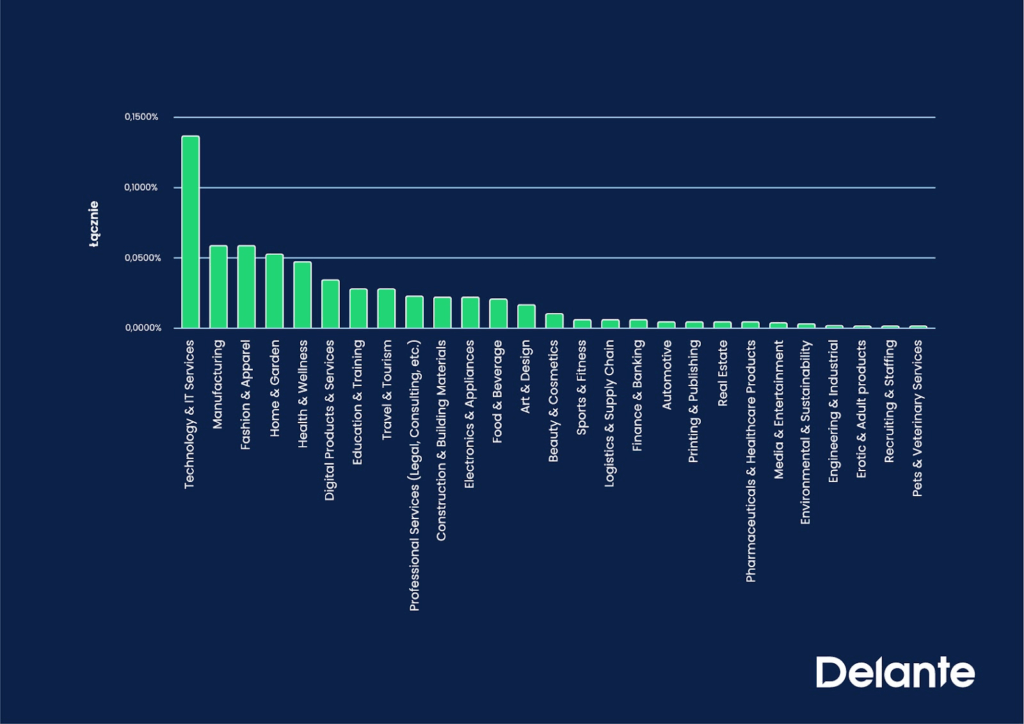
The second issue is the industry you operate in. This became very clear in the research I conducted at the beginning of the year on AI traffic (in general, without a breakdown by tool) to websites in 2024. One of the findings from that study was a large variation in the value of this traffic depending on the website’s topic:
Here, I’m relying partly on intuition and partly on assumptions, but I’m willing to bet that for IT services, optimizing for Claude, praised for its coding abilities, may make more sense than for more lifestyle-oriented topics. On the other hand, Grok is tightly integrated with Twitter—excuse me, with X—a platform where journalists and politicians are heavily engaged. If these types of users are your target, then optimizing for Grok might be justified.
Certainly, every company should evaluate the sense of investing in another marketing channel from the perspective of analyzing their target audience’s behavior. Because at the end of the day, it’s all about them—the people you want to reach with your product or service.
And if you have any questions about AI and marketing and the possible actions in this area, write to us!