
Nano Banana – revolutionary image editing with Gemini? – AI News – #1 September 2025

5min.

Comments:0

01 September 2025

Nano Banana – revolutionary image editing with Gemini? – AI News – #1 September 2025d-tags
Google is rolling out a new AI model in its Gemini app, Nano Banana, set to revolutionize photo editing. Unlike typical generators, its strength lies in modifying existing images with an unprecedented ability to maintain the subject's likeness and allow for multi-step, conversational edits. However, initial user tests reveal that alongside spectacular successes, the technology still struggles—attempts to merge photos result in surreal collages, and making precise changes feels like a frustrating negotiation with the algorithm. Is Nano Banana the true future of image editing, or just a fascinating yet unpolished tool for now?

5min.

Comments:0

01 September 2025

After the Imagen 4 model, which focused on generating images from scratch, it’s time for a tool that aims to transform how we approach graphic editing. This time, the focus is on editing existing graphics. Meet Nano Banana – a model that, according to announcements, is set to become the highest-rated editing tool in the world. The promises are big, and users’ first impressions? Well, they are mixed but extremely promising.

The world of AI has accustomed us to continuous breakthroughs that change our perception of technology week by week. Nano Banana is the next step in this fascinating journey. Instead of creating images from scratch, this model specializes in modifying them. It’s like a conversation with a smart graphic designer who understands our commands and brings them to life. At least in theory. In practice, as with AI, we face an exciting trek through the valley of amazement, full of both spectacular successes and comical failures.
How Does Nano Banana Work and How to Use It?

To begin the adventure with the new feature, there’s no need to install any additional plugins or search for hidden options in the menu. All the magic happens directly in the chat window of the Gemini app. Just upload a photo – whether previously AI-generated or just taken with a phone – and describe the change you want. This approach, known as conversational editing, is at the heart of this innovation.

Google particularly highlights several new capabilities that are set to redefine our approach to photo editing.

You’re Still You, Even with a Retro Hairstyle

One of the biggest challenges for AI models so far has been consistency. How many times have you tried changing the background in a photo only to get an image where your face looks like a caricature belonging to someone completely different? Nano Banana aims to solve this problem. Google has put great emphasis on maintaining the identity of edited characters.

Users who have already had the chance to test the new feature often expressed their amazement. Attempts to change outfits, relocate characters to entirely different places – for example, from an office to a mountain peak – or even experiments with crazy hairstyles ended surprisingly well. Subtle facial features, characteristic eye arrangements, and even minor skin imperfections remained intact. This makes edited photos retain their personal character. You can finally see how your dog would look in a cute skirt without worrying that AI will turn him into a dog of a completely different breed.

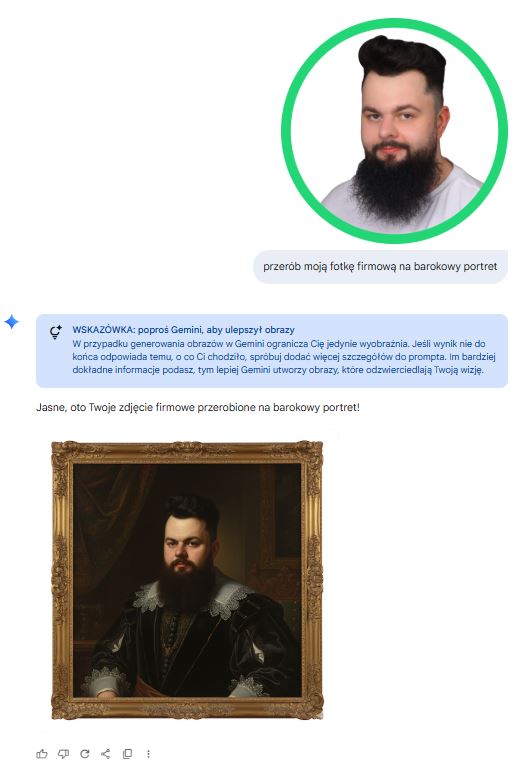
I tested how it works myself… and I must admit, it’s quite good, especially considering I didn’t even wait half a minute for the new version of the photo:

Example of photo editing in Nano Banana
source: own, photo edited in Nano Banana

Creative Demolition and Rebuilding: Multistage Editing

Imagine renovating a room. First, you paint the walls a new color. Then you put in a bookshelf. Next, you add a coffee table and some plants. Nano Banana allows exactly the same iterative process of working with an image. You upload a photo of an empty room and step by step, command by command, you decorate it according to your vision.

This is one of those applications that generated the most enthusiasm at an early stage. Users boasted how smoothly the model changes colors even on complex shapes, adds furniture while maintaining perspective, or even colors black-and-white manga frames. Of course, not always perfect on the first try, but a few additional commands with corrections often led to a satisfying effect. It’s the perfect tool for quick prototyping and testing visual concepts without opening complicated graphic software.

Collision with Reality: When Nano Banana’s Magic Fades

Like any new technology, Nano Banana has its teething problems. Alongside the admiration for character consistency and step-by-step editing, stories quickly appeared online showing that perfection is still a long way off. It is in these imperfections that the challenges faced by AI model creators today are best seen.

When Two Worlds Collide Too Literally: Frustration with Image Merging

One of the most promising features was supposed to be the seamless merging of several photographs into one coherent scene. The feeling when a brilliant idea for a creative photomontage is born in the mind is exciting. Unfortunately, the confrontation of this vision with the model’s capabilities often ended in comedic disappointment. Instead of a harmonious blend of two worlds, users received surreal collages where logic and physics ceased to exist.

This experience can be described as a loss of translation between human intent and machine execution. It feels as if AI, instead of intelligently interpreting the command, brutally overlays layers, creating illogical hybrids. Objects penetrate each other in absurd ways, perspective collapses, and lighting seems to come from two different dimensions. Initial enthusiasm quickly gives way to disbelief and laughter, and the feature, intended as a breakthrough, currently appears as a curiosity producing material for internet memes.

“Almost” Makes a Big Difference: The Fight for Detail and Precision

Equally frustrating are attempts to introduce small, precise changes. It’s the feeling when you want to add one tiny element to a photo, and the model seems to have its own stubborn vision of how it should look and where it should be placed. A simple request to position an object in a specific spot turns into a series of negotiations with the algorithm. The object hovers, is the wrong scale, or is blended into the background in a way no one planned.

What’s worse, users quickly noticed that each subsequent attempt at correction comes at a cost – gradual degradation of the entire image quality. With every edit, details become more blurred, sharp edges soften, and the whole graphic acquires a “foggy,” digital look. This makes the editing process a race against time and number of corrections, and the final effect, even if close to the intention, is often technically worse than the original. It’s a feeling of fighting with the tool, not cooperating with it.

Technical and Ethical Issues to Keep in Mind

Beyond purely functional problems, it’s worth paying attention to a few other aspects. First, the resolution of generated images still leaves something to be desired. Around 1200×800 pixels is enough for social media publication, but it’s insufficient for professional applications without investing in graphic upscaling solutions.

Secondly, the issue of intellectual property. Users noticed that requests to add characters known from pop culture often end with the creation of their bizarre, distorted variants. This shows how models navigate the topic of copyrights, avoiding creating exact copies, which however leads to quite unsettling results.

Finally, it is worth adding that Google cares about transparency. Every image edited or created in Gemini is marked with a visible watermark in the corner and an invisible digital SynthID tag. It is a clear signal that we are dealing with content generated by artificial intelligence.

Is Nano Banana the Future of Graphic Editing?

Despite current imperfections, the potential of Nano Banana is huge. It is a tool that democratizes photo editing, making it more intuitive and accessible to everyone. The ability to maintain character consistency is a real breakthrough, and conversational editing could become the standard in the future.

For now, however, Nano Banana is a fascinating but still unfinished toy. It can be a great helper for quick visualizations and creative experiments but won’t replace professional graphic tools. More precision, better handling of complex compositions, and higher resolution are needed. However, if Google keeps up the development pace, we might witness a small revolution that will permanently change how we think about photo editing. It’s worth following this development, even if along the way many absurd and comical results await us. If you are curious about what the future of AI graphic editing holds, subscribe to the Delante newsletter and stay updated with us!

Source of information about Nano Banana: https://blog.google/products/gemini/updated-image-editing-model/

Author
Maciej Jakubiec - Junior SEO Specialist
Author
Maciej Jakubiec

SEO Specialist

A marketing graduate specializing in e-commerce from the University of Economics in Kraków – part of Delante’s SEO team since 2022. A firm believer in the importance of well-crafted content, and apart from being an SEO, a passionate music producer crafting sounds since his early teens.

Author
Maciej Jakubiec - Junior SEO Specialist
Author
Maciej Jakubiec

SEO Specialist

A marketing graduate specializing in e-commerce from the University of Economics in Kraków – part of Delante’s SEO team since 2022. A firm believer in the importance of well-crafted content, and apart from being an SEO, a passionate music producer crafting sounds since his early teens.