Q4 is the time for comparisons and rankings – how to take advantage of shopping seasons in AI Search?

5min.

Comments:0

07 October 2025

Q4 is the time for comparisons and rankings – how to take advantage of shopping seasons in AI Search?d-tags
It's the most wonderful time of the year – especially for e-commerce businesses. ;) Q4 is not only about Christmas, but also Black Friday and Cyber Monday. All companies operating in online sales generate their highest profits during this period. How to prepare for this time in the era of AI Search?

5min.

Comments:0

07 October 2025

Why do comparisons rule in the fourth quarter of the year?

The last quarter is the most intense shopping period. Everyone wants to give their loved ones special gifts for the holidays, and many people also wait for the famous Black Friday promotions to make various purchases. However, before a user makes a purchase decision, they look for information about available products. How do they do this?

Currently, regardless of the product type, we can find hundreds, if not thousands, of options online. No one has enough time to check every model, search for technical information, or compare products. That is why users look for comparisons and rankings in the early stages of their shopping journey.

  • “Which phone model is best for photos?”
  • “What gift should I choose for an 8-year-old in 2025?”
  • “Where can I buy this product cheaper with fast delivery?”

As a brand, you need to ensure your products appear as recommendations whenever users ask about them.

AI Search is changing the rules of the game

Until now, users searched for information about different product models on specialist websites or significant marketplaces. The emergence of LLM models such as ChatGPT, Perplexity, and Gemini has turned the world of Search upside down.

What does user behavior look like now? Customers are increasingly turning to AI for product recommendations or gift ideas. AI-based models are becoming a new channel for companies, offering a potential point of contact with customers.

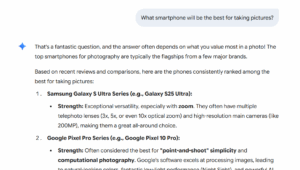
Imagine you want to replace your phone with a newer model. You travel a lot, and taking photos of the places you visit is your way of preserving memories, so a good camera is your top priority. Instead of checking several home appliance store websites and clicking through specific models, you ask the LLM model a straightforward question, and it reviews all the guides and rankings for you. As a result, you get a comprehensive answer with suggestions for specific phone models in a few seconds.

Gemini smartphone recommendation

Source: Gemini model response

AI Search is not only about LLM models, but also about Google itself, where we receive AI-generated answers to many queries. The AI Overviews feature is Google’s response to the popularity of LLM models. From the user’s perspective, it also saves a lot of time. Instead of traditional blue links leading to multiple pages, they get an overview with ready-made recommended models and sources listed on the right.

What does this mean for e-commerce businesses? SEO alone is not enough – to appear in AI-generated search results, you will need a strategy that includes AISO, or AI positioning. This will allow your brand to acquire customers through an entirely new channel.

These actions are worth taking from an e-commerce perspective

  1. Create your own rankings and comparisons

Both AI models and Google base their responses on content found on the web. Materials published by brands and various portals are the source for AI, so if you prepare content in a format that AI likes, you will increase your chances of appearing in such a response. Include the following in your content strategy:

  • Specific examples of product comparisons for queries that users may enter about your brand, e.g., “X gift ideas for children for Christmas.”
  • The second type of content is rankings of the best products in a given category, but as a brand, you must ensure the rankings are objective. If you offer products from different manufacturers, there is no problem, but if you are a manufacturer yourself and operate under your own brand, comparing your products with the competition will be unnatural. Examples of rankings include: “The best laptops for graphic designers in 2025.”
  • The third type of content is comparisons, i.e., an article in which you present the technical differences between two models. Example: “iPhone 16 and iPhone 16 Pro – how do they differ?”
  1. FAQ and Q&A content

AI also highly values content that directly answers questions. Pages with content in a question-and-answer format can therefore benefit greatly from AI citations.

(Tip) As a business owner, you surely know what questions your potential customers ask most often. Take advantage of this by adding FAQ sections to your product or category pages, where you can provide short, concise answers to the most critical questions. This will benefit not only AI bots, but above all, people!

  1. Structured data and transparency

For Google bots and AI models to effectively understand your website, you will need to implement structured data. From a technical point of view, such data is like “signposts” that directly show bots the most critical elements on your website. On a product page, this would include, for example, product features, color options, price, user reviews, and availability. AI models are more likely to refer to a website that is accessible and understandable to them because they will need to use less computing power to interpret its content.

In terms of UX and CRO, it is worth ensuring that reviews appear on the product page as much as possible, preferably not only in bullet-point lists but also as short statements. Potential customers are much more likely to buy when they see positive reviews about a product. Therefore, make sure to include customer review gathering in your marketing strategy.

  1. Additional support in the form of SEM campaigns

Do you already have content with rankings and comparisons prepared? Great! Next, you can support it with SEM campaigns. Setting up Google Ads campaigns based on phrases such as “best X” or “Y ranking” will help you capture traffic at the research stage.

In an era of almost unlimited shopping options, customers often don’t buy right away—they search, check, compare, and only then decide. If you appear earlier, e.g., in a comparison prepared by AI, the customer will remember your brand, which increases the chance of a future purchase.

What does this mean from a business perspective?

Q4 doesn’t have to mean only short-term, seasonal sales for your business. You can use it as an opportunity to enter the AI Search market. If you implement an AISO strategy now, your store will not only be included in the AI response for the December gift ranking—if it appears there now, it is very likely to appear in the following months as well. LLM models “learn” and remember trusted sources, which they are then happy to use in their responses. Make it an investment in long-term visibility, not just a seasonal peak.

Checklist – get ready for Q4

What actions are worth taking with Q4 in mind from an e-commerce perspective?

✅ Create at least 2-3 ranking articles (“Top 10 X,” “X models worth choosing in the 2025/2026 season”).
✅ Add FAQ sections to categories and products (start with the most popular categories and add 4-5 questions and answers to each).
✅ Ensure products have up-to-date structured data (prices, reviews, availability).
✅ Combine SEO and SEM – test campaigns for phrases such as “best X, ranking Y” during Black Friday and the holiday season.
✅ Monitor visibility in AI Overviews and tools such as Perplexity, ChatGPT, and Gemini.

Summary

Q4 is the hottest time for e-commerce. Before reaching the purchase stage, potential customers look for rankings, comparisons, and ideas, and this is your opportunity. If you don’t make sure you appear in these rankings or in AI-generated responses, you will lose customers at the beginning of the purchase path. So don’t wait, start implementing the points from our checklist now!

Author
Michał Grzyb - Junior SEO Specialist
Author
Michał Grzyb

SEO & AI Specialist

Graduate of Management at the Cracow University of Economics. His interest in internet marketing and SEO began during his studies and led him to start working at Delante in August 2022. Expert in building visibility in traditional search engines and AI models. Privately a lover of physical activity in any form and good food.

Author
Michał Grzyb - Junior SEO Specialist
Author
Michał Grzyb

SEO & AI Specialist

Graduate of Management at the Cracow University of Economics. His interest in internet marketing and SEO began during his studies and led him to start working at Delante in August 2022. Expert in building visibility in traditional search engines and AI models. Privately a lover of physical activity in any form and good food.