If you thought the end of the year would be quiet for SEO, Google has other plans. John Mueller reminds us of the fundamentals that are still being overlooked: technical consistency, clean signals, and content strategy instead of "patching" AI texts. We also get a new filter for branded queries in Search Console and trend tests in Discover, which are increasingly pushing users towards AI Mode. Read more SEO news!
In a Bluesky post, John Mueller emphasized that consistency is the most important technical factor affecting how Google interprets and evaluates websites.
He pointed out that many issues visible in search results arise not from a lack of advanced optimizations but from inconsistent signals the site sends to the search engine. This covers, among other things, consistent URLs pointing to the same pages, correct canonical tags aligned with navigation, consistent content, and matching structured data.
He also stressed that the entire site architecture should be built so Google receives unambiguous signals — without internal contradictions or discrepancies. Only on that foundation does it make sense to roll out more complex optimization efforts.
In practice, maintaining a logical, predictable, and consistent site structure isn’t merely a good habit; it’s the base on which the effectiveness of the whole SEO strategy depends.
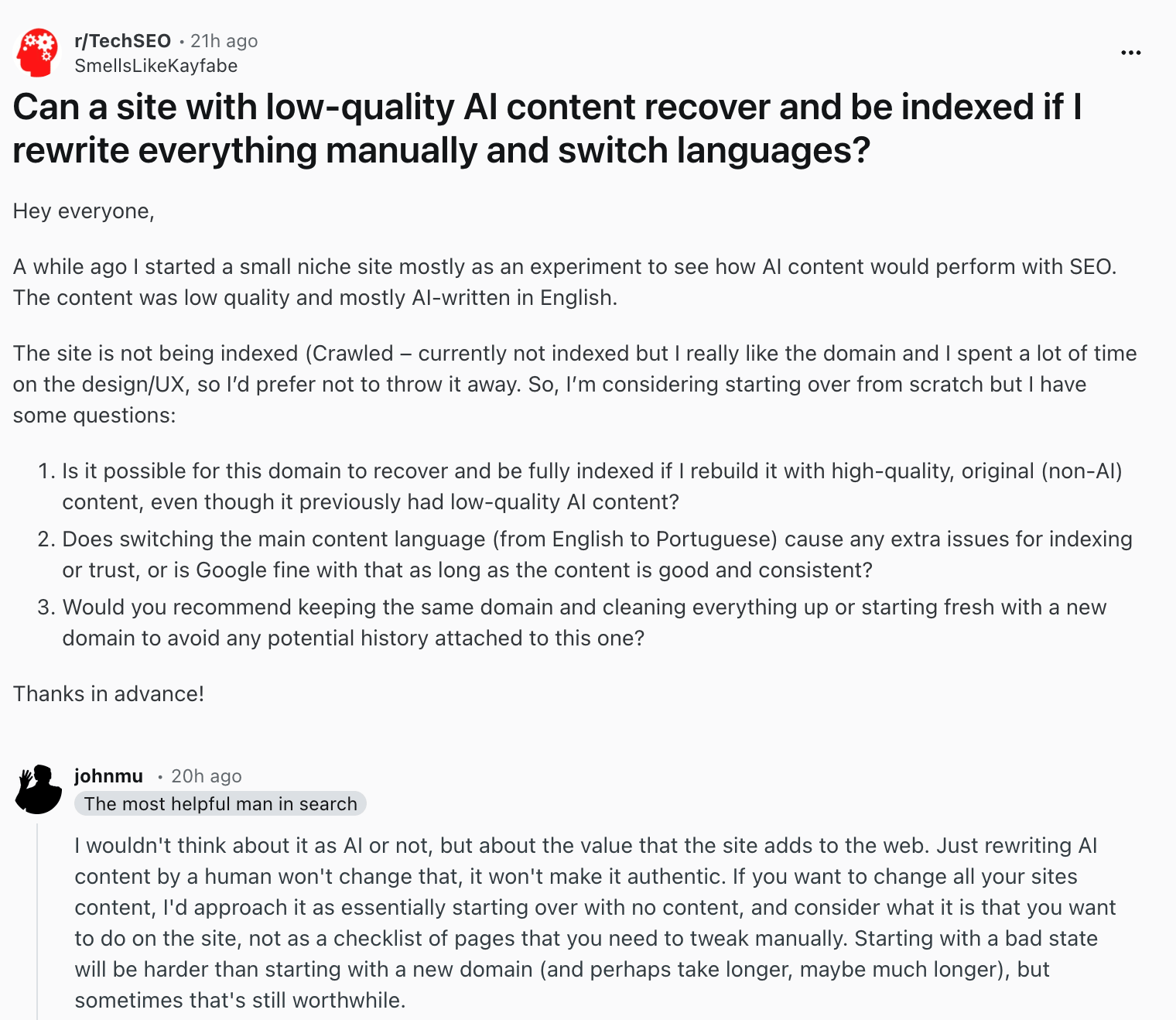
Rewriting AI content alone won’t recover rankings — a new strategy is needed
On Reddit he responded to a question about whether a domain previously filled with low-quality AI content can be saved. As he explained, simply manually rewriting such texts won’t make them valuable or “authentic” from Google’s perspective.
Mueller underlined that a strategic approach is required — instead of thinking about patching old materials, you should consider a new purpose for the site and the real value it will add to the web. He added that rebuilding the reputation of a domain burdened with a poor history can be harder and more time-consuming than starting with a new domain.
In another Reddit thread, Mueller reassured concerns about large video files embedded on the homepage. A user jokingly asked whether a 100-megabyte video loaded in the background could negatively affect SEO. Mueller’s answer was clear: such an element should not have a noticeable impact on Google rankings.
He explained that if the page content and main elements load normally and the video is loaded later, Google’s algorithms should not treat that as an issue.
Google introduces branded queries filter in Search Console
Google announced a new tool in Search Console designed to make it easier to analyze traffic by query type — the branded queries filter. This feature follows the October launch of query groups and represents another step toward improving visibility analysis in search results.
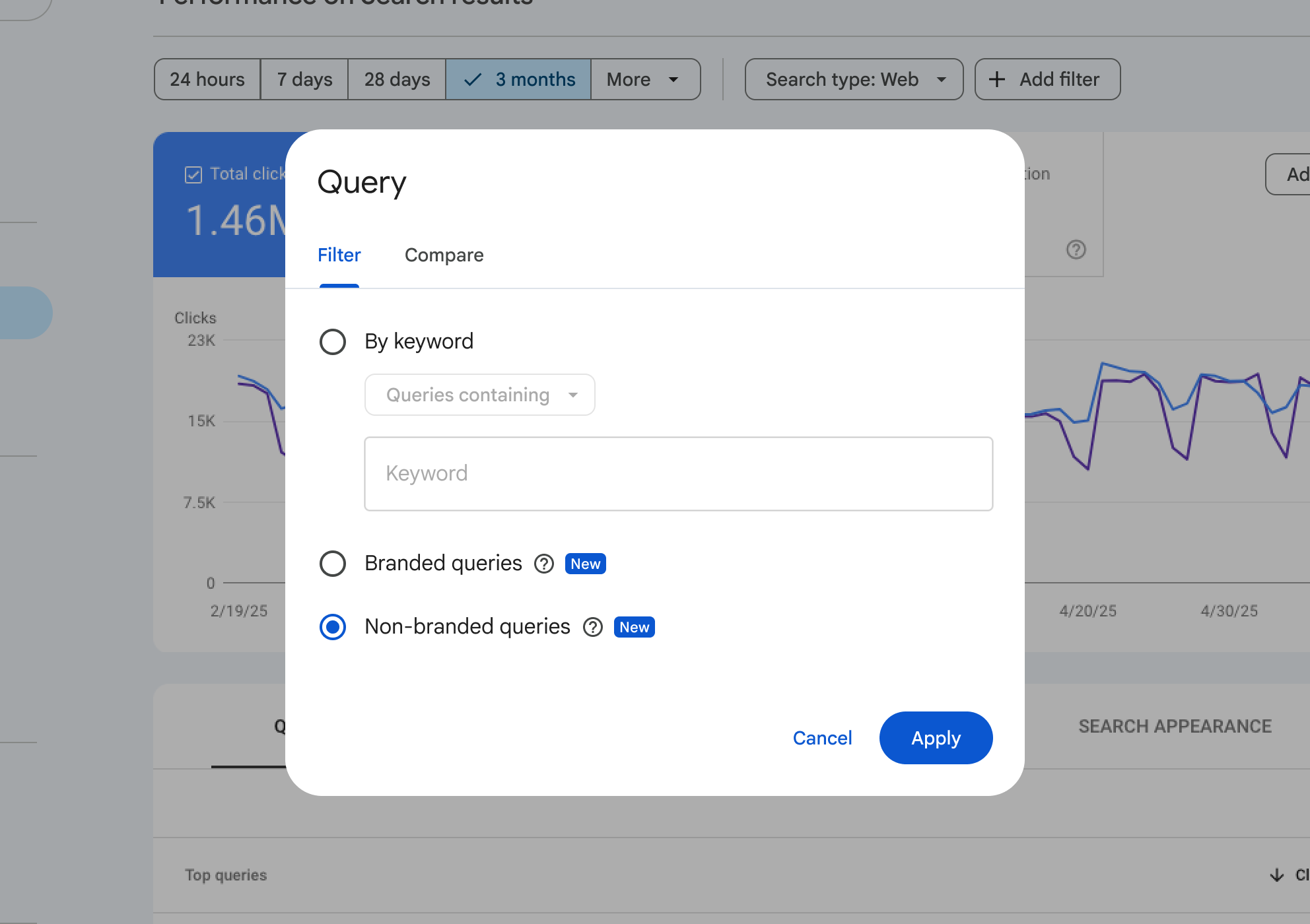
The new filter automatically distinguishes branded queries from non-branded ones. Branded queries include phrases containing the company name, its language or spelling variants, and product or service names unique to the brand. This makes it easier for site owners to see how users reach their site — whether intentionally by brand recognition or through more generic searches.
The filter is available in the Performance (Search results) report and allows switching the view between branded and non-branded queries across all search types: web, image, video, and news. After applying it, you can analyze key metrics such as
impressions,
clicks,
CTR,
average position.
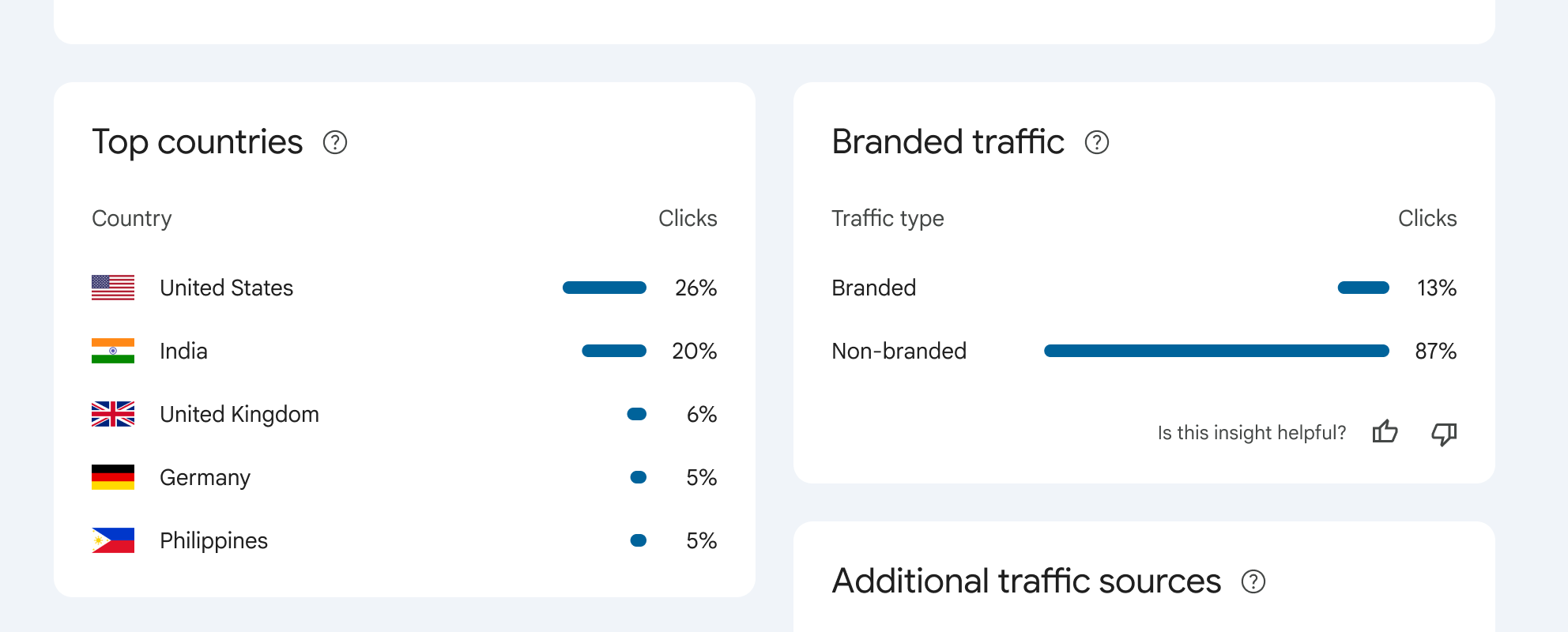
There’s also a new card in the Insights report that shows the share of branded versus non-branded traffic, letting you quickly compare the two sources and assess brand recognition among users.
It’s worth noting that classification is not based on manually created filters or regular expressions. Google uses an internal AI-supported mechanism that accounts for different query variants, typos, and context related to unique products or services. Some misclassifications may occur, but the filter does not affect ranking — it’s only for data analysis.
The feature is rolling out gradually. It may be unavailable for sites with low traffic volume or for properties restricted to certain paths or subdomains.
Google testing “Top searches” widget in Discover
Google has started testing a new element in the Discover app — a “Top searches” widget that appears at the top of the feed. The feature displays a dynamically updating list of topics that are currently trending among search users.
Importantly, clicking any of the listed trends does not lead to the standard search results page but to an AI-based mode. This may signal that Google is increasingly encouraging users to start queries via the AI interface.
The test was spotted by Damien (Andell), who shared screenshots on X. As he noted, the list of top queries refreshes whenever the Discover feed is reopened or refreshed, suggesting it’s generated in real time.
Damien also showed a settings section where users can control the visibility of this module. That suggests Google might make the widget optional and allow users to adjust it to their preferences.
SEO Specialist with experience in copywriting. He has been with Delante since 2023, where he combines creative writing with an analytical approach to SEO. A graduate of the Jagiellonian University (Journalism and Social Communication, Sports Management). Outside of work, he is an active fan of sports, cooking, and TV series.
SEO Specialist with experience in copywriting. He has been with Delante since 2023, where he combines creative writing with an analytical approach to SEO. A graduate of the Jagiellonian University (Journalism and Social Communication, Sports Management). Outside of work, he is an active fan of sports, cooking, and TV series.