




Building visibility precisely where and when the user makes a purchasing decision – particularly in the context of the winter season, which is of fundamental importance to sales here.
Aligning the website structure and content with the way users actually search for products. Capturing more specific, less competitive queries that are closer to the purchasing decision.
The Iguana project is an example of a collaboration in which SEO ceases to be an operational activity and begins to serve as a sales preparation system. It was crucial to move away from thinking in terms of “more content, more keywords” and focus on how users actually make purchasing decisions in the outdoor category.
This market is characterized by high volatility and strong seasonal influences. Users don’t just search for products—they plan activities, compare solutions, and often use very specific search queries. This makes the classic SEO approach, based on a few main keywords, insufficient.
Additionally, as with other eCommerce projects, the growing impact of changes in search results (including rich snippets and aggregated answers) means that visibility does not always translate directly into traffic. This made it all the more necessary to focus on the areas that actually lead to sales.
The goal of the collaboration was therefore not rapid growth, but controlled development based on traffic quality and preparing the website for key sales moments.
From the very beginning, it was clear that Iguana didn’t need a “content scaling” strategy. It needed a customization strategy.
The first step was to define where business value is actually created in SEO. The analysis showed that the greatest potential lies not in informational content, but in properly prepared categories and product pages.
The strategy was therefore based on several assumptions:
This approach allowed us to build an advantage from the start, not in scale, but in accuracy.
Instead of focusing on a few main keywords, we expanded visibility to hundreds of more specific queries that better reflect how outdoor users think. We included different language variations, synonyms, and usage contexts. As a result, the website started appearing not only in highly competitive areas, but also where purchase intent was the most precise.
Product categories were expanded and updated to serve an advisory role. The content was tailored to real user needs – not only describing products, but also helping users choose the right ones. Special emphasis was placed on preparing winter categories in advance, which allowed us to build visibility before the peak season.
Link building activities were focused exclusively on pages with the highest business potential. Instead of building a broad link profile, we concentrated on strengthening selected categories that had already been optimized in terms of content. This approach allowed us to achieve results faster and increase ranking stability during periods of high competition.
We focused on activities that directly support sales – even in an environment shaped by AI-driven search and increasingly demanding Google algorithms.
As a result of the measures implemented, the number of visits from organic search results increased by over 40% year-on-year. This growth was systematic and was particularly evident in the second half of the year, when the website was already prepared for the winter season.
This was not a one-off spike, but the result of consistently adapting the structure and content to users’ intentions.
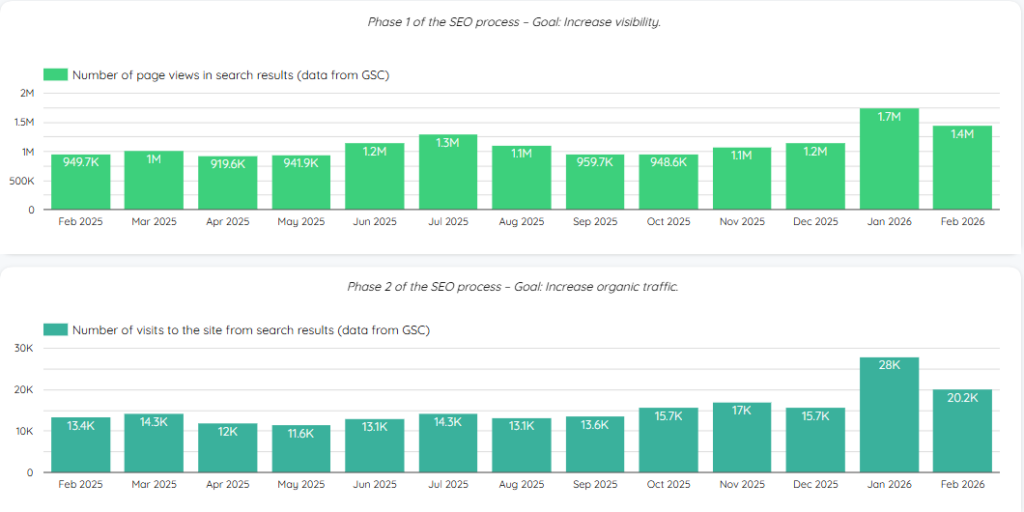
In the first stage of the project, we increased the website’s visibility on Google from around 1 million to 1.7 million impressions per month. In the next step, this translated into an increase in organic traffic – the number of visits from the search engine reached 28,000 per month, more than double the baseline. This allowed us to establish a solid foundation for further increasing conversions and revenue.
The website’s visibility increased by over 50% year-on-year, with the largest increases seen for long-tail phrases. This confirms the effectiveness of a strategy based on capturing more specific queries.
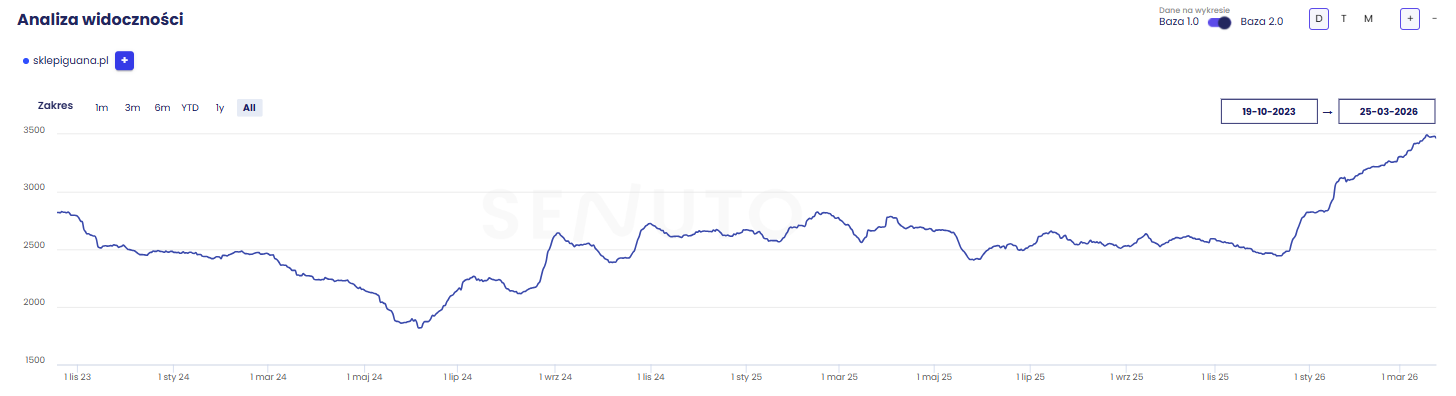
The website began to appear in a significantly greater number of search contexts, which translated into more diverse and high-quality traffic. Thanks to a consistently implemented SEO strategy, the number of phrases visible on Google rose from around 2,000 to nearly 3,500 keywords. Particularly dynamic growth was evident in the final stage of the collaboration, which resulted in record visibility for the website and greater potential for generating organic traffic.
The most significant result was the increase in revenue from SEO. Importantly, the rate of revenue growth was higher than the growth in traffic, which clearly indicates an improvement in the quality of users acquired.
For over six months, revenue remained at a relatively stable level, with month-on-month fluctuations not exceeding a dozen or so per cent. The breakthrough came in the final phase of the SEO process, when a marked increase in sales growth was recorded.
Compared to the baseline, revenue increased by approximately 70–90%, and at its peak reached a level nearly three times higher than during the previous period of stability. A natural correction followed the record-breaking month, yet the result remained approximately 60–80% higher than before the optimisation measures were implemented.
The winter season brought record sales results, which was a direct result of the earlier preparation of the category and better alignment of content with purchasing intent.
Start boosting your brand's online presence!
Delante is your path to success!



The Iguana case shows that in highly seasonal eCommerce projects, SEO should not be treated as a traffic acquisition channel, but as a tool for preparing sales.
The key success factors include:
As a result, SEO became a stable and scalable source of revenue that not only responds to demand but actively captures it.
This is not the final stage of the project. It is the point at which SEO starts to function as a predictable growth engine – ready for further optimization and scaling in the coming seasons.