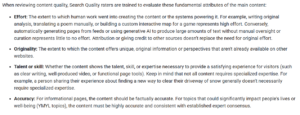
The second element is originality.
Google has long encouraged publishing original information, analysis and research. Now it ties this principle even more closely to the assessment of a page’s main content. This matters especially in the world of generative AI. A model can produce a plausible-sounding article in seconds, based on information that already exists online. Material like that does not necessarily add any new value, though.
That is why, alongside the question:
“Is this text good enough to publish?”
it is worth asking a second one:
“What will users find here that they won’t find in the next five search results?”
This could be proprietary data, expert experience, a product test, a methodology, a case study, photos, a specialist’s commentary, a calculator, a comparison or the results of work done specifically for the piece.
Originality does not have to mean conducting a major study for every article. If the content is being created for a client, it is worth asking someone who really knows the subject for even two or three sentences of their own commentary.
What does the problem look like in practice? What do customers ask about most often? What does the company observe in its own data? Is there an exception to the rule that existing materials do not cover? A few sentences like these can add more to an article than yet another paragraph generated from information already available in the search results.
It is precisely the knowledge that exists inside an organization that can be one of the most valuable sources of original content in the age of AI.
In practice, the role of the content process is changing too. What is becoming increasingly important is drawing out knowledge from the client and their experts, and then turning it into content that is useful to the audience.
How Do We Ensure Originality When Creating Content for Our Clients?
At Delante, our content creation process builds on the knowledge and materials our clients provide: from their Tone of Voice and brand communication guidelines, through expert materials and product knowledge, to information from the people involved in a given process. This lets us reflect the brand’s perspective and its experts’ experience in the content, instead of limiting ourselves to information available in the search results.
For large brands, another important part of the process is detailed subject-matter, product and legal review, as well as following the brand’s communication guidelines, such as lists of approved and banned words and phrases, approved claims and specific communication rules. These are resources an AI model simply does not have on its own.