Author


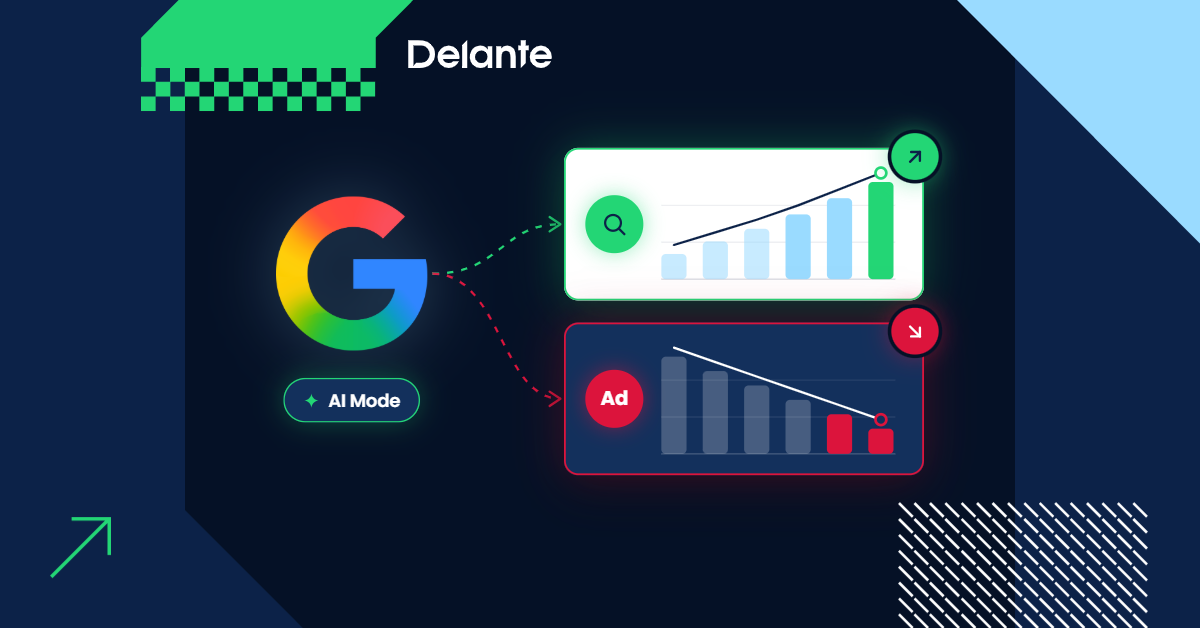
Google has confirmed that AI Mode currently generates less advertising revenue per search than traditional Google Search, even as AI-powered queries drive a surge in search activity. During Alphabet’s Q3 2026 earnings call on October 28, Google revealed that Search revenue grew 12% year over year to approximately $63.3 billion, while search query growth reached its fastest pace in five years. At the same time, Google announced the international expansion of ads in AI Mode and new multi-turn advertising formats in the United States. What does this mean for Google Ads advertisers, SEO, and the future of AI-powered search?
Importantly, lower AI Mode monetization was not the only reason for slower Search revenue growth. Google identified currency movements as the largest factor, alongside changes in advertising spending across specific industries.
For advertisers, the key development is that more Google searches do not necessarily create proportionally more advertising revenue, impressions, clicks, or conversions. AI-powered search is changing both user behavior and the way Google monetizes commercial intent.
On October 28, 2026, Alphabet published its third-quarter financial results.
During the earnings call, analysts questioned why Search advertising revenue growth had slowed despite a substantial increase in search activity.
Philipp Schindler, Google’s Chief Business Officer, acknowledged that the rapid growth of AI Mode was contributing to the slowdown because AI Mode queries were being monetized less effectively.
He explained that the company was seeing:
“lower monetization we were seeing in AI Mode.”
This is one of Google’s clearest acknowledgments that AI-powered search currently operates under different advertising economics from traditional search results.
However, Schindler identified several factors behind the change in revenue growth.
The largest contributor was foreign exchange.
He also pointed to industry-specific developments, including changes in retail advertising spending in Asia-Pacific markets and a normalization of media and entertainment budgets after unusually high spending associated with the FIFA World Cup in Q2.
Lower AI Mode monetization was another contributing factor.
Google did not reveal exactly how much less revenue an AI Mode query generates or quantify its contribution to the overall slowdown.
That distinction matters for advertisers and analysts interpreting the company’s financial performance.
Alphabet reported total quarterly revenue of $127.6 billion, representing 25% year-over-year growth.
Google Search & other generated approximately $63.3 billion, up 12%.
| Metric | Q3 2026 | YoY Change |
| Alphabet total revenue | $127.6 billion | +25% |
| Google Search & other | $63.3 billion | +12% |
| Google Services | $96.3 billion | +11% |
Source: Alphabet Q3 2026 earnings, published October 28, 2026.
Google Search revenue growth has nevertheless decelerated over the course of the year.
It reached 19% in Q1 2026, 17% in Q2, and 12% in Q3.
At the same time, CEO Sundar Pichai reported that Search query growth had reached its fastest year-over-year pace in five years.
Google did not disclose the precise increase in queries.
The apparent contrast highlights an important business challenge: Google is attracting more search activity, but not all of that additional activity has the same advertising value as traditional searches.
For marketers, this does not indicate a decline in Google Ads performance across the board.
It indicates that Google’s search ecosystem is evolving, creating new user behaviors and advertising opportunities that may not follow established monetization patterns.
One of the most important announcements for international advertisers came alongside Alphabet’s earnings report.
On October 28, Google confirmed that it was expanding ads in AI Mode to 10 additional markets.
<grid columns={2} gap={2}>
<grid-item>
<box background=”surface-secondary” radius=”md” padding={3} gap={1}>
**Asia-Pacific**
Australia, India, Malaysia, New Zealand, Pakistan, the Philippines, Singapore
</box>
</grid-item>
<grid-item>
<box background=”surface-secondary” radius=”md” padding={3} gap={1}>
**Africa and North America**
Kenya, Nigeria, Canada
</box>
</grid-item>
</grid>
Google also announced plans to expand ads in AI Mode to additional markets during Q4 2026, including:
The exact timing and eligibility of these additional launches may vary.
The announcement does not mean AI Mode advertising is available in every country where AI Mode itself can be used.
Advertisers should check Google’s official documentation and account-level eligibility before planning campaigns around these placements.
Google also announced the introduction of multi-turn ads in AI Mode in the U.S.
These advertisements can appear during follow-up questions, rather than only alongside the first search response.
This matters because AI Mode supports conversational search journeys in which users refine their needs over multiple interactions.
For example, a shopper might begin by asking about suitable laptops, narrow the comparison by budget, and then request specific product recommendations.
A relevant sponsored placement could appear later in that process, subject to Google’s advertising systems.
This creates a different advertising environment from a conventional search results page, where advertisers typically compete for attention following an individual query.
Google has confirmed the monetization gap but has not published a comprehensive explanation of the causes.
However, its statements provide several insights into the challenges associated with conversational search.
Google has indicated that many AI Mode queries involve upper-funnel research.
Users may explore a problem, understand their options, or compare solutions before developing a clear intention to purchase.
Consider the difference between two queries:
Traditional Search: “best running shoes women”
AI Mode: “I’m training for my first half marathon, mostly running on pavement. Which shoes should I consider if I have a $150 budget and need additional cushioning?”
The second query provides substantially more context.
However, it may represent a different stage of the buying journey.
The user could still be researching several options rather than being ready to complete a purchase.
For advertisers, greater context may create opportunities for relevant messaging, but it does not automatically translate into immediate conversions.
A traditional Google query can display a familiar combination of paid and organic search results.
In AI Mode, users can engage in longer conversations, request explanations, compare information, and ask follow-up questions.
Some interactions may have little immediate commercial relevance.
Others may indicate strong purchase intent.
Google must determine when advertising adds value rather than disrupting the experience.
That creates a more complex monetization challenge than simply displaying ads alongside every AI-generated response.
Google is experimenting with placements across AI Overviews and AI Mode.
The company says its initial advertising tests have delivered encouraging results.
During the earnings call, executives reported that click-through rates for sponsored product listings and organic product listings in AI Mode were already similar.
However, this finding has important limitations.
It concerns a specific comparison between product listings, based on Google’s internal research.
Google did not publish the underlying click-through rates or provide equivalent comparisons for all ad formats.
Comparable click-through rates do not establish comparable ROAS, conversion rates, or revenue per query.
Advertisers should therefore distinguish early engagement signals from confirmed commercial performance.
Another significant finding from Alphabet’s earnings call concerns how people use Google AI Mode.
According to Sundar Pichai:
These figures reflect a major change in search behavior.
Instead of relying only on short keyword phrases, users can communicate more complex needs, constraints, and preferences.
They can also upload images or documents, use voice input, and continue conversations with additional questions.
For international businesses, this increases the importance of understanding the full customer journey rather than focusing exclusively on individual keywords.
A global retailer, for example, may need content that addresses different customer preferences, product specifications, compatibility requirements, and regional purchasing conditions.
We explored these challenges in our article How to Prepare a Global Brand for the Era of Conversational Search.
The key principle is that search visibility increasingly depends on how effectively a brand answers complex questions and helps customers make decisions.
Although both experiences use generative AI, AI Mode and AI Overviews are not identical.
AI Overviews are AI-generated summaries displayed within Google’s conventional search results experience.
AI Mode provides a dedicated conversational search environment where users can ask complex questions and continue exploring a topic through follow-up interactions.
The advertising implications differ.
An ad displayed alongside an AI Overview appears in the context of a conventional search results page.
An ad in AI Mode may be presented within a more extended conversation and can potentially relate to the user’s evolving needs.
Both surfaces can display clearly labeled sponsored content, but they may offer different placements, eligibility rules, and user experiences.
Google explicitly states that paid advertising does not influence the organic answers generated by its AI systems.
This distinction matters for businesses investing in both paid advertising and organic AI visibility.
A company’s presence in an AI-generated answer is not the same as purchasing an advertising placement.
For additional background on the organic experience, see our article How Does AI Overviews Ranking Work?.
Google’s latest results should not be interpreted as a signal to immediately reduce Search advertising budgets.
Nor should advertisers assume that new AI Mode placements will automatically outperform traditional Search campaigns.
For businesses, the more useful takeaway is that the relationship between search activity, advertising exposure, clicks, and conversions is becoming more complex.
Google may process more queries while users complete a larger share of their research within AI-generated experiences.
In these situations, users can learn about products or brands without immediately visiting a website.
From an advertiser’s perspective, this means search volume alone may become a less complete indicator of acquisition opportunities.
The same principle applies to organic visibility.
A brand could appear in an AI-generated recommendation without receiving an immediate click.
That exposure may still contribute to awareness or a later purchasing decision, although its business impact must be measured carefully.
Traditional keyword targeting remains important, especially for searches with clear commercial intent.
However, longer conversational queries create opportunities to understand a customer’s needs in greater detail.
Advertisers should examine the questions customers ask before purchasing, including:
These insights can inform advertising messaging, landing pages, product feeds, and organic content.
It does not mean that advertisers can access the complete text of every user’s AI Mode conversation.
Available targeting and reporting capabilities remain subject to Google’s product rules and privacy controls.
The October 2026 expansion demonstrates that AI Mode advertising is no longer limited to a single market.
However, availability remains uneven.
A business advertising in Canada or Australia may face a different set of opportunities than one advertising in the United Kingdom or Germany.
Campaign planning should account for the availability of placements, supported languages, product eligibility, and current reporting capabilities.
International advertisers should also evaluate performance separately by market rather than assuming one country’s results will apply globally.
Google’s early test results are encouraging, but the company has not published a comprehensive benchmark comparing AI Mode advertising with traditional Search campaigns.
For advertisers, the priority should remain measurable business performance.
Relevant metrics include conversion rate, cost per acquisition, ROAS, lead quality, and revenue.
Where reporting allows, advertisers may also analyze differences between AI-powered placements and conventional Search activity.
However, if Google Ads does not provide a reliable breakdown for a particular placement, businesses should avoid presenting modeled or estimated performance as confirmed results.
Delante’s Google Ads Audit focuses on budget allocation, attribution, campaign efficiency, and return on advertising investment.
These fundamentals remain essential as Google introduces new advertising experiences.
Conversational search affects both paid and organic visibility.
While Google develops advertising placements for AI Mode, brands also need to consider whether their products, services, and expertise are represented accurately in AI-generated answers.
This is where AI Search Optimization (AISO) becomes relevant.
AISO focuses on improving brand presence, recognition, and representation across AI-powered search environments.
For businesses, the objective is not simply to maximize mentions.
It is to improve visibility among relevant audiences and understand how that exposure contributes to traffic, leads, and sales.
At Delante, we combine SEO, SEM, and AI Search Optimization to address different stages of the customer journey.
Organic AI visibility and paid AI advertising should support the same business objectives, even though they operate through different mechanisms.
Google’s earnings report does not justify making immediate, large-scale budget changes based on AI Mode monetization alone.
Instead, businesses should take a practical, evidence-based approach.
1. Review current Google Ads performance. Examine conversions, cost per acquisition, ROAS, and lead quality before changing budgets.
2. Confirm AI Mode advertising availability. Check whether relevant formats are supported in your target countries and accounts.
3. Revisit customer search intent. Identify the complex questions and comparisons that precede purchasing decisions.
4. Improve product and landing page information. Provide accurate descriptions, specifications, pricing, availability, and answers to common questions.
5. Monitor organic AI visibility. Evaluate whether AI Mode, AI Overviews, and other relevant AI systems represent your brand and products correctly.
6. Measure performance across the customer journey. Combine available data from paid search, organic search, AI referrals, and conversions without assuming all interactions can be attributed precisely.
The objective is to prepare for AI-powered search while continuing to optimize the channels that already generate measurable results.
Google plans to continue expanding advertisements in AI Mode and AI Overviews.
The October 28 announcement includes new international markets and multi-turn ads in the United States.
The company expects improved advertising opportunities as AI-powered search adoption increases.
However, Google has not provided a timeline for when AI Mode monetization might match traditional Search.
It has also not disclosed the exact advertising revenue generated per AI Mode query.
For marketers, the key developments to monitor are geographical availability, new ad formats, advertiser controls, reporting capabilities, and confirmed conversion performance.
Google’s Q3 2026 results highlight a fundamental shift: AI is generating more search activity, but Google is still developing the advertising model needed to monetize that activity as effectively as traditional Search.
For businesses, the opportunity lies in understanding how customers search, compare, and make purchasing decisions across both conventional and AI-powered experiences.
As Google expands AI-powered search and advertising, businesses need to understand where their customers discover products, how their brands appear in AI-generated answers, and which channels deliver measurable results.
At Delante, we combine Google Ads, SEO, and AISO to help companies build effective strategies across traditional and AI-powered search.
Whether you’re reviewing existing advertising performance or preparing for emerging AI search opportunities, our team can help you identify where to focus your investment.
Explore our Google Ads Audit and AISO services, or contact Delante to discuss your international search strategy.