Can Regulated Industries (Finance/Pharma) Earn Recommendations in ChatGPT and Gemini?

5min.

Comments:0

07 April 2026

SEO
Can Regulated Industries (Finance/Pharma) Earn Recommendations in ChatGPT and Gemini?d-tags
Can brands in highly regulated sectors like medicine, pharmaceuticals, or finance secure mentions in answers generated by AI models like ChatGPT and Gemini? Yes, but it requires a highly strategic approach to AISO (AI Search Optimization). Operating in the YMYL (Your Money or Your Life) sector demands rigorous work on authority and credibility, both on-site and off-site. Discover how to craft a strategy that satisfies your legal department's strict requirements while remaining perfectly AI-friendly.

5min.

Comments:0

07 April 2026

Compliance and AI Visibility – Can Legal Restrictions Actually Help?

As a CMO in a regulated industry, you undoubtedly face this challenge daily: you and your team plan a brilliant strategy and content calendar, only for the Legal/Compliance department to crush most initiatives in their infancy out of fear of massive fines from regulatory bodies like the FDA, EMA, or SEC. The second challenge? AI tools notoriously refuse to answer user questions about medications or investments, hiding behind the standard disclaimer: “I am not a doctor/financial advisor and cannot provide advice on this topic.”

How do you navigate this? The strict legal restrictions imposed by your Compliance team, while frustrating and seemingly limiting from a marketing perspective, are actually your greatest allies in building AI visibility. In the medical and financial sectors, Large Language Models (LLMs) actively filter out websites with heavily persuasive, marketing-driven messaging. Instead, they search for hard, safe, objective facts they can use to generate risk-free answers for the user.

If your Compliance department ensures that the content on your website is objective, data-backed, and research-driven, you already have the perfect foundation for building visibility in AI responses. However, this requires strategic AISO support on two fronts: on your own website (on-site) and through external publications (off-site).

Why Does ChatGPT Reject Marketing in the YMYL Sector?

Before planning your AISO strategy, you need to understand what you are actually up against. In psychology, there is a phenomenon known as negativity bias. The creators of AI models (OpenAI, Google) intentionally baked this bias into their tools and algorithms on topics related to Your Money or Your Life, specifically to avoid legal liability for AI-generated medical or financial malpractice. Using a process called RLHF (Reinforcement Learning from Human Feedback), developers trained the GPT-4 model to avoid actively giving medical advice.

According to official documentation (1), all OpenAI algorithms are equipped with Guardrails, safety filters designed to prevent the models from answering high-risk questions. What does this mean for you?

  • ChatGPT would rather issue a flat refusal than mistakenly recommend the wrong heart medication, which could expose OpenAI to multimillion-dollar lawsuits.
  • Therefore, in regulated industries, you aren’t fighting your competitors for the AI’s attention. You are fighting its safety filters. Your messaging cannot sound like a sales pitch; it must read like an objective encyclopedia, delivering straightforward, factual information.

The Two Pillars of AISO in Regulated Industries

As mentioned, if a brand wants to appear in AI-generated answers, it must develop a dual-track strategy:

Pillar 1: On-site (AI-Friendly Content)

Even in industries bound by strict regulations, AI bots constantly crawl websites to find facts, since not all YMYL queries involve high-risk areas. For example, if a user asks ChatGPT, “Where can I buy asthma medication X online?”, the model’s job isn’t to recommend a drug or give medical advice; it’s simply to find information on logistical availability. An LLM will have no problem answering this type of query.

How do you optimize your site to appear in AI answers for these types of questions?

  • Implement structured data (Schema.org) for your products, financial services, and FAQ sections.
  • Ensure a clear information architecture. Do not hide crucial elements behind JavaScript clicks (most AI models struggle to parse data presented this way effectively).
  • Adhere strictly to E-E-A-T guidelines: prominently display information about the corporate entity, content authors (ideally licensed doctors or financial experts), and properly cite medical/financial sources.
This last point is critical, especially in light of the latest updates to the Google Search Quality Rater Guidelines regarding YMYL sectors. According to these rules, generative AI systems will bypass domains lacking visible signals of authority, such as expertly authored, bylined content, deeming them too risky to cite (2).

Pillar 2: Off-site (External Informational Content and e-PR)

This is where things usually get complicated for Compliance departments, as the law explicitly forbids advertising pharmacies or prescription drugs. The solution is to change the vector: instead of publishing ads, publish information.

AI models map semantic connections based on Entity Resolution. Your job as a Marketing Manager is to build a strategy that teaches the algorithm that your brand (Entity A) is closely and factually linked to, for example, innovative diabetes treatments (Entity B). How do you achieve this?

  • Publish high-quality, educational, and scientific articles on independent, authoritative industry portals (medical or financial journals), entirely free of CTAs or persuasive language.
  • Execute e-PR campaigns, publishing press releases about breakthrough research conducted by your company or new clinical trials.

Through these actions, when a patient asks ChatGPT about scientific research on diabetes treatments, the model will cite your research in response to strong signals from trusted external domains. This process is called Trust Anchoring, establishing your credibility by leveraging the authority of other highly valued industry websites.

e-PR

We will build your company's expert image and ensure its visibility in top-tier media.

Contact us!
Ania Bitner
Ania Bitner Content Team Leader

AISO in the Medical Sector – A Step-by-Step Blueprint

To help Marketing Managers visualize this mechanism in action, we’ve prepared two operational scenarios for the pharmaceutical and medical industry.

Example 1: The On-site Pillar for a Pharmacy Chain

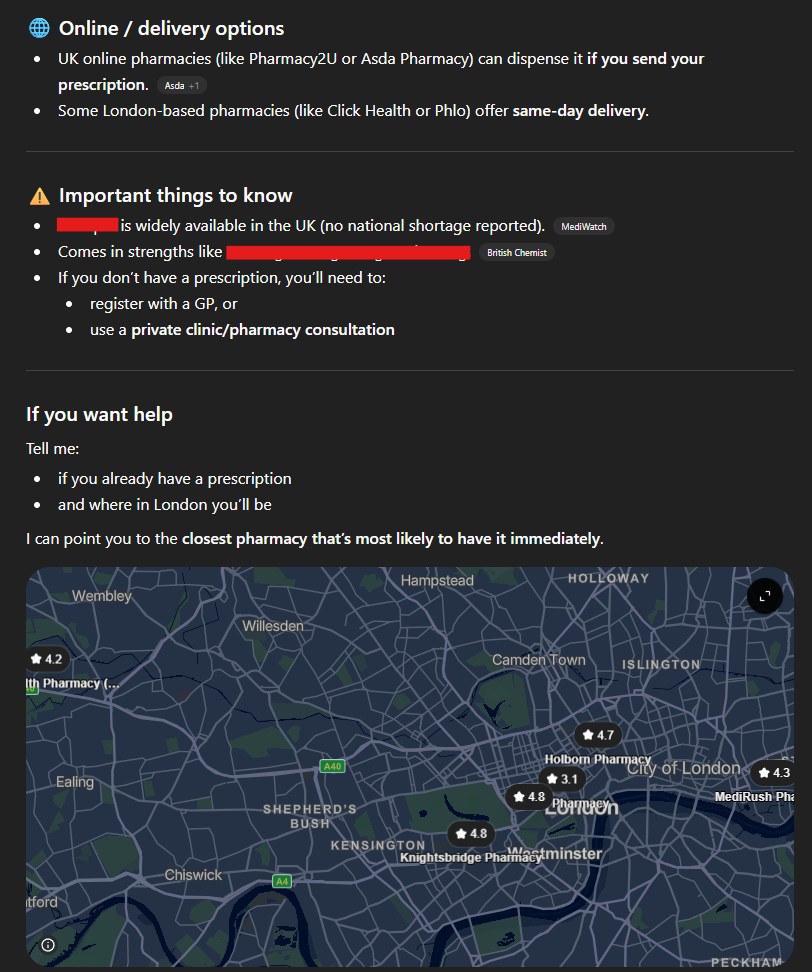
  • The Situation: A user prompts ChatGPT (with web search enabled): “I urgently need medication X in London. Which online pharmacy allows me to reserve it for local pickup?”
  • The AISO Action: The pharmacy chain cannot legally advertise this drug. However, the IT/SEO department can implement Pharmacy and Product, alongside dynamic ItemAvailability tags, feeding the models precise information about the drug’s stock levels at that specific location.
  • The Result: ChatGPT bypasses its medical guardrails because the query is purely logistical; the user isn’t asking for a recommendation or a diagnosis. It responds: “According to current information from Pharmacy X, this medication is available for reservation in London at this location. Please note that a prescription is required.” The pharmacy acquires a customer without violating any advertising laws because the interaction is based entirely on the exchange of factual data.

Source: ChatGPT, example of model response

Example 2: The Off-site Pillar for a Pharma Company and a Rare Disease Drug

  • The Situation: Pharmaceutical Company Y releases an innovative therapy but, due to strict regulations, cannot run Google Ads targeting patients or advertise the new therapy in any traditional way.
  • The AISO Action (e-PR): Instead of writing sales copy, the company publishes a series of whitepapers, objective clinical trial summaries, and interviews with the lead researcher on highly authoritative medical portals (e.g., The Lancet or PubMed).
  • The Result: When a patient asks Gemini, “What are the new treatment alternatives for Disease Z?”, the risk-averse AI model will only pull from the most trusted publications. It answers: “Recent clinical trials conducted by Pharmaceutical Company Y indicate a new treatment pathway…” The company successfully positions itself as an expert at the very source of the patient’s journey, with the full approval of the Compliance department.

AI Visibility for Regulated Industries – Key Takeaways

    • Regulated industries can earn mentions in AI responses, but it requires a dedicated AISO (AI Search Optimization) strategy.
    • Content that strictly adheres to the Compliance department’s guidelines is highly effective for AI models, as these tools prioritize reliable, informational content over promotional messaging.
    • A strategy for YMYL sectors must be executed on two fronts:
      • On-site efforts: Focusing on schema implementation, clean information architecture, and building authority in line with E-E-A-T guidelines.
      • Off-site efforts: Publishing informational articles and press releases on high-authority, trusted industry websites.
    • Ultimately, AISO success in these sectors requires seamlessly blending Compliance guidelines with technical SEO, e-PR, and content strategies.

    With us, you can build massive AI visibility without ever conflicting with your Compliance department. At Delante, we have years of experience working with regulated industries. We know exactly how to navigate the complex intersection of legal restrictions, strict YMYL guidelines, and LLM algorithms. We will show you how to organize your on-site content and build off-site authority to become the definitive expert voice in your market.

    Sources:

    1. https://cdn.openai.com/papers/gpt-4-system-card.pdf
    2. https://guidelines.raterhub.com/searchqualityevaluatorguidelines.pdf

    AISO for Regulated Industries

    We will develop a highly effective AI search optimization strategy for your business!

    Let's talk!
    Michał Grzyb
    Michał Grzyb SEO & AI Specialist
    Author
    Michał Grzyb - Junior SEO Specialist
    Author
    Michał Grzyb

    SEO & AI Specialist

    Graduate of Management at the Cracow University of Economics. His interest in internet marketing and SEO began during his studies and led him to start working at Delante in August 2022. Expert in building visibility in traditional search engines and AI models. Privately a lover of physical activity in any form and good food.

    Author
    Michał Grzyb - Junior SEO Specialist
    Author
    Michał Grzyb

    SEO & AI Specialist

    Graduate of Management at the Cracow University of Economics. His interest in internet marketing and SEO began during his studies and led him to start working at Delante in August 2022. Expert in building visibility in traditional search engines and AI models. Privately a lover of physical activity in any form and good food.

    FAQ

    How do I convince the Legal/Compliance department to implement an AISO strategy?

    Your legal department is actually your greatest ally in the AI world. Lawyers ensure that you don’t use sales-heavy language in YMYL sectors, which is exactly what AI models filter out. Explain to your Compliance team that AISO is not about writing advertisements; it’s about the digital organization of facts, supplying AI models with entity information, and distributing scientific/research knowledge through an off-site strategy.

    Why does ChatGPT cite Wikipedia instead of our official website when asked about our products?

    AI models treat Wikipedia as an objective, unbiased source of information. If your website focuses solely on “advertising” the product and lacks hard, technical definitions and structured data, the AI will deem your brand a biased source. You must implement a structured data architecture and secure objective external citations (e-PR) to wrestle those mentions away from Wikipedia.

    Do keywords still matter in the medical and financial sectors?

    In the AI era, we are transitioning from keyword optimization to entity optimization. AI models do not care how many times the exact phrase “hypertension medication” appears on a page. Instead, they analyze semantic vectors to verify whether the content surrounding that topic exhaustively covers the subject and is linked to a verified authority. This is why content quality and building domain trust are now your highest priorities.