

How does the AI Overviews ranking work?

5min.

Comments:0

20 December 2025

How does the AI Overviews ranking work?d-tags
Are you wondering how to make your company appear in AI Overviews’ responses? To ensure your presence in AIO, you first need to understand how the mechanism itself works. In today’s article, we take a look at Google’s AIO module and suggest what actions you should focus on to increase your chances of being cited. Read on to learn more!

5min.

Comments:0

20 December 2025

Fan-out queries, RAG, and grounding – how does the AIO mechanism work?

First, here are a few terms to help you understand how Google generates responses to user queries in the AI Overviews section.

1. Fan-out queries

The AIO mechanism begins by breaking the user’s query into its constituent parts, known as “fan-out queries.” This involves analyzing the prompt entered and breaking it down into related phrases. How does it work in practice? You can check it out with this tool, which will show associated queries after you enter a sample prompt: https://queryfanout.ai/. Let’s say a user asks Google, “What are the best SEO agencies in Poland?” The breakdown of phrases for such a query might look like this:
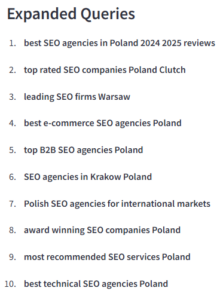
fan out queries

Source: queryfanout.ai

In a nutshell, Google first tries to match a more complex query to related keywords.

In the next step, for these queries, the algorithm queries the Google index to retrieve data and broader context. From an exhaustive list of available sources, the system selects the most meaningful “chunks,” or fragments of text, that it can directly use to construct a response. The goal is to select sources from this exhaustive list that complement each other rather than duplicate information, which is why unique content is particularly important here.

2. RAG

The second key concept in the context of AI Overviews is RAG. This is a technique widely used in LLM tools that aims to reduce hallucinations. The idea is that the model should not “make up” answers, but should rely on reliable sources and provide answers that are as correct and contextually relevant to the query as possible.

How does it work? The RAG system is a connection between the AI model and a database – in the case of AI Overviews and AI Mode, this “database” is the Google index. In this database, we place documents that we want the model to treat as a source of knowledge for generating answers.

3. Grouding

The third concept that helps to understand how AIO works is grounding. Again, this is a mechanism designed to reduce hallucinations, but it works later. Once the model has generated a response, it reexamines the result and compares it to the content of the sources. On this basis, it verifies that the response it has prepared does not deviate from the source material in terms of content.
The mechanisms of AIO described above show how it differs from the traditional search results we have known so far. “Behind the scenes,” in the case of AI Overviews, this process looks different, and this should be kept in mind when planning a strategy for a brand’s presence in this section.

How are AI Overviews answers constructed, and where can we find them?

Do AI Overviews always appear at the top of search results? The answer is no! The layout of the results page depends on what Google considers most valuable to the user in the context of a given query. Sometimes an ad will be higher up, sometimes a map with Google Business Profiles, and sometimes video results.

The part that will be most important to many companies, i.e., the list of cited sources, will not always be clearly visible.

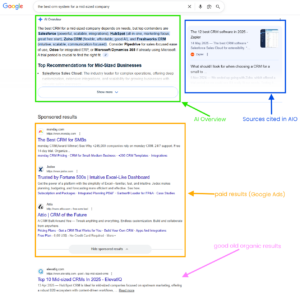
The most common variant is AIO: cited sources on the right, ads below, and only then the good old organic results.

ai overviews

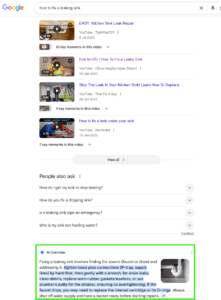
Another option is video results. This layout is especially common for phrases such as “how to do something,” i.e., those where a tutorial recorded in video form may be most useful to the user. In this layout, AIO results appear only below the video and the People Also Ask sections.

ai overviews

The content of AI Overviews answers, and their structure (placing cited sources in a separate side section) means that there are virtually no clicks from this section. After AIO was introduced, many websites saw an average decline in organic traffic of around 30–40% overall. However, for phrases where AIO results are shown, the decline is often around 80–90%.

What types of phrases does AIO display most often?

According to a report from Senuto’s AI Overviews analysis, Know Simple queries, i.e., simple informational queries, most often have an AIO result, accounting for 57.82% of the cases analyzed. It is phrases with this intent that most often appear in this section, compared to other types. Other industry sources also confirm this.

This means that AIO will most often apply to typical “knowledge” phrases intended to quickly provide the user with information on a given topic. For companies that previously relied on monetizing organic traffic acquired on such phrases, this means they will have to change their business model.

What does this mean for brands? AI Overviews should not be thought of in the context of traffic acquisition. As mentioned above, organic traffic to websites has been declining since the introduction of this solution, because users get the answer on a plate and no longer need to visit the website. In the context of AIO, presence will be significant mainly in the form of mentions (e.g., brand recommendations, graphics displaying logos, and citations as a reliable source of information), and only secondarily in the form of citations (i.e., links to the website).

AI Overviews results thus become another point of contact between the user and the brand, similar to social media, where the goal is not to generate traffic to the website, but to build brand recognition.

How to get into the AI Overviews answers?

  • A well-thought-out content strategy – in the context of the aforementioned fan-out queries mechanism, i.e., breaking down the prompt into related keywords, it is important to build thematic clusters rather than individual entries. Industry issues should be covered across all aspects, and it is also worth remembering to use internal linking between thematically related content.
  • Information gain – Google likes to choose sources that bring something new to AIO responses. Rewriting the content of competitors’ articles will not help you get quoted. Therefore, enrich your content with data, statistics, case studies, and your own conclusions.
  • New content formats – the aforementioned example of tap repair shows that sometimes video results win out over standard text on a website. In addition to a blog, consider a YouTube channel.
  • Infographics and photos – graphics often appear at the top of AI Overviews results, and this is your chance to get noticed by users. Create valuable infographics with your logo to build brand recognition.
  • Logical content structure – in the articles themselves, try to focus only on the topic at hand, write specifically, and remember to use a structure with headings, short paragraphs, and bulleted lists.

Monitoring and toolswhat will be useful in the context of AIO?

Now that you know how the AIO response mechanism works, what phrases it appears for, and what can help you appear in them, it’s time to verify your actions. How can you monitor visibility in AIO?

At the moment, there is no official solution from Google – the introduction of data differentiation to Google Search Console has been announced, but with no specific dates. It is also worth noting that monitoring visibility in AIO poses many challenges, as results are personalized and responses to the same query may vary by user.

What are the options at the moment? Many popular SEO tools offer visibility monitoring in AIO. These include Ahrefs, Senuto, and Semrush. Another interesting option is ZipTieDev, which allows you to track not only citations, but also brand mentions and sentiment, i.e., whether the brand is mentioned in a negative or positive light.

AI Overviews rankingwhat is worth remembering?

    • The AIO mechanism first breaks the query into phrases (fan-out queries), then retrieves key fragments from the Google index (RAG), and verifies the answer against sources (grounding).
    • It is most often displayed for simple informational queries.
    • How to increase your chances of appearing in AIO:
      • create unique content and thematic clusters,
      • add your own data, conclusions, statistics (information gain),
      • use videos, infographics, and graphics with your logo,
      • ensure a logical, clear structure.
    • You can monitor your visibility in AIO using tools such as Ahrefs, Senuto, Semrush, and ZipTieDev.

At Delante, we constantly analyze AI Overviews results and help our clients position themselves in AI tools using individual AISO (AI SEO) strategies. If you want your brand to be present in AI tools, contact us!


Sources:

https://insight.senuto.com/aio-report/

Author
Wojciech Urban - Senior SEO R&D Specialist
Author
Wojciech Urban

Senior SEO R&D Specialist

R&D specialist in SEO and web analytics. He feels most comfortable in the area of technical SEO, and his main task is to ensure that websites are optimized for search engines and achieve high rankings in search results.

Author
Wojciech Urban - Senior SEO R&D Specialist
Author
Wojciech Urban

Senior SEO R&D Specialist

R&D specialist in SEO and web analytics. He feels most comfortable in the area of technical SEO, and his main task is to ensure that websites are optimized for search engines and achieve high rankings in search results.

FAQ

How does Google select sources for AI Overviews?

Google breaks down the user’s query into related phrases (fan-out), retrieves the most valuable snippets from the index (RAG), and then checks their consistency with the generated response (grounding). Unique, complete, and substantive sources are selected.

Do AI Overviews affect organic traffic?

Yes. The introduction of AIO causes a significant drop in clicks – up to 80–90% for phrases where this section is displayed. Therefore, the brand’s presence in the response becomes more important than website traffic.

How can I get my website cited in AI Overviews?

The key is to create unique content with real value (information gain), build thematic clusters, add video and infographics, and ensure a clear, user-friendly text structure.