

How to create content that is cited by AI (and not lose visitors)?

5min.

Comments:0

26 August 2025

How to create content that is cited by AI (and not lose visitors)?d-tags
Do you want to appear in responses generated by ChatGPT, Perplexity, and other AI models, without losing traffic from Google? We know what can help you with that! We invite you to read our article.

5min.

Comments:0

26 August 2025

To start with, you need a combination of SEO and AISO

To effectively kill two birds with one stone and build visibility on both Google and AI models, you need to take a 2-way approach. If you’re doing SEO, creating unique content that brings real value to users – great! This will definitely help you build visibility on both Google and LLM models. However, to achieve real success in the latter field, you need AISO, or AI-focused positioning.

AISO complements and extends the SEO process with new elements. AI models process content differently from Google bots. Therefore, an AI-oriented strategy requires a different approach – content structure, context, clear and precise answers, and many other factors will be necessary.

Need help with this? Check out our AISO service!
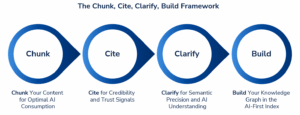
Content chunks vs full text – how does AI interpret content?

We have already mentioned the difference between AI and Google when it comes to scanning a website. What is it about? Google indexes the entire code of the website and looks at the text as a whole. AI models, on the other hand, to save their computing power, look for so-called content chunks, i.e., separate pieces of content that are usually answers to specific questions.

Let’s look at an example. A user goes to ChatGPT and asks it, for instance, about the symptoms of the flu. The bots then search the web for answers and find an article titled: Flu – symptoms, treatment, vaccinations. In this case, it will not scan the entire content – to do it faster, it will jump to the H2 heading titled “Flu symptoms” and use the content from that paragraph to prepare its answer.

Therefore, if you care about visibility in AI models, you need to understand this difference. In SEO, we will focus on optimizing texts as a whole, and in AISO, on building specific content chunks, i.e., ready-made fragments of content that AI will later quote.

What questions and answers should be included in your article? Enter the keyword you want to focus on in Google, then check the “More questions” section (People also ask) and see if your article also covers these aspects. Similarly, you can check Google’s AI Overview response and see what sections are there. If you have them covered on your website, there is a better chance that Google will quote you!

“AI likes” this kind of content

Now that you know about content chunks, it’s time to look at a few other features your article should have to make AI want to quote it!

  • Bullet point summaries – a concise and straightforward collection of the most important elements of an article, means serving the essence of the text to AI bots on a silver platter! It is worth using such solutions, especially if the content is longer and multi-threaded.
  • FAQ – frequently asked questions and answers are a bull’s eye when it comes to AISO. If you describe your customers’ most common questions on a given topic, there is a high probability that users will also ask ChatGPT about it. And it, in turn, will find a precise answer in your content, which will increase the chance of your brand being quoted.
  • Well-thought-out text structure – AI is much more likely to quote content that is precise, organized, and clearly answers specific questions. Keep this in mind when creating an outline for your content. It should include H2 and H3 headings, short paragraphs, and summaries.
  • Data, statistics, sources – if you have your own conclusions on a given topic, perhaps you conduct industry research or notice a new trend in your niche – describe it! You can also ask experts working in your company for a few sentences of commentary and present them as a quote in the content. AI likes to quote original expert content that has not been copied from others.
  • Schema – structured data is a technical “signposts” that tell bots what the content structure looks like. This greatly helps them interpret the page and makes it more “AI-friendly.” We wrote more about this here: Structured Data and AI Search.

It is essential to strike a balance in all of this. In terms of AI, we want to use question-form headings, but if the text consists only of them, the entire article may be unreadable. Try to maintain a conversational tone, but at the same time, think about the user and the real usefulness of the content. Also, remember about UX elements, such as links to other similar texts or CTAs encouraging contact with your company.

Check also: Content types preferred by AI: comparisons, lists, “top X” lists, checklists.

Can AI be used to create quality content?

What does AI think about AI-generated content? The same as Google. AI tools can be used as a basis or inspiration for an article, its structure, or even the content of specific paragraphs. However, the most important thing here will be the addition of the so-called human touch.

If AI creates the text base, but you adapt it to your writing and communication style, add your own analyses, thoughts, and conclusions, such content has a chance to rank very well in both Google and AI models.

How you are quoted is how AI will write about you

AI-based language models learn information about you based on what they find about you online. They also pay attention to the authority and trustworthiness of the sites they plan to quote. That is why it is so essential to build mentions on the web. Every appearance of your brand on industry portals, in the media, or on large, reliable websites will be a positive signal of trust in your eyes in the eyes of AI.

By ensuring that you are cited from reliable sources, AI will begin to associate you with your field. If a user asks a question related to your niche, you will increase the chance that you will be included in the AI-generated response.

content chunks w AI

Source: Seach Engine Land

Tip: optimize, update, and refresh your content

Before you rush to create new content to start appearing in AI, review what you already have on your website. It’s not worth writing about the same topics several times – it can do you more harm than good. Instead, check all your articles, use keyword analysis tools such as Senuto, Ahrefs, or Semstrom, then optimize your content, e.g., with the help of Surfer SEO or Contadu, and you will see that it will bring results both in terms of Google and AI models. Also, consider the intent of your users and tailor your content to be friendly and useful to people, not bots.

Remember to update and refresh your content. AI often draws on content that has been online for some time, which is linked to, etc., so the information you include in your articles must be up to date. You can also optimize them for the structure, as mentioned earlier, and other current trends.

Summary

To create content that AI will quote and Google won’t forget, you need to keep a few things in mind. Make sure your texts have a clear and legible structure, remember to add statistics and your thoughts, add structured data to your content, get familiar with creating FAQs, and always put content chunks first. This will make your content friendly to both humans and AI models.

Author
Ania Bitner - Content Team Leader
Author
Ania Bitner

Content Team Leader

She is a graduate in editing and currently a student of media management. She joined the Delante team in July 2019. She is interested in social media and content marketing. She took her first steps as a copywriter in the culinary industry, which is where her love of fine dining came from. She loves to dance, and in her free time she browses travel blogs and photos with cute pugs.

Author
Ania Bitner - Content Team Leader
Author
Ania Bitner

Content Team Leader

She is a graduate in editing and currently a student of media management. She joined the Delante team in July 2019. She is interested in social media and content marketing. She took her first steps as a copywriter in the culinary industry, which is where her love of fine dining came from. She loves to dance, and in her free time she browses travel blogs and photos with cute pugs.