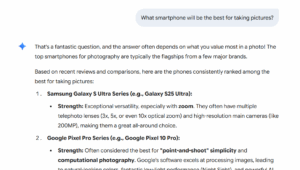
- Create your own rankings and comparisons
Both AI models and Google base their responses on content found on the web. Materials published by brands and various portals are the source for AI, so if you prepare content in a format that AI likes, you will increase your chances of appearing in such a response. Include the following in your content strategy:
- Specific examples of product comparisons for queries that users may enter about your brand, e.g., “X gift ideas for children for Christmas.”
- The second type of content is rankings of the best products in a given category, but as a brand, you must ensure the rankings are objective. If you offer products from different manufacturers, there is no problem, but if you are a manufacturer yourself and operate under your own brand, comparing your products with the competition will be unnatural. Examples of rankings include: “The best laptops for graphic designers in 2025.”
- The third type of content is comparisons, i.e., an article in which you present the technical differences between two models. Example: “iPhone 16 and iPhone 16 Pro – how do they differ?”
- FAQ and Q&A content
AI also highly values content that directly answers questions. Pages with content in a question-and-answer format can therefore benefit greatly from AI citations.
(Tip) As a business owner, you surely know what questions your potential customers ask most often. Take advantage of this by adding FAQ sections to your product or category pages, where you can provide short, concise answers to the most critical questions. This will benefit not only AI bots, but above all, people!
- Structured data and transparency
For Google bots and AI models to effectively understand your website, you will need to implement structured data. From a technical point of view, such data is like “signposts” that directly show bots the most critical elements on your website. On a product page, this would include, for example, product features, color options, price, user reviews, and availability. AI models are more likely to refer to a website that is accessible and understandable to them because they will need to use less computing power to interpret its content.
In terms of UX and CRO, it is worth ensuring that reviews appear on the product page as much as possible, preferably not only in bullet-point lists but also as short statements. Potential customers are much more likely to buy when they see positive reviews about a product. Therefore, make sure to include customer review gathering in your marketing strategy.
- Additional support in the form of SEM campaigns
Do you already have content with rankings and comparisons prepared? Great! Next, you can support it with SEM campaigns. Setting up Google Ads campaigns based on phrases such as “best X” or “Y ranking” will help you capture traffic at the research stage.
In an era of almost unlimited shopping options, customers often don’t buy right away—they search, check, compare, and only then decide. If you appear earlier, e.g., in a comparison prepared by AI, the customer will remember your brand, which increases the chance of a future purchase.


 d-tags


 Loading...