 d-tags


 Loading...
Update: April 2025
Spain is one of the biggest European countries. To see how rapidly the number of Spanish Internet users has increased, it’s enough to compare data from 2000, when only 5.5 million Spaniards used the Internet, and 2010, when the number exceeded 30 million. Today, more than 46 million Spanish people are active Internet users. SEO in Spain can make your company website more visible to local consumers who determine the demand for goods and services. So what to focus on when devising your business strategy?
Before you start doing SEO in Spain
1. Do Spaniards buy online?
Main reasons for using the internet in Spain
Source: Digital 2025 Spain
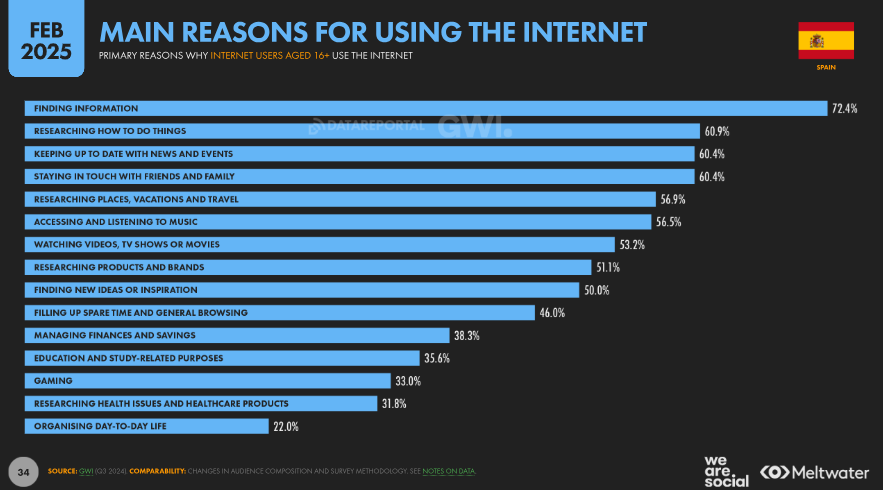
In Spain, people most often use search engines to find information, research how to do things, and stay up to date with news and events. If we want to carry out SEO in Spain and thereby increase sales of our products and services, we might be interested in whether the country’s residents are eager to shop online. This, of course, requires market research to assess local demand for specific goods. Valuable, although more general, insights can be gained by examining the overall attitude of the country’s residents toward online shopping.
Weekly online shopping activities in Spain
Source: Digital 2025 Spain
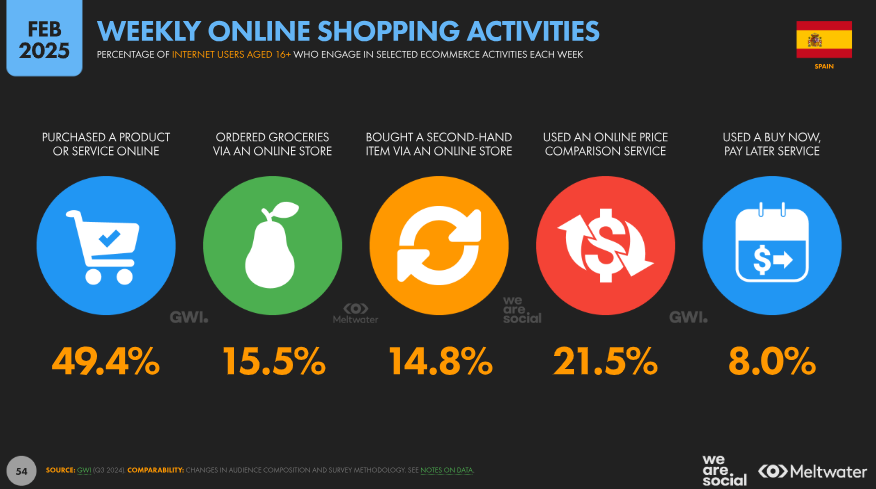
Nearly 50 percent of Spanish internet users make online purchases on a weekly basis (compared to almost 56% globally – source: GWI). More accurate insights can be obtained by analyzing online shopping expenditures per consumer.
Online share of consumer goods spend
Source: Digital 2025: online shopping still popping
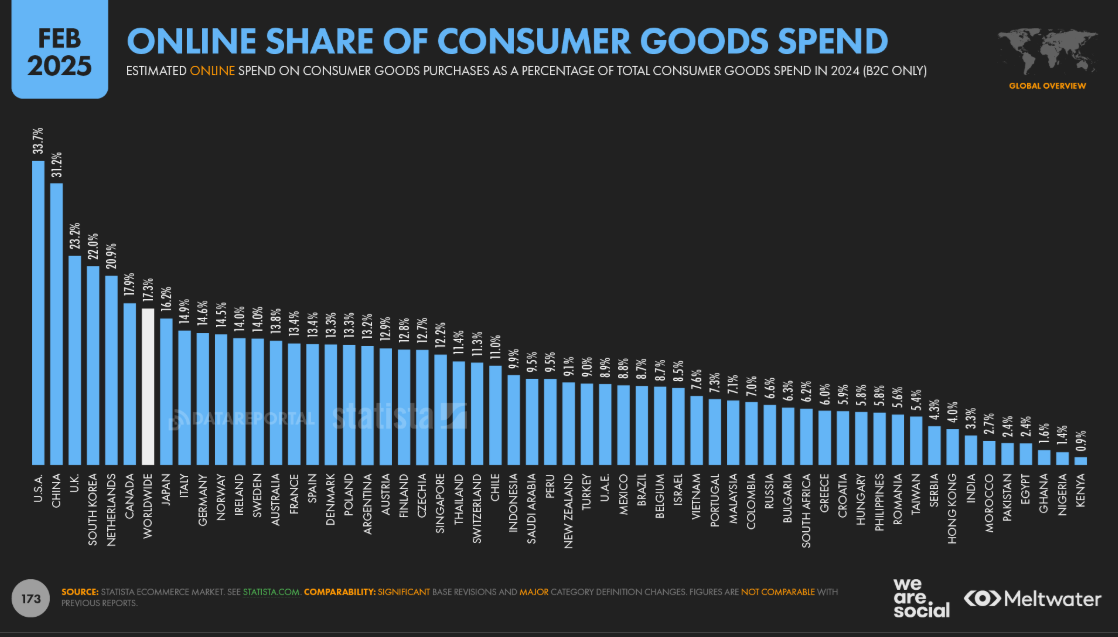
Purchasing goods online is becoming increasingly popular year by year. Such shopping is especially common in countries like the United States and China. A growing number of online purchases are also being made in countries such as the United Kingdom, South Korea, and the Netherlands. Spain, on the other hand, ranks lower, with online purchases accounting for 13.7% of total consumer goods spending. Although this figure indicates a growing popularity of e-commerce, it still remains significantly lower than in countries leading this sector.
2. Social media in Spain
If we plan to expand our business and successfully enter the Spanish market, we cannot overlook social media in our SEO efforts. According to statistics showing the percentage of internet users who visited social media platforms in April 2024, Spain ranks higher than Germany, China, or Italy.
Most used social media platforms in Spain
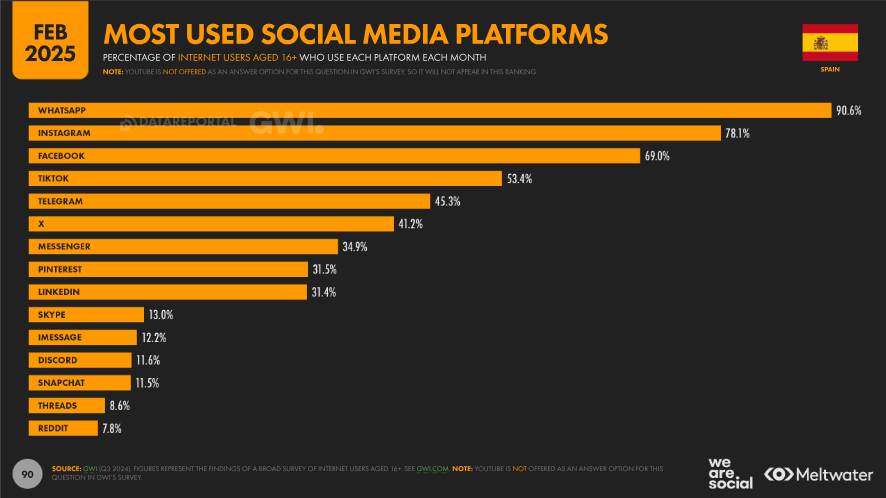
In Spain, the most commonly used platform is WhatsApp. It’s no surprise that Instagram, Facebook, and TikTok follow closely behind. SEO efforts in Spain should also take into account activity on X (formerly Twitter), Pinterest, and Reddit.
3. Search engines popular in Spain
From an SEO specialist’s perspective, it is important to know which search engine is the most popular. In Spain, as in many other countries, Google is the top choice. It is followed by search engines such as Bing and Yahoo.
Share of search engine referrals
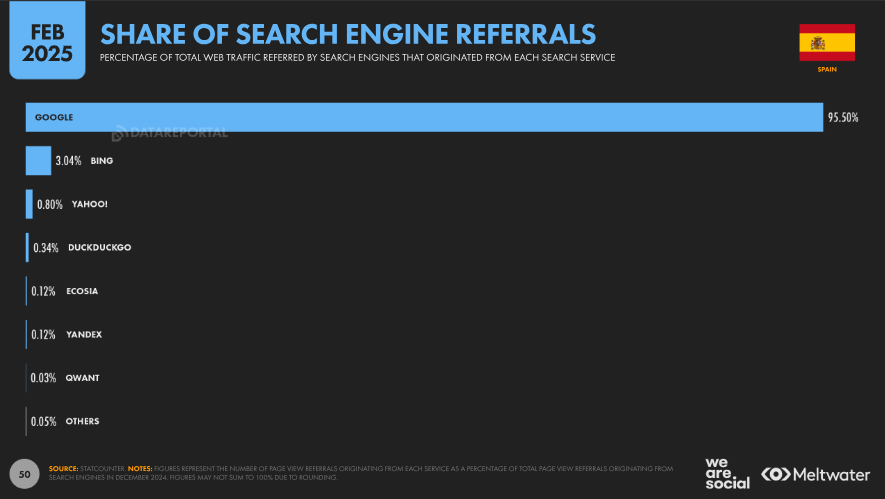
Source: Digital 2025 Spain
Doing SEO in Spain – useful tips
1. Language issues
To make sure that a website is displayed to people speaking a given language, it’s necessary to provide certain content elements that will help search engine robots identify your target group. When doing SEO in Spain, you need to take into account various varieties of language spoken in the country (we’ve discussed similar issues in our entry describing SEO in France).
Spaniards speak Castilian (this is the language that most people refer to when talking about “Spanish”), Catalan, Basque and Galician. Moreover, each region differs when it comes to its local identity and culture.
Exemplary differences between Castilian and Catalan:

It also needs to be borne in mind that there are various language differences not only in Spain itself but also in all Spanish-speaking countries. Having some experience on the Mexican market or cooperating with a native speaker from Mexico doesn’t guarantee being successful in Spain as these two language varieties differ so much that treating them equally could do a lot of harm. Apart from that, it’s also advisable to take into account all possible associations that may arise around your products or services. This will allow you to avoid unpleasant situations as those faced by Mazda Laputa. The name of the car refers to Gulliver’s Travels by Jonathan Swift triggered negative connotations in the inhabitants of Spain and Chile.
2. Link building
If you want to effectively optimize a website in Spain, link building is key. It’s worth starting by creating accounts on the most important social media platforms (such as Facebook, Instagram, LinkedIn, X (formerly Twitter), or YouTube). This is not only a way to increase visibility but also a source of valuable backlinks.
Additionally, remember to:
- Add your website to local directories (e.g., Hotfrog),
- Check where your competitors are getting their backlinks (e.g., using Ahrefs),
- Look for local blogs, forums, and industry-specific websites where you can acquire backlinks.
If you want to make your company even more visible to foreign customers, provide certain signals that will clearly determine your target group. Different varieties of Spanish are spoken by residents of numerous countries and SEO activities performed in Spain should revolve around strategies and steps that will increase your website visibility in this particular country.
Before creating any content, determine your target group and select the appropriate language spoken by Spaniards. Provide the .es domain name of your page and build a powerful link database comprising either .es websites or pages with texts written in Spanish.
SEO for Spanish websites – the takeaway
SEO is like any other field of life. A local business won’t let a foreign company become a serious competitor in the industry unless this company starts specializing in local trends, culture or language nuances. Getting to know these elements and taking them into consideration when planning international SEO services activities will certainly increase your chances of becoming successful in the Spanish market.