Google.com instead of google.pl and “Good SEO is good GEO” – SEO News – #1 – September 2025
d-tags
d-tags
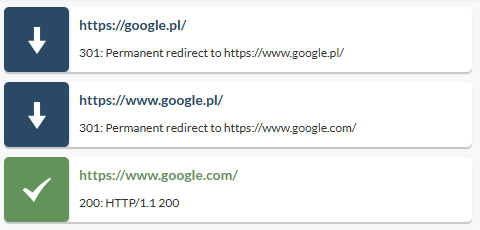
Google has officially announced that all country-code top-level domains (ccTLDs) — such as google.pl, google.de, google.fr or google.co.uk — will be gradually redirected to the global domain google.com. This change, executed in stages over several months, ends the era of regional Google search addresses, although the ability to localize search results remains unchanged. This is already visible for the Polish top-level domain.
Google has officially announced it will stop reporting six schema types that were previously deprecated for use in search results. The company says these schema types were infrequently used and did not provide meaningful additional value for users.
The changes affect the following structured data types:
Google did not mention Book Actions in this announcement; that type was previously signalled for deprecation, so its status may be decided separately.
The deprecation affects the whole reporting ecosystem. Data related to these schema types will no longer be available in:
Google has expanded the documentation about business links in Google Business Profile, roughly doubling its length. The updates are important for business owners and local SEO professionals because they affect both how users are directed and the technical requirements for links.
Google explicitly states that links in Business Profiles must lead to a dedicated landing page for the specific location. Multi-location businesses may not use generic pages or link to a different location. Example: an “order” link for a restaurant must take users to the specific location’s ordering page, not the chain’s main site.
Google added a requirement called “Direct completion of actions.” Links in Business Profiles must allow customers to complete the specified action. An “order” link must allow a user to finalize the order, not merely lead to an informational page. This is particularly relevant for industries such as foodservice.
Google also excludes several kinds of links from being used in Business Profiles: links to social media, news articles, app stores and shortened URLs.
A new section details how links are indexed. Google’s bots will visit profile links daily to verify them and will not honor robots.txt for this verification. Requirements include:
If a link fails to meet these conditions, it may be removed from the profile.
At WordCamp US (August 28) Danny Sullivan, Director at Google Search, addressed the new acronym GEO (Generative Engine Optimization) that has been discussed in the industry. He argued that it is just another label for Google search and that the core of SEO has not changed.
“Good SEO is good GEO, AEO, AIO, LLM SEO or whatever we call it. What you’ve done for search in general – what you might have thought of as SEO – is still fine and is still what you should be doing.” — Danny Sullivan
According to Sullivan, SEO was never just about the “blue links” in Google. It’s about understanding how people search for content and delivering answers in the appropriate form — whether through classic search, voice on a mobile device, or the new AI Overviews layer.
However, this mainly applies to Google Search. When it comes to searches within AI models such as ChatGPT, Perplexity, Claude, or Gemini, we already know that activities like AI Search Optimization (AISO) are based on different factors
During a Q&A, Angie Drake noted a drop in CTR for organic results since AI Overviews were introduced: impressions are up but clicks have fallen dramatically. Sullivan acknowledged the issue and said Google is working on it.
He also emphasized that Google will continue to provide direct answers to simple factual questions (e.g., “what time is the Super Bowl?”) because users expect quick facts. At the same time, he reiterated that exceptional, valuable content will be rewarded and that Google recognizes the challenges publishers face with new result formats.
Again, Sullivan stressed that good SEO equals creating unique, valuable content and delivering a positive user experience.
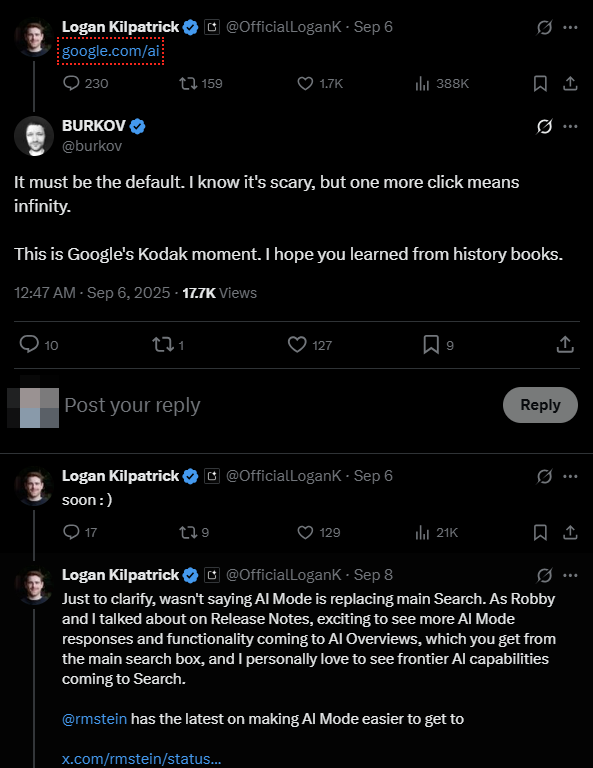
Google is intensifying development of AI Mode in Search, which aims to make Google more advanced and personalized. Logan Kilpatrick, Google’s Senior Product Manager, suggested the AI mode could soon play a larger role in how people search on Google.
The single word “soon” sparked debate, but Google later advised not to read too much into the statement, emphasizing that it was more of an announcement than a concrete change.
Robby Stein, Google’s Vice President, added that Google is currently focused on making AI Mode easy to access for those who want it, rather than forcing it as the default.
A lot is happening in the industry. On one hand, we have new requirements for Google Business Profiles and a cleanup of structured data types. On the other, there is a clearer push toward generative AI in search.
For SEO specialists and online business owners, the message is clear: stay up to date, test new solutions and adapt to rising user expectations. One thing remains constant — valuable content and a good user experience will always be rewarded.