
What is the llms.txt file and do you really need it?

4min.

Comments:0

27 May 2025

SEO
What is the llms.txt file and do you really need it?d-tags
Lately, the llms.txt file has been getting a lot of buzz in the SEO and tech community. The idea is that having this file on your website can help Large Language Models (LLMs) better crawl and interpret your content. Read on to find out what this file actually is, and join us for a little Pascal’s Wager* to decide if you need it on your site.

4min.

Comments:0

27 May 2025

*Shoutout to our CEO, Matt Calik, for this comparison. 😉

What is the llms.txt file?

The llms.txt is a markdown text file that summarizes the key content of your website. You can use it to highlight the most important pages for your business. Think of llms.txt as a hybrid between robots.txt and sitemap.xml – but specifically designed for LLM bots and AI systems like ChatGPT, Google Gemini, Claude, or Perplexity.

According to its creator, Jeremy Howard, the file’s purpose is to help these AI models read and understand websites as a whole. This, in turn, would enable more effective indexing of your content and improve its visibility in AI-powered systems.

There are two versions of the file:

  • The basic version: yourdomain.com/llms.txt
  • The extended version: yourdomain.com/llms-full.txt (which includes more directives and content)

The basic version typically looks like this:

# Title

> Optional description goes here

Optional details go here

## Section name

- [Link title](https://link_url): Optional link details

## Optional

- [Link title](https://link_url)


The file should be placed in the root directory of your domain. Several online generators already exist, such as https://wordlift.io/generate-llms-txt/ or https://writesonic.com/free-tools/llms-txt-generator. WordPress also offers plugins that help generate this file.

Wordpress plugins to generate llms.txt file

Sounds great, right? But does it really work? Do we actually need it?

Does llms.txt file really work?

At the moment, there’s no direct proof that the llms.txt file works as intended. None of the major LLM providers (OpenAI, Google, Anthropic) have officially confirmed its use.

That said, supporters argue: Why not try adding it to your site? If it ever becomes a standard like sitemaps or robots.txt, you’ll be ahead of the competition by implementing it early. There’s some logic in that. 😉

One notable advocate of this logic is Alex Moss from Yoast, who spoke about llms.txt during his presentation at BrightonSEO this April. He predicts it could become a new standard, comparing it to structured data markup. Since then, Yoast has published their own llms.txt file as an example, which you can check out here: https://yoast.com/llms.txt
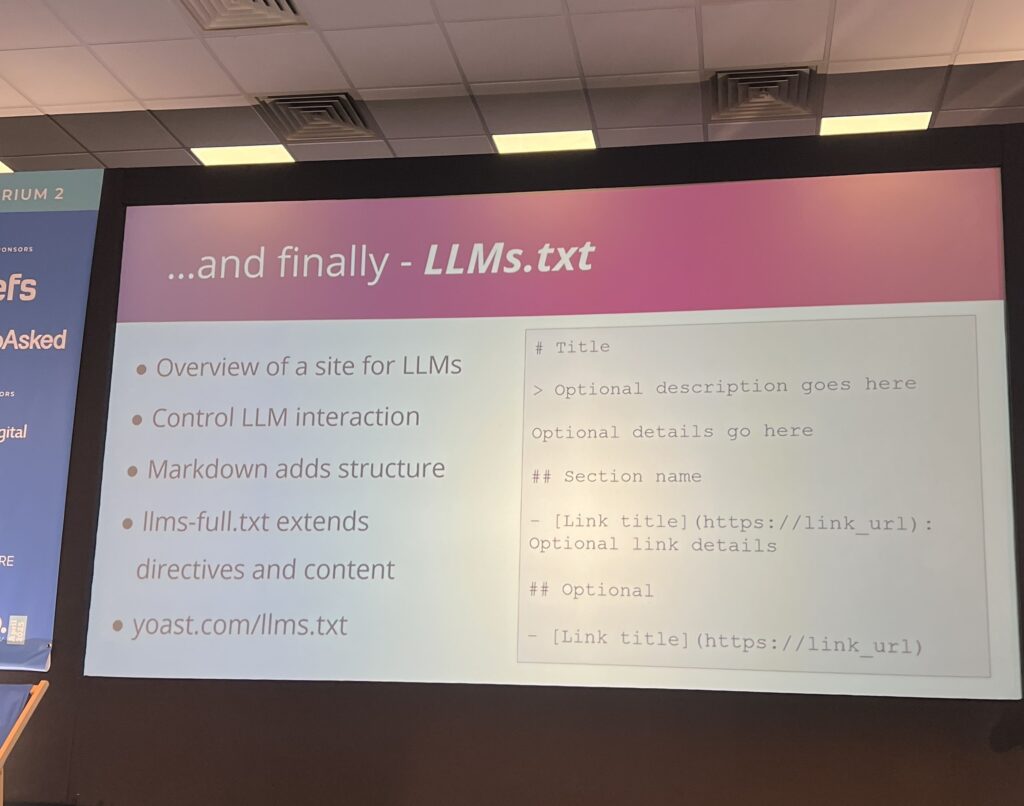
Alex Moss from Yoast about llms.txt file during BrightonSEO April 2025

On the other hand, the extended version is already used by companies like Zapier. You can see their example here: https://docs.zapier.com/llms-full.txt

Our SEO Team Lead, Paulina Konopka, agrees with this positive view:

Currently, the llms.txt file is just a proposal, not a mandatory standard. However, there’s a good chance it will gain importance in the future. It’s worth considering implementing because it gives website owners more control over whether and how their content is used by AI models. This is especially crucial for those who invest heavily in content and want to protect its value from unauthorized use. From an SEO perspective, adopting it early could be a smart, forward-thinking move. Better to be prepared than to play catch-up.

Paulina Konopka
Paulina Konopka SEO Team Leader

For the skeptics

Some experts remain skeptical, including our Senior SEO & R&D Specialist, Wojciech Urban. Here are some of the drawbacks he points out:

  • The llms.txt file is only a proposal—there’s no evidence AI bots actually use it. Wojciech, a data-driven professional, remains a bit of a skeptic here.
  • AI crawlers are designed to collect content without needing such a file (for example, check this out: https://r.jina.ai/https://delante.co)
  • There’s a risk of manipulation with large language models (LLMs). Think about why Google stopped supporting the keywords meta tag… 😉
  • If AI bots do start relying on the file, they might link to the llms.txt text file instead of the actual webpage, which could harm user experience (UX).

On this last point, Wojciech’s comparison with meta keywords is echoed by… John Mueller of Google. Whether John is the definitive SEO authority is up to you, but here’s what he wrote on Reddit about llms.txt:

“AFAIK none of the AI services have said they’re using LLMs.TXT (and you can tell when you look at your server logs that they don’t even check for it). To me, it’s comparable to the keywords meta tag – this is what a site-owner claims their site is about … (Is the site really like that? well, you can check it. At that point, why not just check the site directly?)”

Source: Search Engine Journal

If we’re looking for a new technical standard or solution to make integration and cooperation between our sites and AI tools easier, I’d place my bets more on MCP – the Model Context Protocol.
2025 is shaping up as the year of AI agents – ChatGPT itself is already more of an agent than just a chatbot. This is a huge topic that deserves a separate article, but the llms.txt file idea doesn’t really bring anything new; AI crawlers manage fine without it.
Using MCP in e-commerce could potentially enable a complete purchase process via ChatGPT or other AI agents without the user ever having to visit or click through the website, just voice control. That’s the kind of revolution worth preparing for. https://modelcontextprotocol.io/introduction

Wojciech Urban
Wojciech Urban Senior SEO & R&D Specialist

In summary

The llms.txt file sparks plenty of debate and has both advocates and critics. It’s definitely worth testing and waiting for official confirmation of its effectiveness. SEO is a field that constantly evolves – change is the only constant! 😉

What do you think? Would you add llms.txt to your website? Or maybe you already did?

Author
Joanna Nicpoń - SEO specialist
Author
Joanna Nicpoń

Senior SEO Specialist

Senior SEO Specialist. At Delante since August 2017. She specializes in SEO strategies for E-commerce, IT, and YMYL sectors (including PL, US, UK, and DACH markets). By combining technical optimization with a business-driven Customer Success approach, she builds profitable, long-term client relationships. An expert in content strategies and website migrations. Project Manager and author of the case study nominated for the Global Search Awards 2024. After hours: cinema, traveling, and Heroes III.

Author
Joanna Nicpoń - SEO specialist
Author
Joanna Nicpoń

Senior SEO Specialist

Senior SEO Specialist. At Delante since August 2017. She specializes in SEO strategies for E-commerce, IT, and YMYL sectors (including PL, US, UK, and DACH markets). By combining technical optimization with a business-driven Customer Success approach, she builds profitable, long-term client relationships. An expert in content strategies and website migrations. Project Manager and author of the case study nominated for the Global Search Awards 2024. After hours: cinema, traveling, and Heroes III.