
5 SEO mistakes that block brand visibility in AI Search (2026)

4min.

Comments:0

16 October 2025

5 SEO mistakes that block brand visibility in AI Search (2026)d-tags
Although large brands sometimes invest millions in marketing and SEO, this does not guarantee success, especially in the age of AI Search. ChatGPT, Perplexity, and AI Overviews recommend only certain brands, and often these are not the most prominent players. Larger companies may lose out in this race due to mistakes that prevent them from gaining a foothold in AI. What to avoid in your AISO strategy for 2026? Read on to find out!

4min.

Comments:0

16 October 2025

1. Talking about yourself instead of responding to customer needs and questions

Big brands often assume that what they want to communicate is essential, focusing on their own communication and ignoring customer needs. The result is websites overloaded with self-promotional content and brand language that do not necessarily bring real value to users. This is a costly trap in the context of AI positioning.

Why is this a mistake in the context of AI Search?

If a brand does not create expert content because it believes that its authority and recognition are already sufficient, it is making a big mistake. LLM models “learn” about a brand based on what they find on the web, on social media, but also on the company’s own website. So if there is a lack of practical content—guides, FAQs—the model may choose another, smaller brand that publishes applicable content. In its eyes, quoting such a brand will be more valuable, and preparing helpful answers for users is the goal of all AI models.
How to fix it?

What does this mean from a business perspective? As a result, thousands of dollars spent on content may not bring conversions and the expected results. AI will not quote content that does not solve users’ problems. So put yourself in the shoes of a potential customer and, regardless of your brand’s size, try to answer the most common questions and concerns that may arise about your products or services.

2. Lack of structured data and social proof

Incorrect budget allocation can fail to implement the most essential elements, and in the context of AI positioning, this will definitely be the schema. Even if you invest thousands of dollars in original and engaging product descriptions, but do not mark elements such as price, variants, or product availability in the schema, AI may not quote your website.

Why is structured data crucial for AI?

Structured data is like signposts for AI. A bot, such as ChatGPT, visits your website and seeks information about a product. If you provide specific details in the code, it can quickly find and use them. If, on the other hand, it does not find such markings, it may leave the site. Bots strive to minimize the resources they use when retrieving information from websites, so if you make it easier for them, you increase your chances of being cited.

Learn more here: Structured data and AI Search.

The second important aspect is social proof, i.e., signals that indicate that a product is worth buying. Users are much more likely to buy a product when they can see customer opinions, such as star ratings or reviews. Product reviews and ratings are essential to credibility for both potential customers and AI bots. Importantly, when asked about product recommendations, LLM models often quote reviews they have found, e.g., “Users indicate that the advantage of this product is (…)”.

What if your website does not have the two elements mentioned above? From a business perspective, you may lose traffic from AI tools to smaller competitors who have complete structural data and reviews on their website.

3. Ignoring AI Search as a channel (no AISO strategy)

Even several hundred thousand zlotys spent on marketing activities will not make you appear in ChatGPT’s or other models’ responses if you omit AISO from your strategy.

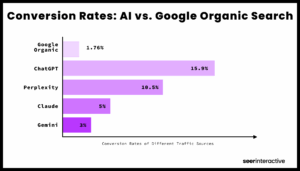
Traffic acquired from LLM tools has a high conversion rate. Users often approach AI models with questions about a specific product or service, indicating they already intend to buy. By not presenting their responses as suggestions, you miss the opportunity to attract truly valuable traffic.

AI Search conversion on ai traffic vs organic search

Source: Seerinteractive

How to plan an AISO strategy? First, you will need to conduct an AI visibility audit and identify areas that require optimization. Next, it will be crucial to implement technical and content improvements to make the website as AI bot-friendly as possible.

If you ignore AI Search at this stage, it’s like saying in 2012 that “mobile SEO is just a fad.” This mistake can cost your brand a share in a new traffic channel, and the resulting backlog will be more brutal to catch up on over time. The sooner you start positioning your website with AI in mind, the better.

4. Lack of content update process

Many large brands produce hundreds of articles that no one ever returns to. Greater financial resources allow for the creation of a lot of content, but if re-optimization and article refreshes are overlooked, it is definitely a mistake.

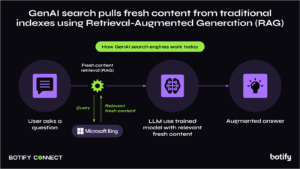
LLM models analyze the user’s query and then search for information on the web in real time (ChatGPT uses Bing results, so when positioning with this tool in mind, optimization for this search engine should be considered). When selecting sources, AI models often lean towards newer content. Newer content, especially from a site that AI considers reliable, will be more relevant and valuable to users in the tool’s understanding.

strategia AISO how llm works

Source: botify.com

What is worth remembering? AI will not quote outdated content. If you don’t implement a process of re-optimizing and refreshing content, most of your content budget will be “frozen” in content that doesn’t convert. Annually, this can amount to thousands of dollars in losses, not because the content is harmful, but because it is outdated.

5. Inappropriate KPIs and incorrect analytics

Errors that block brand visibility in AI can also occur at the KPI setting stage. Suppose a business measures the effectiveness of its activities solely by focusing on the website’s Google rankings for selected keywords or on traffic growth. In that case, it will be difficult to draw conclusions about AI visibility.

It is not enough for management to receive “pretty charts.” It is necessary to measure ROI and customer acquisition costs. Constant monitoring of visibility in AI will also be essential—it will be imperative to verify which pages are more likely to be cited in AI tools such as ChatGPT or AI Overviews. Based on this, conclusions can be drawn about which elements work and which do not.

Suppose you delay implementing an AISO strategy and implementing appropriate data-driven optimizations. In that case, you may make decisions too late, and your competition will already have had time to “settle in” in AI results.

Summary: How to increase brand visibility in AI Search

The conclusion? The mistakes mentioned above are absolutely not due to a lack of budget, but to wrong decisions and established priorities for action. Large brands should remember to create helpful content, implement technical elements such as schema, and base their reporting on business goals.

In 2026, it will not be the size of the organization and budgets that will determine success in AI Search, but the ability to adapt to new realities and implement appropriate optimizations.

Sources:

https://www.seerinteractive.com/insights/case-study-6-learnings-about-how-traffic-from-chatgpt-converts


Find out how to increase your brand visibility in AI with the AISO service.

Author
Mateusz Calik - CEO
Author
Matt Calik

CEO

CEO, has been building Delante since 2014. Responsible for international SEARCH strategies. He has a strong analytical approach to online marketing backed by more than 12 years of experience. Previously associated with the IT industry, as well as the automotive, tobacco, and financial markets. Has experience in creating scaled processes based on agile methodologies.

Author
Mateusz Calik - CEO
Author
Matt Calik

CEO

CEO, has been building Delante since 2014. Responsible for international SEARCH strategies. He has a strong analytical approach to online marketing backed by more than 12 years of experience. Previously associated with the IT industry, as well as the automotive, tobacco, and financial markets. Has experience in creating scaled processes based on agile methodologies.