The Most Popular Online Payment Methods in Poland – Ranking

6min.

Comments:0

19 June 2025

Ads
The Most Popular Online Payment Methods in Poland – Rankingd-tags
Thinking of expanding your e-commerce business to Poland? It's a fantastic, booming market with immense potential. But before you start calculating revenue, consider a critical detail that many international businesses overlook. Imagine setting up the perfect online store, investing in marketing, and attracting eager customers, only to lose them at the very last step. This isn't a hypothetical scenario; it's what happens when you fail to offer the payment methods Polish consumers trust and expect.

6min.

Comments:0

19 June 2025

Costly Indifference – Why Your Choice of Online Payment Methods Determines Your Profit

Imagine you run a café in a popular tourist city – a stylish place with top-quality freshly ground coffee and expert baristas. You get many customers every day, but there’s a catch. Your café only accepts 50-cent coins. Sounds absurd, right? No one would consciously impose such a restriction and cut themselves off from 99% of potential customers. Are you absolutely sure that, at the final step of your online sales process, you’re not creating a similar invisible barrier for your clients?

Business owners in e-commerce often focus all their efforts on attracting visitors to their websites, forgetting that customers can easily drop out at the very last moment. When shoppers reach checkout but don’t find their preferred payment option, cart abandonment rates skyrocket. It might be due to mistrust in unfamiliar payment providers, preference for one-click convenience, or simply reluctance to enter credit card details.

The payment method you offer is your cash register. This is where the final decision is made. All the work you put into SEO, Facebook ads, and beautiful product photos is put to the ultimate test here. You may not realize how many customers quit because they can’t pay the way they want. Every extra form field, unclear instruction, or missing trusted payment option acts like an emergency brake. The trust you’ve built throughout the buying journey can vanish in a second.

Even if you’re just a step from success, the entire transaction may fail. That’s why a well-designed payment system isn’t an expense or a luxury. It’s the most precise tool you can have to close sales.

How Do Customers Want to Pay in Your Store? Ranking of Online Payment Methods in Poland

Which online payment methods are most popular among Polish consumers today? You can’t rely only on guesses or intuition. Hard data speaks louder than a thousand business tips. The 2024 Gemius report on Polish e-commerce reveals exactly what Polish consumers want. Here’s the key info you need.

1st place: BLIK 🥇

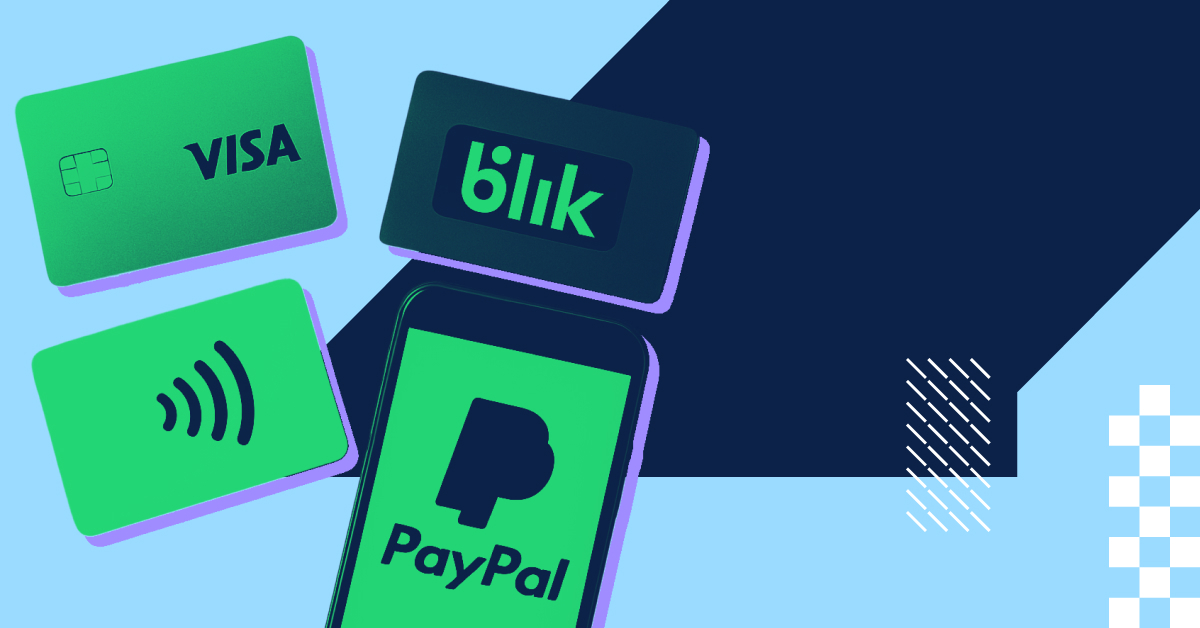
Leading the pack with a crushing advantage is BLIK. It’s chosen by 51% of online shoppers. More than half of your potential customers expect to see the familiar six-digit BLIK code at checkout. From a business perspective, transaction fees for BLIK range from 0.99% to 1.25%, depending on the payment operator (PayU, Przelewy24, or Tpay), making it economically viable.

Why has BLIK, nonexistent a decade ago, become the synonym for online payments in Poland? It’s no coincidence – it’s the result of a brilliant blend of technology, psychology, and convenience. BLIK removed all the annoyances of online payments — no need to log into your bank, copy long account numbers, enter SMS codes, or card details.

All you do is enter a six-digit code from your bank app — which you already have on your phone — and confirm the payment with one tap. The process takes just seconds. BLIK offers users strong control and security — transactions cannot proceed without your conscious approval in the app, which only you can unlock. The code is one-time use and valid for only two minutes.

BLIK is a brand people identify with — modern, Polish, and just “cool.” Offering BLIK signals that your business is up-to-date, understands customer needs, and is part of the modern world.

2nd place: Instant bank transfers 🥈

Second in popularity are instant bank transfers, chosen by 22% of Polish consumers. If your store targets customers aged 35+ or more traditional shoppers, this method is essential. Many people trust familiar, longstanding payment solutions — and instant bank transfer is their standard.

Customers are redirected to their bank’s online environment, feeling “at home.” They don’t need to trust a new system because they’re operating in a familiar banking space. Compared to BLIK, however, this process involves more steps — redirect, login, and approval — so it feels secure but slower.

Fees for instant transfers range from 0.5% to 2.3%, depending on the payment provider. If you don’t offer this yet — it’s time to change that. For many, it remains the only acceptable online payment method.

3rd place: Card payments 🥉

Cards close the top three with 10% of customers preferring them. This may surprise you given Visa and Mastercard’s global dominance. But having a card handy and entering 16-digit numbers, expiration dates, and CVC codes can be a barrier. Additional 3D Secure authentication adds friction.

Though somewhat outdated, cards offer convenience. Customers can save card details in browsers or digital wallets (Apple Pay, Google Pay) for one-click payments. For many, it remains the fastest way to shop.

Accepting cards opens your store to a global customer base since Visa and Mastercard are accepted worldwide. Card transaction fees range between 1.19% and 1.29% plus around 0.30 PLN per transaction.

4th place: Cash on delivery

Surprisingly, cash on delivery still holds 7% of the Polish e-commerce market. This traditional payment method allows customers to pay only upon receipt of goods, offering maximum transaction security.

Its popularity stems from allowing customers to see and check products before payment — popular especially for clothing, footwear, and electronics, where satisfaction is uncertain.

However, offering cash on delivery involves extra costs and logistics challenges — higher shipping fees, risk of refused packages, and delayed payment receipt.

5th place: Traditional bank transfers

Only 3% choose traditional bank transfers, often preferred by corporate clients or very traditional shoppers. It’s crucial to simplify the process — provide clear, copyable payment details and automatic email confirmation to reassure customers.

Treat traditional transfers as a secondary option — processing takes longer (hours to days) due to manual payment verification.

6th place: Buy Now, Pay Later (BNPL)

At the bottom are deferred payment methods (3%) — modern versions of trade credit. Customers buy now and pay within 14 or 30 days. This is especially attractive for expensive purchases, easing immediate budget constraints and simplifying returns.

BNPL operators charge merchants 1.2–2% commission but assume payment default risk, guaranteeing you receive funds.
newsletter-icon

Sign up for our newsletter!

Discover the latest tips, case studies, and strategies from digital-marketing experts!

Delante – Best technical SEO agency

How to Choose the Perfect Payment Methods for Your Store? A Simple 3-Step Strategy

With this clear map of preferences, creating an effective payment system is easier than you think. Stop guessing about exotic or rarely used options that confuse customers. Instead, focus on a strategic three-tier payment model that works in practice — and covers most of your customers.

Step 1: The foundation – BLIK

No debate here — BLIK is the cornerstone of online payments in Poland today. To have a winning checkout, BLIK must be included. Not just as an option, but as the first, most visible payment method. 51% of e-commerce users choose it — that’s more than half of your potential customers. By implementing BLIK, you show you care about user convenience and understand the market’s expectations.

Step 2: Solid pillars – Instant bank transfer and card payments

Next come the supporting methods — instant bank transfers and cards. Together, they cover 32% of user preferences. Though less spectacular than BLIK, their absence is noticeable and hurts sales.

The trio — BLIK, instant transfer, and card — fulfills the needs of the vast majority. Build your checkout on this and sleep better at night.

Step 3: Flexibility for niche needs

Your customers are people with very different expectations, habits and levels of trust in online payments. And while most users use modern forms such as BLIK or quick transfers, there are also those who operate differently – and it is worth including them in your strategy.

Do you need to have all these methods? Not always. But you should know your target group and consciously decide which of them will be of real importance. Sometimes it is the 2–3% of customers in a niche that can generate more profit than the remaining 20%. Flexibility pays off – especially in e-commerce.

Every abandoned shopping cart is lost profit. Thanks to our purchase path analysis, you will find out if it is the lack of appropriate payment methods that is to blame. Approach payments strategically – and increase conversion without increasing your advertising budget. We will optimise the purchase process so that customers not only want to buy – but actually do so.

Online Payment Methods — Turn Barriers Into Trust

For years, checkout was treated as a technical detail — a form to fill and a button to click. But the truth is, this is where customers decide if they trust you. If they entrust their money to you, they expect more than a working system. They want a smooth, intuitive, tailored experience.

Look at the numbers: 51% choose BLIK, 22% instant transfer, 10% card, plus 7% cash on delivery, 3% BNPL, and 3% traditional transfer. People have clear, deeply rooted preferences tied to their online security feelings. It’s your choice whether your store matches them.

If you want to enter the Polish market with your business, knowing and offering these payment methods is crucial. Partner with a Polish agency staffed with native speakers and experienced professionals who understand local customer habits and legal nuances. Get in touch to make your entry smooth and profitable!

Author
Damian Hliwa - Senior SEO & UX Specialist
Author
Damian Hliwa

Head of SEO

Over the several years of his career in SEO, Damian has gone through many positions. They start from internship, through team leader to head of SEO. During these years, his main specialization has been and still remains SEO and technical audits, but he is no stranger to linkbuilding or content campaigns. After hours, a filmmaker and photographer as a so-called one-man-army, a lover of good coffee brewed with all kinds of methods, Polish mountains and cycling.

Author
Damian Hliwa - Senior SEO & UX Specialist
Author
Damian Hliwa

Head of SEO

Over the several years of his career in SEO, Damian has gone through many positions. They start from internship, through team leader to head of SEO. During these years, his main specialization has been and still remains SEO and technical audits, but he is no stranger to linkbuilding or content campaigns. After hours, a filmmaker and photographer as a so-called one-man-army, a lover of good coffee brewed with all kinds of methods, Polish mountains and cycling.