
OpenAI introduces o3-pro—a model designed not just to answer, but primarily to think. It's been given more computational power to handle the most challenging tasks in science, programming, and data analysis. Is slower, yet deeper, reasoning the future of AI? We examine how o3-pro stacks up against the competition and whether it’s truly the revolution professionals have been waiting for.
We have barely gotten used to the capabilities of the GPT-4 and o3 models, and OpenAI is already serving us another novelty – o3-pro. This new model, recently made available to users of Pro and Team plans, is touted as a true breakthrough in complex reasoning. Is it really a new quality in ChatGPT, or just marketing hype? Let’s check what’s under the hood.
How does ChatGPT o3-pro differ from its predecessors?
At first glance, o3-pro is an evolution of the well-known o3 model. The devil, as always, is in the details. The key difference is what OpenAI refers to as “thinking before answering.” Models in the “o” series have been trained not to rush to an answer but to first analyze the problem, break it down into components, and only then form a conclusion.
The o3-pro model takes it a step further. It is dedicated significantly more computational power, which practically means it “thinks” more intensely and for longer. This might sound like a disadvantage – after all, who likes to wait? – but in the case of complex issues, the additional seconds (or even minutes) of reflection result in much higher quality and accuracy of responses. It’s a bit like the difference between a quick, instinctive retort and a thoughtful, in-depth analysis by an expert.
Where does o3-pro show its claws?
OpenAI does not hide that o3-pro is a tool for special tasks. It has been optimized for fields that require iron logic and precision.
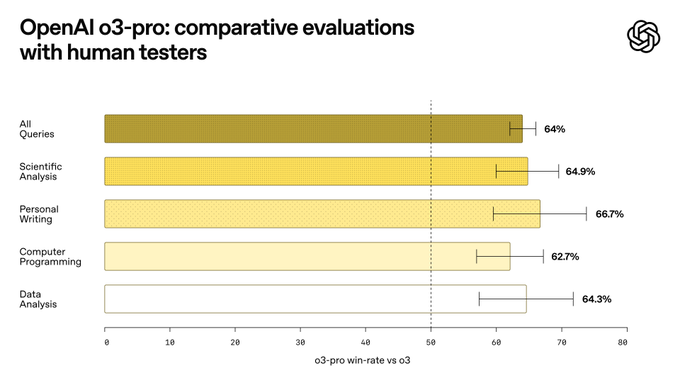
Physics, advanced mathematics, programming, or analysis of complex datasets – these are natural environments for o3-pro. In internal tests and expert evaluations, this model consistently outperforms its predecessor, o3, in these areas. Imagine AI that not only generates code but is capable of thoroughly analyzing it, finding subtle errors, and proposing optimizations, understanding the context of the entire project.
Moreover, o3-pro has nearly the full arsenal of tools we know from ChatGPT – it can browse the internet in real-time, analyze files, interpret images, and even personalize responses with its memory function. This makes it a powerful partner in research and analytical work.
Of course, benchmarks are not everything, and o3-pro also has its limitations. It currently does not support image generation or Canvas functions. It is also slower, which might be a barrier in applications requiring immediate responses. Nonetheless, in the battle for precision and depth of reasoning, it seems to set a new standard.
The increasing availability of AI models is changing the way we search for information, and your clients are increasingly turning to ChatGPT and encountering AI Overviews in Google search.
The new OpenAI model is not entering the market in a vacuum. It faces giants like Gemini 2.5 Pro from Google and Claude 4 Opus from Anthropic. However, the first benchmarks show that o3-pro has an ace up its sleeve. In the AIME 2024 math test, it beat Google’s offering, and in the scientific GPQA Diamond test, which checks doctoral-level knowledge, it outperformed the Anthropic model.
For SEO specialists and data analysts, this may mean access to a tool capable of conducting analyses of unprecedented complexity, and for developers – a partner that will genuinely speed up and improve their work. Time will tell how the market will verify these promises, but one thing is certain – the AI arms race has just entered another exciting phase. Stay up to date with us and sign up for the Delante newsletter!
A marketing graduate specializing in e-commerce from the University of Economics in Kraków – part of Delante’s SEO team since 2022. A firm believer in the importance of well-crafted content, and apart from being an SEO, a passionate music producer crafting sounds since his early teens.