Search 2.0 – How is Search Changing in 2025?

6min.

Comments:0

31 July 2025

SEO
Search 2.0 – How is Search Changing in 2025?d-tags
In SEO, as in life, the only constant is change. Read about how Search has evolved recently and how this can impact our businesses. How can we avoid missing potential clients and adapt to these changes?

6min.

Comments:0

31 July 2025

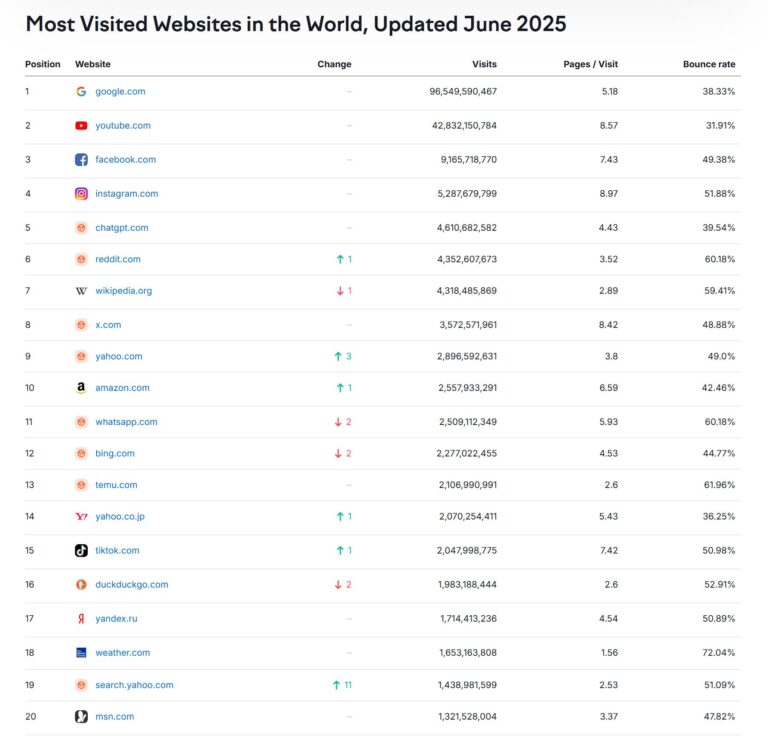
Do you know which websites are in the TOP 20 most visited websites in the world according to SemRush data (updated June 2025)? Let’s check:

Most Visited Websites in the World, updated in June 2025 - data from SemRush

Source #1: Semrush

And do you know what they all have in common? Actually, only one of them (WhatsApp) doesn’t have a search option.

Every other one is a search engine or has a highly developed search feature. We can use them with different intentions (whether we’re looking for new shoes, industry news, information for a report, a video on how to tie a tie, or a recipe for blueberry buns) – but we are searching for some kind of information.

Search ≠ Text-Based Search Engines

Searching for information is no longer just about searching on Google or another text-based search engine.

Searching now also includes:

  • Various AI tools, such as ChatGPT, Google Gemini, Claude, Perplexity AI, etc.,
  • Social media platforms, such as Instagram, TikTok, Pinterest, YouTube, etc.,
  • Online forums, such as Reddit or Quora,
  • Various apps, such as H&M, Booking, Filmweb, etc.,
  • The so-called “Dark Social,” such as WhatsApp groups, private Slack channels, where analytics is more difficult.

Are you visible on each of these platforms? Or at least on the ones your target audience uses?

Speaking of Social Media, fun fact: 46% of Gen Z prefers Social Media over search engines to find information (Source 2). Therefore, if your products/services are targeted at this age group, you should be heavily active on social media to reach them.

And if you think the mentioned online forums are dead, check out the visibility of Reddit in the United States:
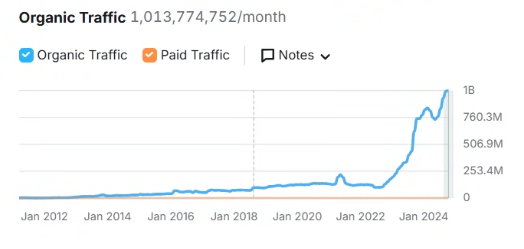
Reddit – visibility in the U.S. market (SemRush chart, July 2025)

Semrush chart showing the visibility of the domain reddit.com in the U.S. market. Screenshot taken in July 2025.

Of course, much of this is likely related to the agreement Google made with them (worth around $60 million annually), which grants real-time access to Reddit’s data and the use of Google’s AI for search on the Reddit platform. We discussed this while summarizing the biggest changes in search for 2024: Google and Reddit Collaboration.

The same applies to Quora, Stack Overflow… And it certainly tells us one thing – people are still using online forums, and we should be there. Let’s also think about other user-generated content (UGC) channels in our marketing strategies.

Changes also in Google Search

Zero-click Searches

The fact that Search goes beyond text-based search engines doesn’t mean Google isn’t changing. The biggest change is that search results are no longer primarily just regular “blue links” (simply links to websites). Instead, we are seeing more and more Zero-Click Searches in the results.

Examples include:

0️⃣ AI Overviews
0️⃣ Direct Answer
0️⃣ Featured Snippets
0️⃣ Knowledge Panels
0️⃣ Local Packs
0️⃣ People Also Ask

Marcin Polak and I wrote a full article on this – I encourage you to read: Zero Click Searches: What Are They and How Do They Impact Today’s Search?

But to keep up with Kardashians changes in Google, you need to think again about whether your brand is visible in these results.

AI-Mode

A few months ago, Google introduced AI Mode in the U.S. during the Google I/O 2025 conference. Read more in the article by Gosia Kwiecień, who summarized the event: How AI is transforming Search: New features from Google I/O 2025 and what they mean for your brand’s visibility

Whether and to what extent AI Mode will catch on, and how it will further change Search, only time will tell. Google also tested Voice Search, which was supposed to radically change how we use Google – did that happen? Not exactly. AI Mode will definitely be a bigger evolution than voice search and will cause even more disruption – that’s why it can’t be ignored, and we must start working on AISO (AI Search Optimization). Stay updated with SEO news to quickly react to any changes. If you want to receive these updates and not miss important news, subscribe to our newsletter:

newsletter-icon

Sign up for our newsletter!

Discover the latest tips, case studies, and strategies from digital-marketing experts!

Delante – Best technical SEO agency

So we’re still searching, but our search is evolving. Search is changing because user behaviors are changing, and technologies are adapting to that. Nevertheless, these changes are an evolution, not a revolution. We shouldn’t fear them, but rather strive to keep up with them.

Micro-moments

What these changes bring is the introduction of interactivity into our search experience – leading to what are called micro-moments. Users engage in various real-time interactions, and these micro-moments become crucial in capturing consumers’ attention.

What are micro-moments?

These are brief, yet pivotal moments when users interact with our brand, sometimes consciously – looking for information or making purchasing decisions – but sometimes unconsciously. For example, you’re browsing Instagram while waiting for your coffee to brew at work, and suddenly you see new New Balance shoes. You think, “I don’t have those yet.” You check the product, but the coffee’s ready, so you leave. But that’s enough – now ads follow you, and those shoes keep reminding you.

Micro-moments can occur across various platforms – search engines, social media, or mobile app interactions, but also with traditional media: TV, print, billboards, flyers, etc. They can also be used creatively: even a clever sticker where your potential customers are. And it’s definitely worth doing – well-utilized micro-moments can influence purchasing decisions.

All of this makes marketing almost subconscious for the user. But we must be aware of it. 🙂 And what does this all certainly mean? Wherever your customer can encounter your brand, you should be there.

How Can Changes in Search Affect Your Business?

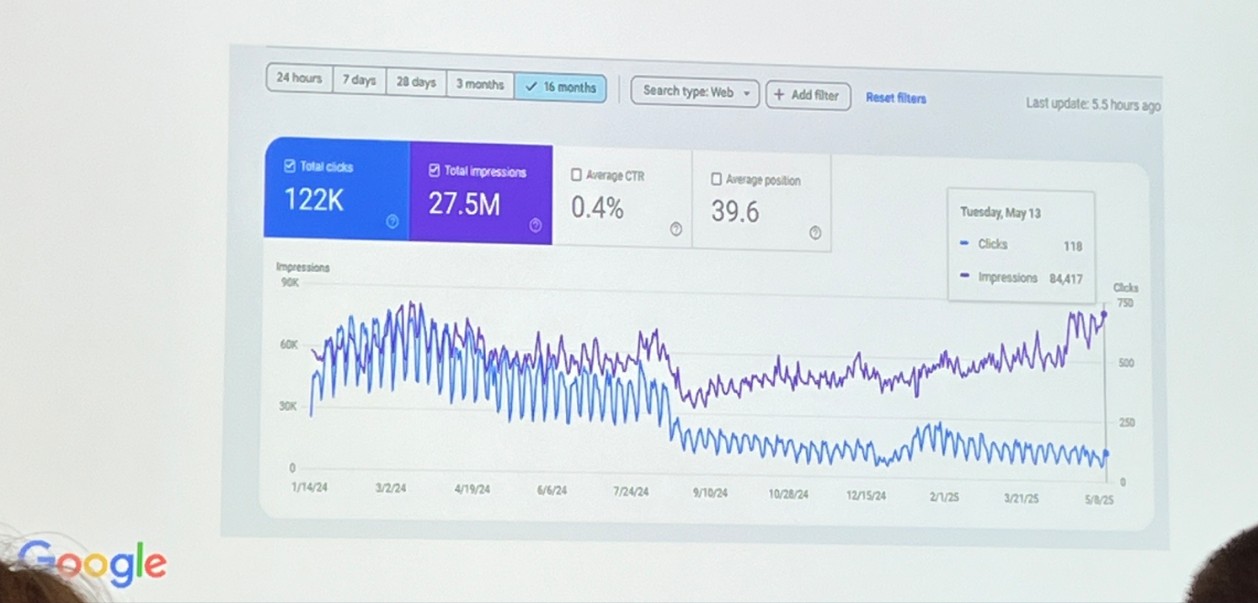
The current changes have a significant impact on SEO results and are trends visible globally. The introduction of AI Overviews and the growth of other zero-click searches mean that even with a well-executed SEO process, increasing visibility, and more page views, the number of clicks may decrease. As shown in the attached slide:

The chart from the Google Search Central Live conference in Warsaw from June 2025 shows the current global trend: impressions are increasing, while clicks are decreasing.

The chart shown by Google employees at the Google Search Central Live conference in Warsaw in June 2025 illustrates the current global trend: impressions are increasing, while clicks are decreasing.

People are getting answers to their queries directly in search results, which is why they don’t click through to websites. After the introduction of AIO, it is said that traffic on websites has dropped by nearly 35% on average (as presented by Ahrefs – Source 3). On websites where most traffic came from blogs, these declines are often even larger (up to 70-80% year-over-year). This is because AI Overviews “consume” most informational query results. What is emphasized is that although clicks are fewer, they are often of much higher quality – people visit websites to make a conversion. Of course, this is not comforting for publishers and websites that relied solely on traffic for revenue – they should definitely change their strategy and adapt to the changes, which will be discussed later in the article.

All these changes visible in search and the aforementioned split in user attention often result in difficulty identifying the most important traffic source. People break down the information-searching process across multiple channels, leading to attribution challenges. I refer here to good sources (Sources 4 and 5).

All of this forces us to rethink our KPIs.

Adapting Marketing Results Analysis

We should of course adapt to changes, and it’s worth starting this adaptation with the analysis of marketing results. What we should be doing now includes:

📈 Analyzing brand visibility
📈 Tracking direct traffic and AI traffic
📈 Looking beyond just GA4 (compare conversion data with CRM or CMS data)
📈 Focusing on conversions (Because Google Search is still present in the conversion path – and transactional queries still lead to websites)

So, in general, let’s look at marketing activities holistically: different channels work together – with a common goal – conversion.

You will surely ask (and rightly so): so how should we adapt to the changes and react to them with SEO and other marketing channels?

How to adapt to changes in SEO activities and beyond?

A few tips from me:

✅ Conduct thorough research of your target group -> adjust your marketing strategy to choose traffic or search channels best suited to their needs,
✅ Create unique content for this group – find your niche, test different formats. This will also allow you to be cited by AI, shared on Social Media, etc.,
✅ Distribute content across multiple channels,
✅ Adjust your SEO strategy to changes in search and your individual case,
✅ Check if you appear in Bing (ChatGPT is powered by its results) – and read more here: Bing SEO.
✅ Optimize your Social Media,
✅ If you’re working locally, don’t forget local optimization (Google Business Profile, Apple Maps, Big Places),
✅ Think outside the box! Create new content, attract people in various ways, think holistically to ensure your actions complement each other and engage users.

Summary

The changes in Search we are observing involve:

⭐ User behaviors,
⭐ User search intent,
⭐ Technology,
⭐ Platforms/channels,
⭐ Analytics,
⭐ KPIs,
⭐ Results analysis.

But all of this is an evolution, not a revolution, and we can (and should!) adapt to these changes.

Sources:

  1. https://www.semrush.com/website/top/ (The screenshot above was taken on July 28, 2025 – the list is updated by Semrush at the end of the month, which is why the screenshot shows data from June 2025.)
  2. https://cropink.com/gen-z-social-media-usage-statistics
  3. https://ahrefs.com/blog/ai-overviews-reduce-clicks/
  4. https://sparktoro.com/blog/attribution-is-dying-clicks-are-dying-marketing-is-going-back-to-the-20th-century/
  5. https://sparktoro.com/blog/in-a-zero-click-world-traffic-is-a-terrible-goal/
Author
Joanna Nicpoń - SEO specialist
Author
Joanna Nicpoń

Senior SEO Specialist

Senior SEO Specialist. At Delante since August 2017. She specializes in SEO strategies for E-commerce, IT, and YMYL sectors (including PL, US, UK, and DACH markets). By combining technical optimization with a business-driven Customer Success approach, she builds profitable, long-term client relationships. An expert in content strategies and website migrations. Project Manager and author of the case study nominated for the Global Search Awards 2024. After hours: cinema, traveling, and Heroes III.

Author
Joanna Nicpoń - SEO specialist
Author
Joanna Nicpoń

Senior SEO Specialist

Senior SEO Specialist. At Delante since August 2017. She specializes in SEO strategies for E-commerce, IT, and YMYL sectors (including PL, US, UK, and DACH markets). By combining technical optimization with a business-driven Customer Success approach, she builds profitable, long-term client relationships. An expert in content strategies and website migrations. Project Manager and author of the case study nominated for the Global Search Awards 2024. After hours: cinema, traveling, and Heroes III.