




The main challenge was the inconsistency between results reported in the Google Ads panel and actual business profitability. Despite generating sales and seemingly acceptable performance metrics, the account did not support real financial outcomes.
The account was reorganized by structuring campaigns and separating brand from non-brand traffic. A diversified campaign mix and continuous testing were implemented, while optimization shifted from ROAS to real margin. As a result, the activities began to directly support financial performance and enabled scalable growth.
A Google Ads case study for a B2B e-commerce business, where the goal was not a higher ROAS in the ad panel, but greater control over which campaigns actually drive financial performance.
Bimeb is a wholesaler of furniture accessories supplying the carpentry and furniture industries. Its offering includes drawer systems, hinges, runners, and space organization solutions.
In B2B e-commerce, not every transaction has the same value. Product groups differ in margins, cart value, and sales potential. That’s why focusing solely on ROAS does not provide a complete picture of campaign profitability.
Industry: furniture accessories and interior equipment
Business model: B2B
Sales channel: e-commerce
Service: Google Ads
The Google Ads account was generating transactions, and the reported ROAS initially appeared strong. However, the data in the ad panel did not fully reflect actual business performance.
With combined brand and non-brand traffic, it was difficult to clearly assess which campaigns were generating new demand and which were simply closing users already familiar with the brand.
The goal was to reorganize the account, improve data transparency, and build a model where the Google Ads budget supports sales with real business value.
During the analyzed period, conversion value increased by 618%. Campaigns generated 11.4k conversions, and the actual ROAS reached 1,961%.
Conversion value: +618%
Number of conversions: 11.4k
Actual ROAS: 1,961%
However, the key outcome was not just the growth in conversion value or high ROAS.
The most important factor was the ability to make budget decisions based on data closer to real profitability, rather than metrics that look strong in the panel but do not support financial performance.
The data below shows the growth in conversion value and the scale of activity after restructuring the account and changing the optimization approach.
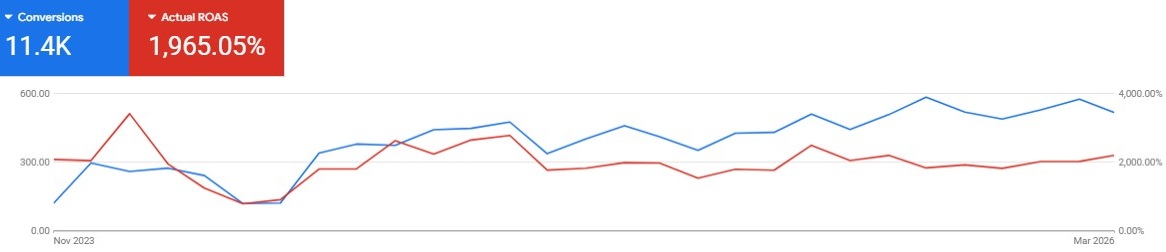
Results in Google Ads
11.4k conversions and an actual ROAS of 1,961%.
It is a way of evaluating performance that goes beyond the ROAS reported by Google Ads and incorporates data that better reflects the real value of sales for the business.
Each campaign type played a specific role—from generating new demand to supporting users closer to conversion.
Budgets, bidding, and scaling decisions were evaluated in relation to margins and actual sales value. This enabled more controlled growth without improving metrics that do not translate into business outcomes.
ROAS can look strong in the ad panel while failing to reflect the true profitability of campaigns.
In the Bimeb project, the goal was to shift from metric-driven optimization to business-value-driven optimization. Account restructuring, separating brand from non-brand, and focusing on margins enabled better budget allocation and campaign scaling decisions.
We will verify whether the ROAS in your panel reflects actual performance, identify which campaigns generate new demand, and show where budget can be reallocated to better support business results.
Let’s talk about Google Ads!