Author


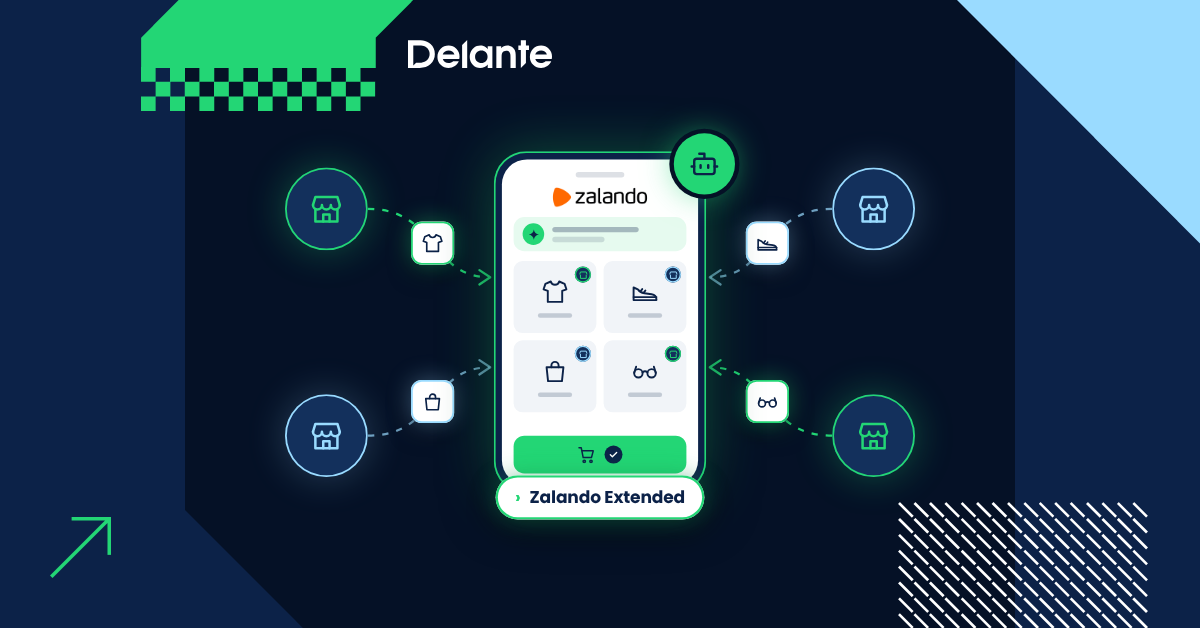
Zalando announced Zalando Extended on November 3, 2026, introducing a new shopping model that will let customers discover and purchase products from external online retailers without leaving the Zalando app. The company plans to enable its own AI shopping agent to complete purchases on customers’ behalf starting in 2027. A pilot partnership with home and living retailer Westwing is already underway. The development marks another step toward Agentic Commerce, potentially changing how online stores acquire customers, manage product visibility, and generate sales.
Important: Zalando has announced its AI-assisted checkout model for 2027. The full purchasing functionality is not yet broadly available, and the company has not disclosed a complete international rollout schedule.
For e-commerce businesses, the announcement raises a strategic question: What happens when customers buy products through an AI-powered intermediary rather than visiting an online store directly?
Zalando Extended is designed to expand the range of products available within Zalando’s ecosystem by including items sold by independent online retailers.
Until now, a customer looking for a product unavailable on Zalando would typically need to visit another store to complete the purchase.
The proposed model introduces an additional option.
Customers will be able to discover products from external retailers through Zalando, while the platform’s AI agent will help complete the purchase without requiring the shopper to leave the app.
Based on Zalando’s announcement, the intended shopping journey may involve the following stages:
This describes the planned operating model. Zalando has not yet released complete technical documentation explaining every step of the checkout, payment authorization, returns, or post-purchase processes.
The company says participating retailers will be able to reach Zalando customers without implementing complex technical integrations or changing their existing logistics operations.
That could lower some of the barriers associated with entering a traditional marketplace ecosystem.
However, the commercial terms and detailed technical requirements for participating retailers have not yet been fully disclosed.
Zalando has selected Westwing as the first partner for Zalando Extended.
Westwing specializes in premium home furnishings, furniture, and lifestyle products.
The partnership began in 2026, with AI-assisted purchases of Westwing products through the Zalando app planned for 2027.
This distinction matters: the pilot partnership is already underway, but AI-powered checkout remains a future capability.
Zalando intends to begin with categories such as larger home goods before gradually expanding the range of products available through external retailers.
Home furnishings are an interesting starting point for AI-assisted shopping.
Purchasing furniture often requires customers to evaluate dimensions, materials, colors, product variants, delivery conditions, and compatibility with their existing spaces.
An AI shopping assistant could potentially help organize and compare this information.
In more advanced scenarios, it could also support the transaction itself.
Zalando has not announced a complete list of future partners or a specific launch date for every market.
The announcement came alongside Zalando’s third-quarter financial results.
The company reported revenue growth and continued expansion of its platform business.
| Metric | Q3 2026 | YoY Change |
| Alphabet total revenue | $127.6 billion | +25% |
| Google Search & other | $63.35 billion | +12% |
| Google Services | $96.3 billion | +11% |
| Google Cloud | $30.7 billion | +103% |
Source: Alphabet, Q3 2026 Earnings Report, published October 28, 2026.
According to Reuters, Zalando’s gross profit margin declined by 0.9 percentage points, primarily because of targeted promotional investments, particularly in sneakers.
There is no evidence that this margin decline was directly caused by the development of the AI shopping agent.
The broader strategic development is Zalando’s transition toward a platform-based business model.
Its partner business and retail media operations continued growing, while B2B revenue increased by almost 28% year over year.
Zalando Extended builds on this direction by potentially expanding product selection without requiring Zalando to carry every item in its own retail inventory.
The company may also generate additional advertising revenue by allowing external retailers to promote their products through Zalando’s retail media ecosystem.
This creates a possible combination of commerce, customer acquisition, and advertising opportunities.
Traditional online marketplaces typically bring retailers onto a shared platform, where products are listed and transactions are conducted through marketplace infrastructure.
Participation may require sellers to adapt product feeds, order management systems, fulfillment processes, or technical integrations.
Zalando Extended proposes a different approach in which an AI agent helps facilitate purchases from external stores.
The key distinction is the AI agent’s ability to act on behalf of the customer during the transaction.
This is an example of Agentic Commerce.
As explained in Delante’s Agentic Commerce definition, this model involves autonomous or semi-autonomous AI agents participating in product discovery, comparisons, recommendations, and purchasing activities.
Agentic Commerce goes beyond a traditional shopping chatbot.
A chatbot may answer questions about products or suggest options.
An AI shopping agent can potentially perform additional actions, such as checking availability, comparing offers, adding products to a cart, and initiating a transaction with the user’s authorization.
Zalando Extended aims to move from AI-assisted discovery toward AI-assisted purchasing.
That is why the announcement matters beyond the fashion industry.
From an e-commerce perspective, the most significant change is the potential emergence of another intermediary between a customer and an online retailer.
Historically, SEO and paid advertising have often focused on bringing potential customers to the retailer’s website.
In Agentic Commerce, more of the discovery, comparison, and purchasing process may happen within an AI-powered environment.
This creates new opportunities for online retailers, but it also changes how businesses should think about visibility, measurement, and customer relationships.
With Zalando Extended, customers are expected to remain in the Zalando app even when purchasing products from external online stores.
For participating retailers, this could create sales without the conventional journey of a customer clicking through to the retailer’s website.
That changes the relationship between traffic and revenue.
A business might generate additional orders through an AI shopping platform without seeing a corresponding increase in conventional website sessions.
As a result, retailers will need to distinguish between traffic generated through their owned channels and sales influenced or completed by external AI-powered systems.
These developments are part of a broader measurement challenge.
In our article How to Measure Visibility and Sales in Agentic Commerce, we explain why traditional traffic and conversion metrics may not fully capture AI’s involvement in customer acquisition and purchasing decisions.
AI agents need reliable product information to identify, compare, and recommend relevant items.
Depending on the platform, this may include product names, identifiers, attributes, prices, variants, availability, shipping conditions, and return policies.
If this information is incomplete or inconsistent, an agent may struggle to interpret the offer correctly.
For example, a product’s availability might differ between its website, shopping feed, and inventory management system.
A conventional customer may notice and resolve some discrepancies manually.
An automated shopping agent may be less tolerant of inconsistent or unavailable information.
This is why preparing a store for Agentic Commerce involves more than making product descriptions appealing to customers.
Businesses also need structured, accessible, and up-to-date information that automated systems can process.
Delante explores this topic in SEO in the Era of Agentic Commerce: How to Prepare Your E-commerce for AI Customers and Agents.
Selling through an AI-powered intermediary could help retailers reach customers they might not otherwise acquire.
However, it may also introduce new dependencies.
Retailers will need to consider how much control they retain over customer communication, branding, pricing, returns, and post-purchase relationships.
They will also need to understand the economics of participating in such systems.
A new sales channel can generate additional orders while also introducing commissions, advertising costs, or other operational expenses.
Zalando has not yet disclosed all commercial details of Zalando Extended.
Therefore, businesses should avoid assuming that participation will automatically improve profitability.
The important questions are how much incremental revenue the new channel creates and whether that revenue remains profitable after all associated costs.
Zalando has announced that external retailers will be able to advertise products through its retail media business.
This could create additional opportunities for brands to promote their products within an AI-supported shopping environment.
For businesses, the development is relevant because product discovery may increasingly happen across several types of platforms:
These environments may have different advertising formats, attribution systems, and methods of presenting products.
However, Zalando has not yet disclosed exactly how paid promotions will interact with its AI agent’s recommendations.
There is currently no basis for claiming that advertisers will be able to directly purchase preferential recommendations from the agent.
Zalando’s announcement highlights the importance of preparing online stores for systems that need to discover, understand, and interact with product offers.
At Delante, we have investigated this challenge through our own technical research.
In a study of 15 online electronics and home appliance retailers in Poland, we used our proprietary Agentic Ready Checker to evaluate selected technical elements relevant to AI shopping agents.
The average Agentic Ready Score was approximately 33 out of 100, with individual results ranging from 4 to 67.
The research evaluated factors such as accessibility for automated systems, structured data, machine-readable interfaces, and content clarity.
The findings suggest that even established retailers may have technical areas requiring improvement.
However, the Agentic Ready Score is Delante’s proprietary readiness indicator. It is not an industry-wide certification or a direct measure of whether a particular agent can successfully complete a purchase.
The study provides a practical illustration of the preparation challenges facing online stores.
You can explore the technical methodology in our Agentic Ready Score definition.
We also published the full Agentic Commerce report on electronics and home appliance retailers on our Polish website. The report is available in Polish.
How much control will consumers give AI shopping agents? Will customers trust them to compare offers and complete purchases? And what happens to brands when AI becomes part of the buying process?
We discussed these questions in episode #5 of Delante’s Forward Thinking podcast, covering Agentic Commerce, consumer trust, and advertising in AI-powered environments.
Watch Forward Thinking #5: Agentic Commerce and AI Advertising.
Note: This podcast episode is in Polish.
The Zalando Extended announcement does not mean every retailer needs to build its own shopping agent immediately.
A more practical first step is to evaluate whether existing product data and technical infrastructure can support interactions with automated systems.
Review product names, descriptions, identifiers, attributes, variants, and compatibility information.
Ensure the information is complete and consistent across relevant platforms.
Product pages, shopping feeds, and inventory systems should present consistent information.
Outdated or conflicting data may prevent an agent from identifying a suitable offer or accurately representing its conditions.
Evaluate the implementation of relevant schema.org markup, including Product and Offer where appropriate.
Structured data can help machines interpret information, although it does not guarantee inclusion in any AI shopping platform.
Determine whether important product information can be accessed and interpreted by automated systems.
Review JavaScript rendering, website access controls, and the availability of relevant machine-readable interfaces.
Our technical guide, How to Adapt Your Store Architecture to Agentic Commerce, explains the infrastructure considerations in more detail.
Ensure that delivery terms, payment methods, return policies, and customer service information are easy to find and understand.
These details may influence whether an AI agent can accurately evaluate a store’s offer.
Check whether AI tools can find your products and describe their prices, availability, specifications, and purchasing conditions correctly.
Product visibility alone is insufficient if the information presented by AI is inaccurate.
The goal is to make your products discoverable, understandable, and usable across relevant AI-powered shopping experiences.
Zalando plans to introduce AI-assisted checkout for Westwing products in 2027.
The company has not yet published a complete rollout timetable for other retailers, product categories, or countries.
Further announcements will be important for understanding how external stores can participate, what technical requirements apply, and how transactions and commercial relationships will be managed.
For e-commerce businesses, the broader development is already relevant.
Online stores increasingly need to prepare their product information for two audiences: human shoppers and AI systems that may discover, compare, recommend, or purchase products on their behalf.
Zalando Extended is another example of how that model could operate at scale.
It does not mean traditional online stores will disappear, but it creates new considerations for how retailers maintain visibility and compete for customers.
At Delante, we help online retailers improve product data quality, technical accessibility, content, and visibility across AI-powered search and shopping environments.
We evaluate whether AI systems can discover your products, interpret your offers correctly, and interact with the information needed to support purchasing decisions.
Contact Delante to discuss how your online store can prepare for AI-driven shopping.