

Update: September 2025
Hungary is a country located in Central Europe, a member of the European Union and the Schengen Area. In terms of territory, it is more than three times smaller than Poland, but just like us, it certainly cannot complain about a lack of neighbours (it borders as many as seven countries). It is considered an upper-middle-income country with a very high Human Development Index. The official language is Hungarian and the official currency is the forint.
E-commerce Market in Hungary
The Hungarian e-commerce market is developing at an impressive pace, and everything indicates that its best times are yet to come. It is estimated that over 85% of Hungarians have internet access, creating a solid base of potential customers.
Expanding into Hungary can be very beneficial since online marketing and running an online store are relatively simple and inexpensive here. However, one must keep in mind the specifics of this market. International stores need to face the strong position of local players and one of the highest VAT rates in the world—27%.
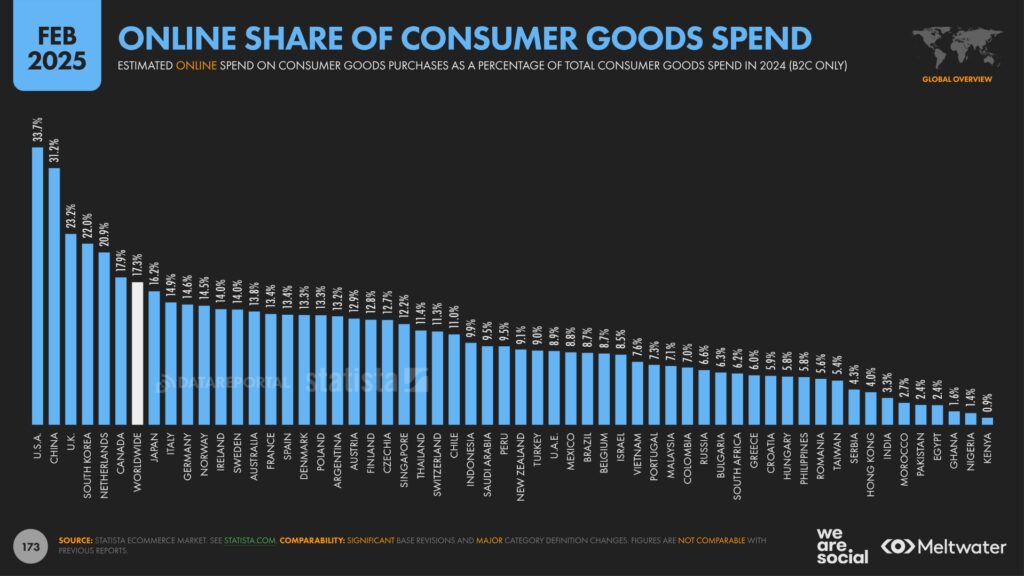
Hungary’s online share of consumer goods spending (February 2025)
Source: Digital 2025: online shopping still popping
Hungary’s share in online consumer goods sales stands at 5.8%, placing the country in the lower part of the presented ranking, between Croatia (5.9%) and the Philippines (5.8%). This result is much lower than the global average of 17.3%, which indicates that the Hungarian e-commerce market in this segment is still developing and has very high growth potential. This means that traditional brick-and-mortar trade continues to play a dominant role, while at the same time offering a major opportunity for online businesses to gain market share in the future.
The Hungarian Shopper – Who Are They and What Do They Buy?
To run effective marketing campaigns, we must first understand who our audience is. Data from February 2025 sheds new light on the behaviour of Hungarian internet users.
Who is the Hungarian e-consumer?
The largest share of online buyers are people aged 25–55, often with higher education and permanent employment. Among those over 55, the percentage is also significant, at around 71%.
Although over 40% of purchases are made via mobile devices, desktops still dominate, accounting for around 56% of transactions. However, mobile optimisation is an absolute necessity to avoid losing the growing group of mobile customers.
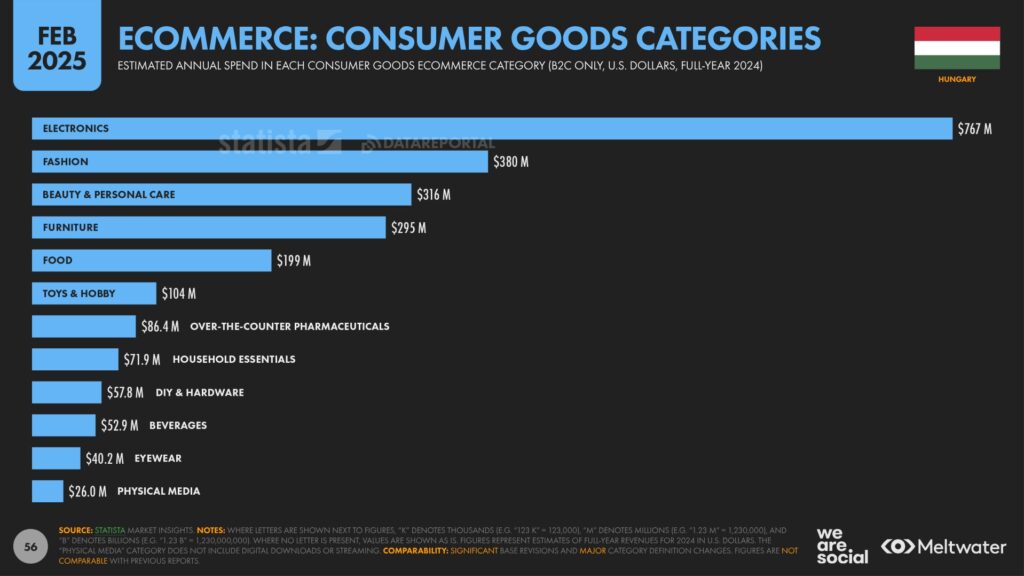
Consumer goods categories in Hungary (February 2025)
Source: Digital 2025 Hungary
Hungarians most often buy clothing, electronics, groceries, and furniture online.
Apart from local giants such as eMAG, Vatera.hu, and Media Markt, Hungarians eagerly use international platforms such as eBay, Alibaba, Booking.com, and Amazon.
Source: Digital 2025 Hungary
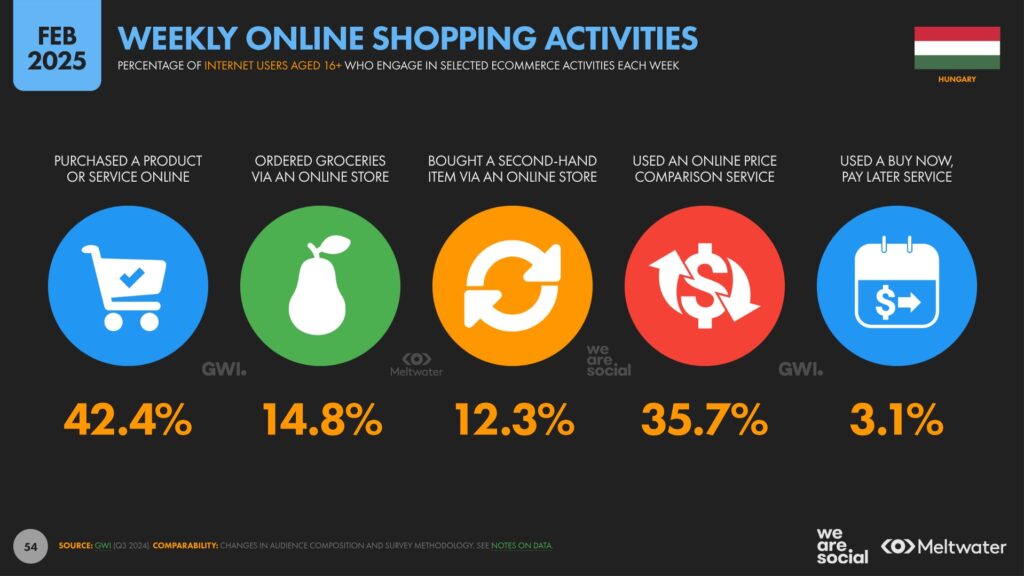
Hungarians are not just browsing for information—they actively shop. Each week:
- 42.4% of internet users buy a product or service online,
- 35.7% use price comparison sites, showing high price sensitivity and the need to find the best deal,
- 14.8% order groceries online,
- 12.3% buy second-hand products.
Why Do Hungarians Use the Internet?
Before making a purchase, Hungarians use the internet for many other purposes. Understanding these motivations allows us to better adjust content marketing strategies.
Source: Digital 2025 Hungary
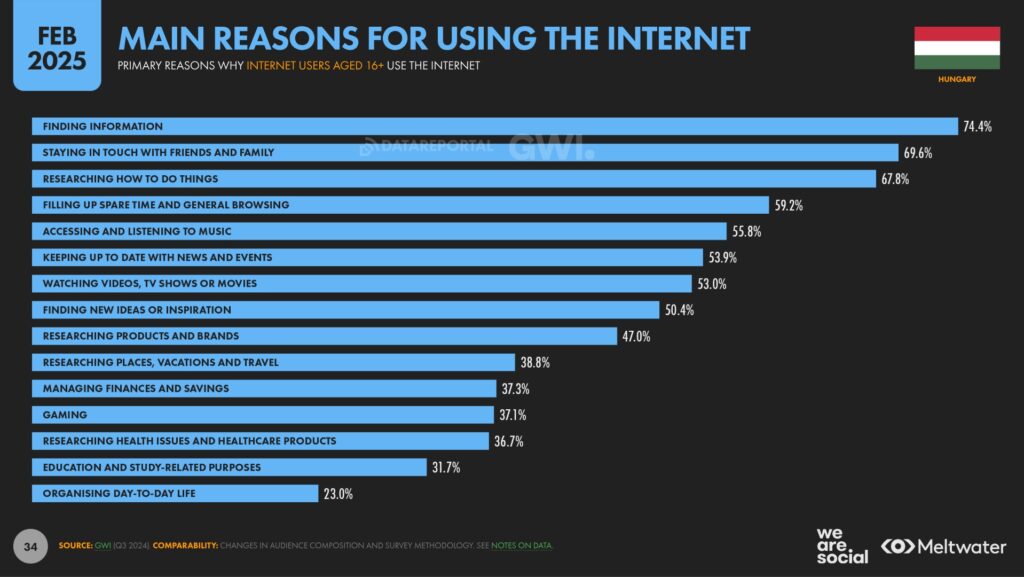
The main reason Hungarians go online is information search, declared by as many as 74.4% of users. Almost as many (69.6%) use the internet to stay in touch with family and friends. Moreover, the internet is an important source of practical knowledge—67.8% of users search for tutorials and instructions. It is also used to fill free time and browse diverse content, which 59.2% of users do. From an e-commerce perspective, it is particularly important that 47% of Hungarians actively research products and brands online before making a purchase decision.
Payment and Delivery Methods
The most popular payment method remains cash on delivery. Despite the growing popularity of credit cards and digital wallets, the attachment to cash is still very strong. The lack of a cash-on-delivery option may cause cart abandonment.
The vast majority—72% of orders—are delivered directly to the customer’s home. Pick-up points account for around 16% of all deliveries.
Which Search Engine Do Hungarians Use Most?
Source: Digital 2025 Hungary
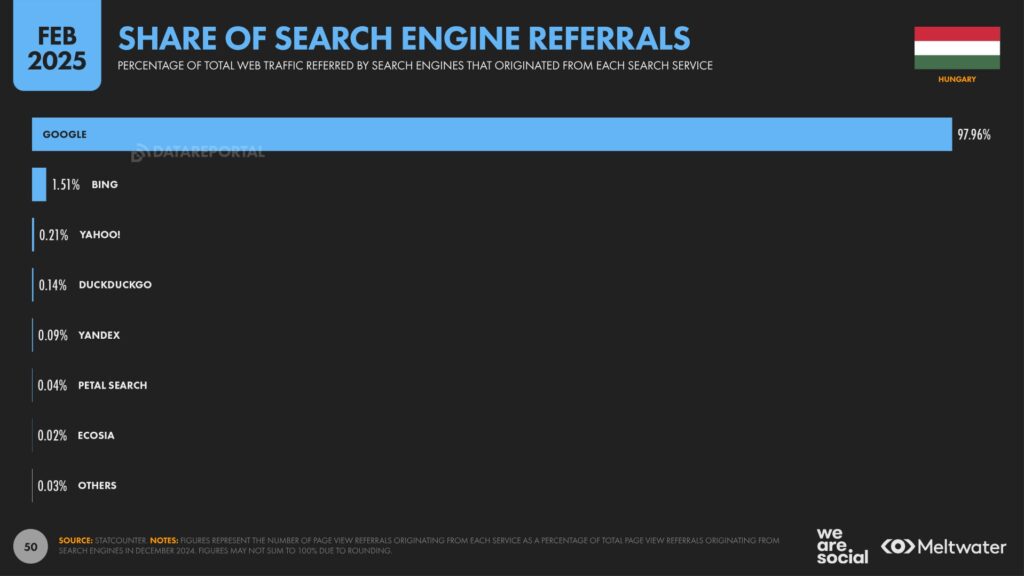
The Hungarian market for search engines is almost a monopoly. According to data from January 2025, Google accounts for 97.96% of all searches. Bing is in second place with 1.51%.
Bing’s different algorithms, despite its lower popularity compared to Google, can generate different search results. This is particularly important for optimisation in the context of artificial intelligence (AISO). For this reason, to comprehensively monitor visibility in AI tools, it is recommended to include Bing as part of an extended SEO strategy.
Key SEO Aspects of the Hungarian Market
Effective SEO in Hungary requires a carefully prepared strategy that takes local specifics into account.
Language and Localisation
Hungarian is absolutely key. It is an agglutinative language with complex grammar, so automatic translations are ineffective and sound unnatural. Investing in professional translations that capture linguistic and cultural nuances is essential for building trust.
Using a local .hu domain or /hu/ is a strong signal to both users and search engines that your company is seriously engaged in the Hungarian market. Registration is available to any EU company, with a minimum period of 2 years.
Technical Optimisation
- Mobile optimisation: Despite desktops dominating transactions, website responsiveness is crucial for user experience and Google ranking.
- Page loading speed: Users expect instant access to content. A slow site means lost customers.
- URL structure: Use SEO-friendly URLs, which may include Hungarian diacritical characters (e.g., á, é, í, ó, ö, ő, ú, ü, ű), as this is good SEO practice.
Content and Keyword Strategy
Create unique, valuable content in Hungarian. Considering that 67.8% of Hungarians search for tutorials and 47% for product information, investing in blogs, detailed product descriptions, reviews, and comparisons is worthwhile. This builds authority and addresses user needs.
Conduct in-depth keyword research based on terms Hungarians actually use, and focus on local SEO. SEO tools will help identify the phrases with the highest potential.
Link Building
Acquire links from credible, local sources—Hungarian industry portals, blogs, and news services. This is one of the most important ranking factors that builds domain authority in Google’s eyes.
To effectively obtain valuable links, it’s worth:
- Adding your site to popular Hungarian business directories, such as Aranyoldalak.hu (Hungarian Yellow Pages) or Cylex.hu.
- Analysing competitors’ backlink profiles (using tools such as Ahrefs or Semrush) to discover where they acquire their most valuable links and attempt to replicate them.
Social Media
Hungarians are very active on social media. It is an excellent channel for building engagement, driving website traffic, and supporting SEO efforts.
Source: Digital 2025 Hungary
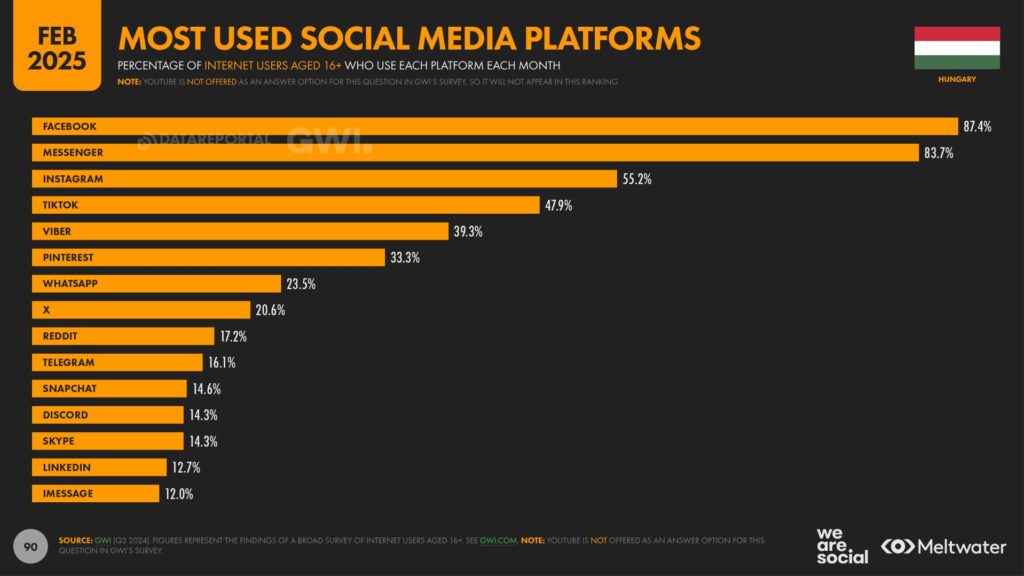
The most popular platforms in Hungary are:
- Facebook: 87.4%
- Messenger: 83.7%
- Instagram: 55.2%
- TikTok: 47.9%
Being active on these platforms, in Hungarian, is a great tool for interacting with users. It is also worth considering cooperation with local influencers to quickly reach a wide audience.
SEO in Hungary – Summary
Expanding into the Hungarian e-commerce market offers enormous opportunities but requires careful preparation and a deep understanding of local specifics. Adapting your SEO strategy to the unique features of the Hungarian market will allow you to effectively reach local consumers and succeed in this dynamically developing region.
Read more about international SEO across different markets here: International SEO Services