 d-tags



 Loading...
In this article, you will find the answers to the following questions:
- What’s the current condition of the Austrian economy?
- How does the e-commerce market look like in Austria?
- What do the Austrians buy the most via the Internet?
- What domain to choose if we want to optimize the website for the Austrian market?
- What are the rules of site optimization in Austria?
Austrian market in a nutshell
Austria is a federal republic consisting of 9 provinces (Bundesländer), with Vienna as its capital. It is a relatively small country located in Central Europe, covering an area of approximately 83,900 square kilometers, which makes it significantly smaller than many EU member states.
Austria has been a member of the European Union since 1995, which enabled its full participation in the EU single market. The removal of trade barriers and the free movement of goods, services, capital, and people have made foreign trade one of the key pillars of the Austrian economy. Today, the majority of Austria’s trade is conducted with other EU countries, particularly Germany, Italy, and Central European markets. In recent years, the total value of Austrian exports and imports has remained close to 190–200 billion EUR annually, demonstrating resilience despite global economic fluctuations.
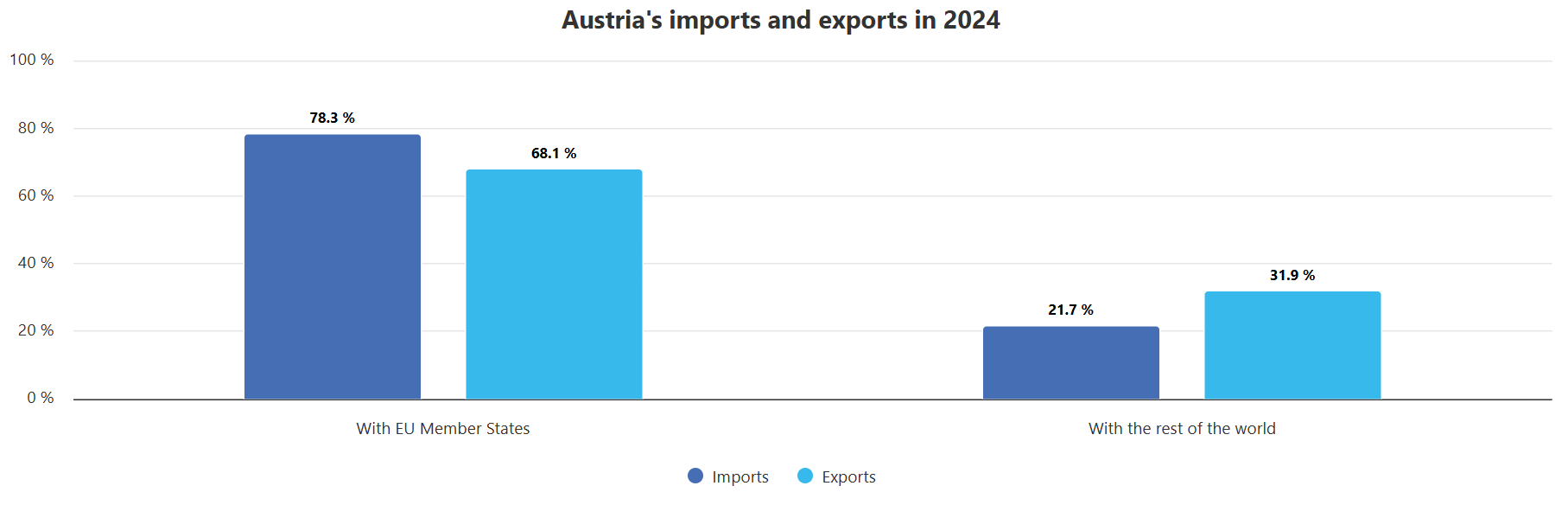
source: https://european-union.europa.eu/principles-countries-history/eu-countries/austria_en
Although Austria is often associated with tourism and agriculture, its economy is strongly dominated by the services sector, which currently accounts for over 70% of GDP. Key areas include trade, transport, business services, and tourism. Austria is widely regarded as one of the most stable economies in the European Union, characterized by high GDP per capita, a strong purchasing power of consumers, and a well-developed infrastructure. These factors make Austria an attractive and relatively low-risk market for foreign investors and companies planning international expansion, including in e-commerce.
E-commerce market in Austria
The e-commerce market in Austria is highly developed and mature. Currently, around 95–96% of the population uses the Internet, which translates into more than 8.5 million active users online. Internet penetration is high across all age groups, making Austria one of the most digitally connected markets in the European Union.
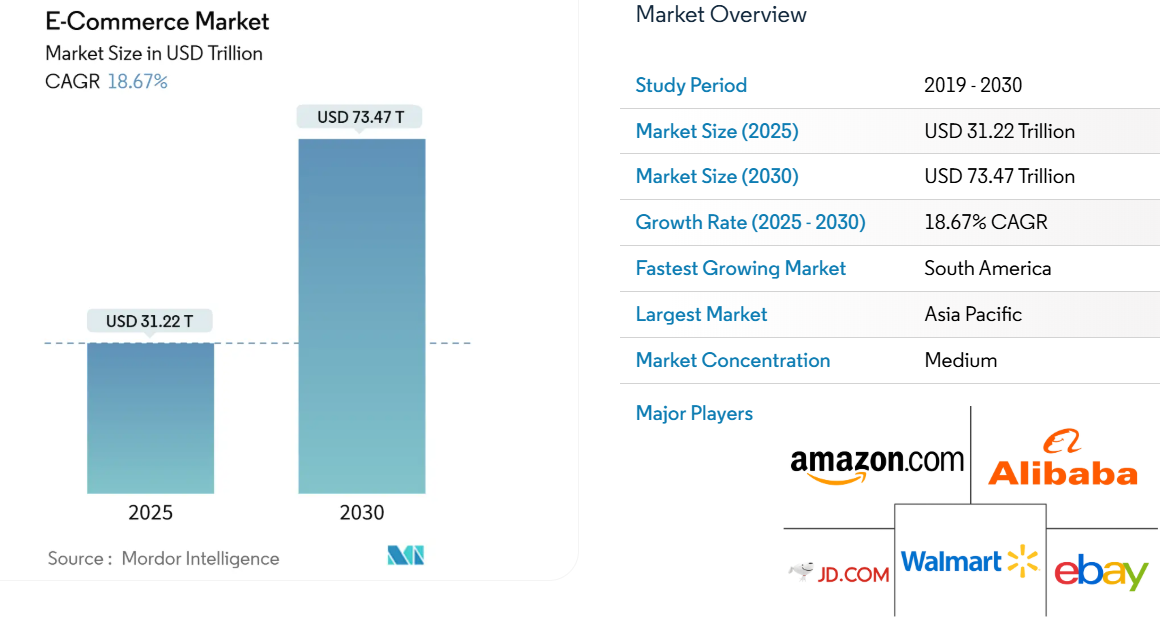
source: https://www.mordorintelligence.com/industry-reports/global-ecommerce-market
Online shopping is widespread: over two-thirds of Austrians regularly purchase products or services online, and e-commerce plays a significant role in the overall retail landscape. The Austrian e-commerce market is estimated to be worth over 10 billion EUR annually, with steady year-on-year growth driven by convenience, cross-border shopping, and high consumer trust in online transactions.
In terms of devices, mobile commerce has become the dominant channel. Smartphones now account for more than half of all e-commerce transactions, while desktop devices remain relevant, especially for higher-value purchases. This shift confirms the importance of mobile-first design, performance optimization, and responsive UX for businesses planning to expand into the Austrian market.
Demographic data shows that the most active online shoppers are users aged 25–44, although e-commerce adoption is strong across all age groups. The gender split among online buyers remains relatively balanced, with only minor differences between men and women. Cross-border shopping is particularly popular among younger consumers, who frequently purchase from foreign online retailers.
Several key trends shape the Austrian e-commerce market today. Mobile shopping continues to grow, and omnichannel solutions such as “click and collect” have become standard expectations rather than niche features. Consumers increasingly value flexibility, transparent delivery options, and seamless integration between online and offline shopping experiences.
For many years, fashion and apparel have remained one of the strongest e-commerce categories in Austria, but other sectors — including electronics, home & living, and groceries — have recorded dynamic growth. The market is dominated by large international platforms such as Amazon and Zalando, which continue to set standards for logistics, customer service, and user experience.
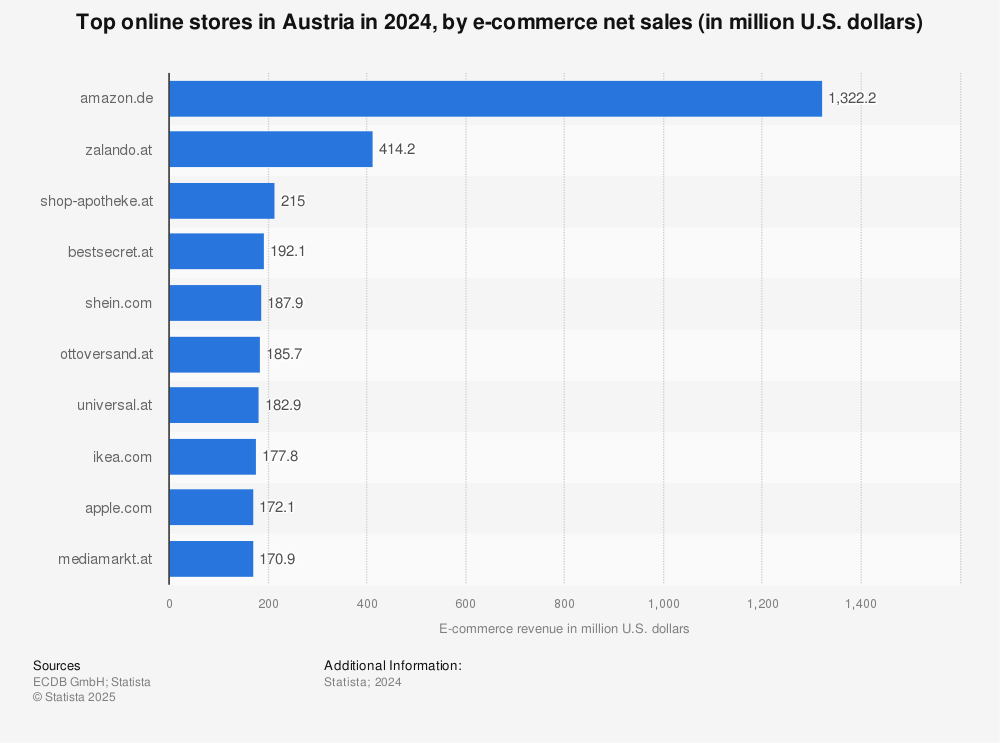
source: https://ecommercenews.eu/ecommerce-in-europe/ecommerce-in-austria/
Payment preferences in Austria reflect a high level of digital maturity. Credit and debit cards, bank transfers, instant payments, and digital wallets are widely used, while cash on delivery is steadily declining. Austrian consumers expect payment processes to be secure, fast, and easy to use. As a result, most online stores operating in Austria offer multiple payment options, typically three or four, to meet customer expectations and reduce checkout friction.
The next component of the e-commerce market in Austria that’s worth taking a closer look at is definitely logistics. According to the World Bank’s ranking of the logistics industry, Austria took the 7th place in 2016 when it came to the easiness of parcel delivery in the country. Even though 66% of Austrian population live on the countryside, there’s a proper infrastructure that makes it possible to deliver the packages quickly and efficiently. (source: www.export.gov).
A lot of products ordered by Austrians online have to be imported. In fact, Austrian customers spent 7,9 billion USD in 2017, from which 4,3 billion USD went to foreign online retailers. All this means that Austrian e-commerce market holds great potential, also for Polish entrepreneurs. That’s precisely why it might be worth to consider offering your products there.
SEO in Austria
Now that you know how e-commerce market looks like in Austria and what are the trends for the next years, it’s time to consider the factors that might influence the success of your brand on an Austrian market. For starters, get familiar with the most significant elements of SEO in Austria.
The language matters
German is the official language in Austria. It’s significant to take into account that the language used in Vienna is slightly different than the one used in i.e. Berlin. There’s a “standard” version of the German language (Hochdeutsch), which young people in German-speaking countries learn at school (Germany, Austria, Switzerland, and Lichtenstein). Nonetheless, the majority uses different dialects, depending on the region they come from. Actually, the Austrian “variety” of the language is said to be similar to the Bavarian dialect. The differences are visible even in the basic phrases and words. Here are a few examples:
- I hob… – Austria, Ich habe… – German (“I have…”)
- leiwand – Austria, gut, erstklassig – German (“good, first-class”)
- hackeln – Austria, arbeiten – German (“to work”)
Such examples can be provided endlessly. In order to translate your website to German properly, no matter which version of the language you aim for, you should, therefore, consider hiring a professional translator, so that you don’t make any mistakes on your website.
Which domain to choose?
The main domain in Austria is .at. It’s a national domain that has been in use from 1988 onwards. It can be easily used for so-called domain hacks with words and phrases that work well with the preposition or ending -at, such as arrive.at. Besides, you can also use the domain .co.at. In both cases, the prices are not very high, you can buy domain for one year for about 25 euros.
There are no specific requirements for anyone who wants to register the above domains. You don’t have to own a company in Austria, and there’s no local representative needed.
Additionally, it’s worth to take into account that choosing the domain .at will bring better results in terms of optimization than, for example, redirecting there the German domain. As a result, our website will be more visible in Google.
Search engines in Austria
If you’re thinking of conquering the Austrian market, you should check what search engines are used there the most. It’s essential since every search engine has its own rules. Below you’ll find the most common search engines in Austria.

Source: http://gs.statcounter.com/
As can be seen, there’s no major surprise. Google ranks first (with almost 48%). That’s precisely why it’s worth optimizing your website according to Google’s rules and guidelines. The next places belong to Safari, Edge and others.
Link building in Austria – where is it worth to build links?
Link building forms a crucial part of effective SEO in every country. In Austria, it’s no different. Not only the number of backlinks referring to the website counts but more importantly – their quality. It matters, especially in Austria. Therefore, whenever you attempt to build links, choose the websites that are seen as high-quality by Google.
The SEO market in Austria is not very big yet. One of the advantages is that there’s a possibility to optimize your website for this market also with the use of .de domains. The links coming from such websites count in Austria as well. When it comes to link building from Germany, though, local SEO is essential. It’s worth building links from social media and Q&A sites, which in German-speaking countries are very specific and more “substantive”. You can also use local catalogs with websites.
As already mentioned, local SEO also matters when it comes to the optimization of your website. If your company has a physical address in a given country, it’s worth to make it public and include it on the website. It increases the credibility of the website, both for the users and Google. If your online store owns some certificates, they can also increase trust if you display them.
Find out more about international SEO services.
Social media in Austria
Social media is another major factor that affects optimization in Austria. It’s a great way to be constantly in touch with your customers. Below you can see what social networks are used the most by the Austrians.

Source: http://gs.statcounter.com/
Among all social networks in Austria, Facebook ranked as the most popular (with approximately 70%). Pinterest is also used quite frequently (nearly 8%). That’s why it might be worth creating a profile and posting images of your products there actively. It’s important to ensure they are all high-quality, and there’s a link to the product page from your store. Other popular social networks in Austria are also YouTube, Twitter, Instagram, and Tumblr.
Top 5 industries on Facebook in Austria are sales, services, FMCG, e-commerce, and fashion. This data stems from the total number of local fans for the 200 biggest and most popular websites in Austria (according to www.socialbakers.com).
AI Search in Austria
Observing the changes that have taken place in search results over recent months, it is impossible to ignore visibility within AI-driven models. In selected markets — including countries of the European Union — Google is gradually rolling out features such as AI Overviews and AI Mode, which influence how users receive answers to their queries.
This means that traditional SEO remains the foundation, but it now needs to be complemented by activities that help build visibility not only in classic search results, but also in AI-generated responses. Such an approach increases the chances that content will be used by Google in new result formats, while still maintaining visibility in traditional organic search results on the Austrian market. Want to be visible in AI-generated answers? Check out our AISO offer and contact us!
A few words to summarize
As you can see, Austria is an attractive market for selling your products for a few reasons. It’s one of the strongest and most stable markets in Europe. In the optimization process, it’s worth to take into account the language, especially when it comes to local SEO. It’s also essential to invest some time and effort in quality link building and social media marketing. If you keep all this in mind, you can easily start conquesting the Austrian e-commerce market.
Sources:
- https://www.mordorintelligence.com/industry-reports/austria-ecommerce-market
- https://www.oecd.org/en/publications/oecd-economic-surveys-austria-2024_60ea1561-en.html
- https://european-union.europa.eu/principles-countries-history/eu-countries/austria_en
- https://cross-border-magazine.com/e-commerce-in-austria-status-2025/