
Event marketing – what is it and how can your brand benefit from it?

6min.

Comments:0

02 May 2025

Event marketing – what is it and how can your brand benefit from it?d-tags
Event marketing is much more than just organizing events — it’s a powerful way to build relationships with your audience and strengthen your brand’s presence. Learn how it works, what business value it brings, and how to promote your events using SEO and SEM strategies.

6min.

Comments:0

02 May 2025

What is event marketing?

Put simply, event marketing refers to promotional efforts centered around organizing events — anything from conferences, trade shows, and training sessions to product demos and even team-building events. These can take place offline (e.g., in conference halls or convention centers) or online (e.g., webinars or livestreams). It’s a key marketing communication tool aimed at building connections with your audience — whether that’s current or potential customers, business partners, employees, or media — and boosting your brand image through direct contact and audience engagement.

It’s important to remember that event marketing is not just about organizing the event itself — it also includes promoting it, engaging with attendees, and analyzing results afterward.

How does event marketing work?

This type of promotion is all about creating emotional, memorable experiences. Attendees get to experience your brand “live” — how you communicate, what your offer looks like, and most importantly, what kind of atmosphere you create. This builds deeper, more authentic relationships than what’s typically achieved through online ads or social media posts alone.

With event marketing, brands can:

  • educate their audience,
  • build a community of engaged followers,
  • boost loyalty among clients and partners,
  • showcase new products or services,
  • generate sales leads (e.g., via event registrations),
  • position themselves as industry experts.

Tips from an experienced Specialist:

From my experience, event marketing always starts with a clearly defined goal, meaning “why am I doing this at all?”. It’s crucial to know what we want to achieve and what actions we will take to get there. This could be, for example, lead generation, brand building, education, or testing. If we don’t have a clearly set direction, it’s hard to evaluate later what worked, what didn’t, and what we should improve in the future. The choice of the right form of communication and booth design is crucial for achieving our objectives. However, let’s remember that, beyond the business aspects, event marketing is also an excellent opportunity to build relationships and motivation among participants. These are what give the event its true value. Moreover, events themselves are a great opportunity to understand the needs of others and, based on this, adjust our actions in the future. This could become an important driver for the next stages of the strategy. After the event, it’s worth doing a retrospective, a kind of self-assessment, and drawing conclusions that will help improve our actions in the future and decide whether it was worth it or if something was missing, or maybe it was a success :))

Agnieszka Gajda
Agnieszka Gajda Marketing Manager

What are the benefits of event marketing?

Event marketing offers a range of powerful business benefits. First of all, nothing replaces real-time interaction — whether in person or online. Talking, engaging, asking questions — it all creates a sense of connection. If the experience is positive, it instantly builds favorable associations with your brand. That kind of engagement is hard to replicate with traditional ad campaigns.

Events also encourage active participation — attendees listen, ask questions, interact. It’s a level of engagement most marketers strive for. If you host events regularly, you also create a long-term relationship with your audience. Asking for feedback after each session and implementing user suggestions shows your audience they matter — that you’re listening and value their input.

What’s more, event marketing helps generate high-quality leads. People who sign up or attend are usually already interested in the topic or product, making them warm leads with strong sales potential.

One of the biggest advantages, in my opinion, is the expert positioning that event marketing allows. Speaking at conferences, hosting webinars, or joining panel discussions highlights your brand’s expertise, experience, and openness to sharing knowledge. This strengthens trust and builds long-term authority.

And let’s not forget the long-term content value. You can repurpose events into video recordings, case studies, ebooks, blog posts — content that continues to drive results long after the event ends.

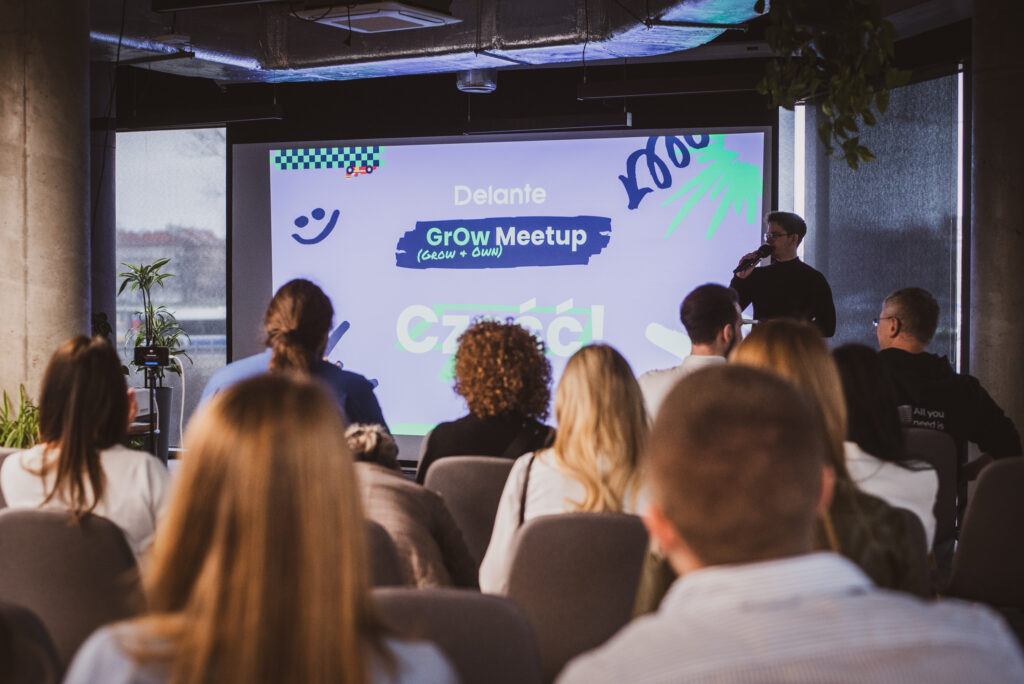
GrOw Meetup at Delante - example of Event Marketing

We’ve experienced all of this firsthand, which is why in 2025 we launched our own recurring event — GrOw Meetup. These quarterly sessions reflect everything that matters to us at Delante: building strong relationships with partners, fostering great networking opportunities, and sharing our knowledge and expertise. We host them at our Kraków office and (for now, at least) they’re held in Polish — but who knows what the future holds? 😉 In the meantime, feel free to sign up for our newsletter to stay in the loop — we regularly share insights and updates there.

newsletter-icon

Sign up for our newsletter!

Discover the latest tips, case studies, and strategies from digital-marketing experts!

Delante – Best technical SEO agency

How to promote your event using SEO and SEM?

Let’s be clear: events don’t promote themselves. 😉 You need a strong promotion strategy tailored to your audience, industry, brand tone, and logistical capabilities. Whether it’s through SEO, Google Ads, or Meta Ads, you need to align your event marketing with your broader business goals.

As an SEO/SEM specialist, here are a few practical tips from experience that might help if you’re considering these channels.

Promoting events with SEO

If SEO is the right channel for you, start early — this strategy takes time to show results and likely won’t work well for last-minute promotions.

  • Start with the event page (either a landing page on your current site or a standalone website). It should be optimized with relevant keywords (e.g., “medical conference,” “healthcare event”), and clearly describe what the event is about, when and where it takes place, why it’s worth attending, whether it’s free or paid, if there’s a certificate, who’s speaking, and the agenda. Include photos or videos from previous editions (if it’s recurring). Speak directly to your target audience using benefit-driven language. Don’t forget about user experience (UX) — make sure your page is easy to navigate and registration is quick and seamless. If you use third-party registration tools, include a clear link and even a short explanation of the process. Make it easy to follow your social media, share the event, and leave comments — it’s great for community building and boosts user-generated content (UGC), which is beneficial for SEO.
  • Also, consider using structured data markup like https://schema.org/Event to enhance visibility in search engines.
  • Create supporting content to boost visibility. For example: Blog posts (e.g., “5 reasons to attend XYZ Medical Conference”), expert articles (e.g., pre-event speaker spotlights), FAQ sections (e.g., how to get there, whether it’s livestreamed, how to sign up), recaps of previous editions (e.g., “Highlights from XYZ Conference, February 2025”).
  • If your event is not online, local SEO is crucial. Use the city name in your copy, show the exact address, embed a map, and provide transportation tips.
  • Link building also plays a major role — get your event listed on industry websites, event calendars (like my post “2025 Marketing, SEO & PPC Events” – a few people have reached out to me, and I added their events here 😉 ) or niche blogs and media outlets. These backlinks help boost Google rankings and improve visibility. Plus, they create valuable brand mentions.
  • Most people search for event info on mobile devices, so your page must be fully responsive. Embedding a Google Maps / Apple Maps link is helpful — especially for attendees trying to navigate to your venue the day of the event.

Promoting events with SEM

Paid advertising is a great way to increase visibility and reach a broader audience. Consider the following formats:

  • Google Ads – A highly effective channel for promoting local and industry events. The best-performing campaigns include: Search ads – target specific queries like “2025 medical conference,” “healthcare event San Diego”, Demand Gen, Remarketing ads – re-engage users who visited your event page, Geotargeted ads – perfect for events in specific locations.

    Pro tip: run ads at least 2–3 weeks before the event — that’s the key decision-making window for most participants. For recurring events, align campaigns with key ticket milestones (e.g., early bird pricing).
  • YouTube Ads and video campaigns – If you have a teaser video or speaker invitation, promote it with: In-Stream Ads (e.g., before relevant videos), Discovery Ads (shown as recommended content or repurpose them on TikTok and Instagram as short-form video ads), Google Display Network (GDN) – Use banner ads for brand awareness and remarketing — especially on relevant industry websites, Performance Max campaigns – If you want full multichannel coverage (Google Search, Display, Gmail, YouTube), Performance Max is worth testing. Just be sure your creative assets (headlines, visuals, CTAs) are well-designed.

Summary

Event marketing is a highly effective way to build your brand, engage with your audience, and drive qualified leads. But organizing the event is only half the job — promotion is just as important. SEO and SEM play a key role in helping you reach the right people, boost registrations, and maximize your event’s impact as part of your overall marketing strategy.

If you’d like support with your next event campaign — contact us! We’re here to help. 🤗

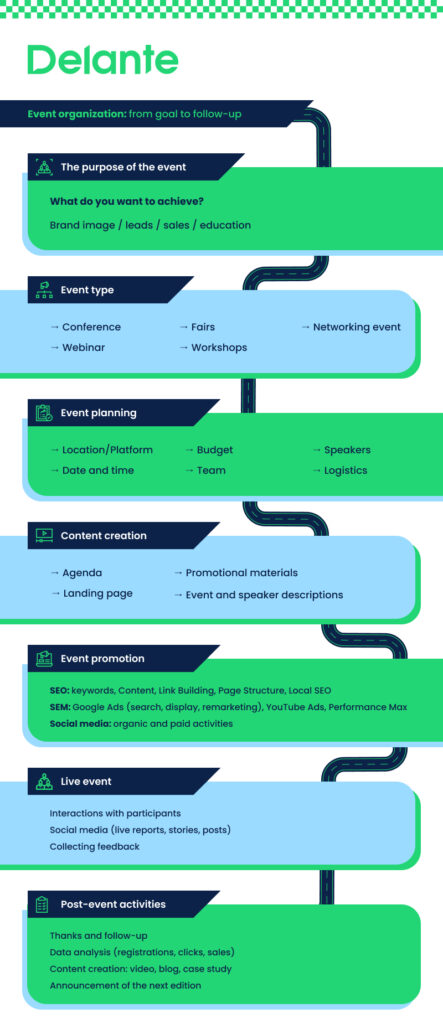
And as a complement to the summary, check out our infographic that illustrates how to approach event organization and marketing. 🚀

An infographic illustrating key steps in event marketing and organization.
Author
Joanna Nicpoń - SEO specialist
Author
Joanna Nicpoń

Senior SEO Specialist

Senior SEO Specialist. At Delante since August 2017. She specializes in SEO strategies for E-commerce, IT, and YMYL sectors (including PL, US, UK, and DACH markets). By combining technical optimization with a business-driven Customer Success approach, she builds profitable, long-term client relationships. An expert in content strategies and website migrations. Project Manager and author of the case study nominated for the Global Search Awards 2024. After hours: cinema, traveling, and Heroes III.

Author
Joanna Nicpoń - SEO specialist
Author
Joanna Nicpoń

Senior SEO Specialist

Senior SEO Specialist. At Delante since August 2017. She specializes in SEO strategies for E-commerce, IT, and YMYL sectors (including PL, US, UK, and DACH markets). By combining technical optimization with a business-driven Customer Success approach, she builds profitable, long-term client relationships. An expert in content strategies and website migrations. Project Manager and author of the case study nominated for the Global Search Awards 2024. After hours: cinema, traveling, and Heroes III.