Marketing in a year of low trust: how to build brand credibility in the age of AI?

6min.

Comments:0

29 December 2025

Ads
Marketing in a year of low trust: how to build brand credibility in the age of AI?d-tags
In the era of deepfakes, misinformation, and the growing use of AI, trust has become the scarcest currency in marketing. Consumers are already tired of ubiquitous AI-generated content, and it is becoming increasingly difficult for them to distinguish between what is real and what is a deepfake. Find out how to maintain brand credibility and monitor whether anyone is impersonating your brand.

6min.

Comments:0

29 December 2025

The AI paradoxbalancing capabilities and user preferences

Many entrepreneurs have become fascinated by AI and are eager to use it across various aspects of their business—to write emails, create chatbots for their websites, write articles, post on social media, and create graphics.

And this is where the AI paradox comes in. According to a survey conducted by HubSpot, 75% of marketing leaders say that AI will become increasingly important and more frequently used in their strategy. At the same time, 84% prefer human contact to an AI assistant.

Only 19% of consumers worldwide feel excited about AI – significantly more feel concerned (34%) and skeptical (30%). As an entrepreneur or marketer, remember to maintain a balance between the almost unlimited possibilities offered by AI and what customers actually prefer.

More and more customers will pay attention to credibility

In the age of AI, an online store can be set up in just a few clicks. As a result, it is increasingly common to encounter unverified, suspicious websites, and users are more sensitive to potential scams.

Therefore, when thinking about creating your brand in 2026, consider how you can ensure credibility above all else. In the age of AI Search (ChatGPT, Gemini, Perplexity) and Social Search (YouTube, Reddit, TikTok):

  • Reliable, expert content wins over typical marketing messages.
  • All data confirming your credibility – tax ID, Company Registration Number, physical address, contact details – should be included on the website.
  • Authors signed by name win over the brand logo alone.
  • Case studies, customer reviews, and portfolios will be even more critical than before.
  • Transparency is essential, both in actions and communication.

All Trust Signals, i.e., indicators that will allow customers to verify your brand, will be crucial in 2026.

How can you monitor whether someone is impersonating your company/brand?

Deepfakes, the ability to use a brand’s voice or image and replicate it with AI, make impersonating a brand easier than ever. This carries the risk of a huge image crisis or even legal abuse and fraud by scammers.

Between 2024 and 2026, the number of deepfakes is projected to increase by over 900%.

What can these attacks involve?

  • impersonating the CEO,
  • false PR messages,
  • manipulated video content about products,
  • fabricated “expert opinions,”
  • generated screenshots and conversations.

In 2026, every company should know how to detect attempts to impersonate a brand and quickly neutralize misinformation incidents.

What should you pay special attention to?

  • The appearance of social media profiles using a name, logo, or visual identity that is strikingly similar to the official one,
  • The registration of domains containing the brand name with minor modifications (typos, hyphens, different endings).
  • Messages sent “on behalf of the company” that the marketing, PR, or customer service team is unaware of.
  • Sudden questions or complaints from customers about offers, promotions, or messages that the company did not actually send.

The brand should regularly monitor social media and search engines for any fake websites and profiles impersonating the company. Tools for monitoring brand mentions, such as Brand24, are also a good solution. It is also worth developing a company-wide process for reporting suspected incidents.

What to do if you suspect someone is impersonating your company?

  • First, verify the source of the message and ensure it is not content published by your company.
  • Secure the source of the incident – take screenshots of the fake profile or message.
  • Report fake accounts or content to the platforms where they appeared.
  • Inform your audience, customers, or partners about the attempted fraud and indicate which accounts are authorized channels for your brand.
  • In more serious cases, consider legal action.

Mass production of content by AI and user preferences

It is estimated that by 2026, as much as 60-70% of the internet will consist of content created by artificial intelligence models. What could be the effect of this?

  • AI models “hallucinate” – they are programmed always to give the most likely answer and do not admit a lack of knowledge on a given topic. As a result, they can easily mislead users who do not verify the information they receive.
  • Errors spread virally – someone asks AI to write an article, which contains a factual error. Other websites or accounts unwittingly repeat the error, citing this source. As a result, false information generated by AI can go viral.
  • Recipients do not know who to trust – the mass production of AI content, not only written, but also in the form of videos or podcasts, makes it increasingly difficult for recipients to distinguish reliable content. This leads to a general decline in trust, especially if the brand’s communication is not sufficiently credible.

In addition, users are simply becoming “allergic” to typical AI-generated content. Specific phrases, punctuation, sentence structure, and characteristic errors in graphics – recipients encounter all of these far too often. A brand that overuses AI in its communications, without any verification or human touch, can lose a lot and discourage potential customers. 

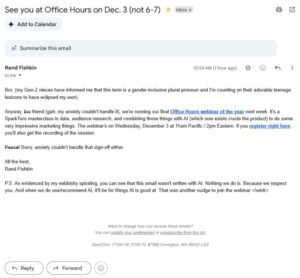
This is perfectly illustrated by Rand Fishkin, who shared his email with newsletter subscribers on LinkedIn. The email is funny, written in a human tone, and uses personal storytelling. The result? The most responses to an email the company has received this year.

linkedin post email

Source: LinkedIn

Transparency in the context of AI will be your advantage

Almost 3 out of 5 consumers (60%) say it is very important to them that companies disclose when they use AI. (1) Despite this, many brands still do not do so.

  • Are you creating a promotional video for your company with the help of AI? Include this information in the description or use the functionality designed for this purpose. Users must be aware that they are viewing content generated by AI.
  • Is your chatbot AI-based? Inform users that they are talking to a bot, and also provide information on how to contact a human employee. Many users dislike communicating with bots and are unable to get answers to their questions, so it is important to provide them with easy access to an alternative contact method.
  • If you use AI to help you write emails, verify what you send to customers. Many brands do not even pay attention to the message they send out, which can then cause image crises. Read such emails, modify them, and add something of your own. Users want to read messages from people, not bots.

Don’t want to risk a crisis and a loss of trust in your brand? Make sure that as you enter 2026, you take two key things into account:

  • AI Policy – prepare rules for the responsible use of AI in your company. Specify which models employees can use, for what purposes, and what data should not be entered into AI. Inappropriate use of AI not only poses reputational risks but also legal issues, e.g., in the case of sharing customer data.
  • Human Review – designate employees responsible for verifying all content that will be released externally.

Showcase your company’s expertise and human side

In an era of low trust, both algorithms and people will pay attention to expertise. What should companies do to strengthen their image as experts?

  • Showcase your employees, credit them for the content they create – preferably with their first and last names.
  • Build your brand on social media for both the company and your experts. In terms of industry, LinkedIn and YouTube will be the most important.
  • Publish case studies with real statistics and results.
  • Document the knowledge and processes in your company. Show how you operate and how you help your customers.
In short, your brand should not be an “impersonal logo,” but a team of competent people who are experts in your industry. In the context of building trust, which has been undermined by the widespread use of AI, the most important thing will be to show the human side of your business.

Do what AI cannot do – be creative

In the context of content creation, the best thing you can do is to stand out from the mass-produced AI articles. AI content is generated based on statistics and probability – it cannot replicate human creativity. And that should be your superpower!

Create creative content, come up with connections that AI would not think of. Also, use storytelling – it is an essential manifestation of the “humanity” of your content – after all, artificial intelligence does not have its own experiences to share. An example of such content is a video recorded by our Business Growth Advisor, Giuseppe, who used Italian stereotypes to talk about SEO. Check out the video:

Want to see how your brand looks in AI and whether it is vulnerable to misinformation?

Write to us! We will help you check your brand’s visibility in AI. We will assess how models describe your brand and whether they exhibit errors, hallucinations, or false data. We will also help you plan actions to strengthen your online credibility in 2026.

AI Visibility Monitoring & AI Traffic Report

Learn more!
Wojciech Urban
Wojciech Urban Senior SEO R&D Specialist

Brand credibility in the age of AIsummary

  • In the age of deepfake AI-driven content and mass AI-generated content, trust is becoming a key competitive advantage, and brands must consciously balance automation and human contact.
  • Audiences are increasingly verifying the credibility of companies, which is why expert content, transparency, real authors, case studies, and clear signals of trust will be the absolute foundation of marketing in 2026.
  • Impersonating brands using AI is becoming a real threat, so companies should actively monitor the internet and have crisis response procedures in place. Abuse of AI-generated content without human review leads to a decline in trust, repetition of mistakes, and audience fatigue with formulaic content.
  • The strongest brands in 2026 will focus on transparency in the use of AI, showcasing experts, and creativity based on human experiences that AI cannot replace.

Sources:

https://offers.hubspot.com/ai-report-surveymonkey

Author
Wojciech Urban - Senior SEO R&D Specialist
Author
Wojciech Urban

Senior SEO R&D Specialist

R&D specialist in SEO and web analytics. He feels most comfortable in the area of technical SEO, and his main task is to ensure that websites are optimized for search engines and achieve high rankings in search results.

FAQ

Does the use of AI in marketing reduce brand trust?

No, provided that AI is used responsibly, transparently, and always with human verification of content, because audiences trust brands that maintain authenticity and a “human touch” more.

How can a company detect and respond to attempts to impersonate its brand?

The brand should regularly monitor social media, search engines, and domains, and in the event of an incident, quickly secure evidence, report false content to platforms, and inform recipients about official communication channels.

Should brands inform their audience that they use AI in their communications?

Yes, because transparency about the use of AI increases consumer trust and can become a real competitive advantage, especially in times of growing skepticism about automatically generated content.