Portugal attracts with its climate, cuisine, and relaxed pace of life. For you as an entrepreneur, it offers another advantage: a market with enormous digital potential, yet still relatively uncontested by competition. How can you ensure successful SEO in Portugal? You'll find the answer below!
Portugal is a small country located at the southwestern tip of Europe, with just over 10.5 million inhabitants. Small, yet full of potential. It’s situated on the Iberian Peninsula, sharing borders only with Spain and the Atlantic Ocean, making it a natural bridge between Europe and the markets of South America and Africa.
The largest economic centers are Lisbon – the capital with over 2.8 million residents in its metropolitan area – and Porto, the second-largest city with a population exceeding 1.7 million.
As for the currency, things are simple. Since 1999, the Portuguese have been using the euro, which greatly simplifies life for entrepreneurs from other EU countries. There’s no need to worry about currency conversions or exchange rate fluctuations – everything operates under a stable, unified currency.
However, the most important thing to remember from the start is that people in Portugal speak Portuguese. And no, it’s not the same Portuguese spoken in Brazil – but we’ll cover that in more detail later on.
What Does the E-Commerce Market in Portugal Look Like?
According to Insight Market Reports, the Portuguese e-commerce market is valued at $6.45 billion in 2025, and the outlook is highly promising – it’s projected to reach $11 billion by 2030. That’s an average annual growth rate (CAGR) of 11.33% – an impressive figure that excites many entrepreneurs. It’s a much faster pace than in mature markets like Germany or the UK.
Interestingly, Portugal has only recently started to unlock its full e-commerce potential. A few years ago, Portuguese consumers were still skeptical about online shopping. In 2020, only 35% of internet users shopped online. The COVID-19 pandemic accelerated that transformation, and recent data shows that nearly half of Portugal’s population (48.9%) made online purchases between February and April 2024, representing a 5% increase compared to 2023.
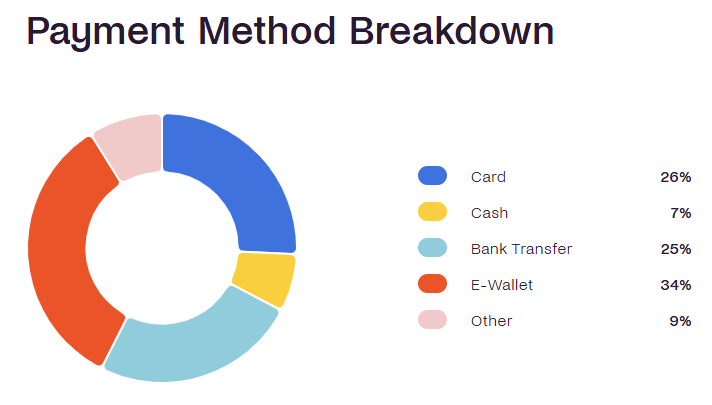
What Are the Most Popular Online Payment Methods in Portugal?
Digital wallets (34%)
Credit cards (26%)
Bank transfers (25%)
Cash on delivery (7%)
Other methods (9%)
Source: https://www.ppro.com/countries/portugal/
The undisputed leader among e-wallets is MB WAY – a local payment solution with over 5 million active users and around 9 million monthly transactions. MB WAY is more than just a wallet – it’s a mobile app linked to a user’s phone number, allowing instant payments using a PIN or fingerprint.
The second cornerstone of Portugal’s payment ecosystem is Multibanco – a national bank transfer system based on SEPA standards.
Entering the Portuguese market without integrating MB WAY and Multibanco is like trying to sell in Poland without BLIK or Przelewy24 – it simply won’t work.
And one more interesting fact: cash on delivery still accounts for around 7% of transactions. Despite growing digitalization, some consumers still prefer to see the product before paying for it. This payment option remains especially popular among older generations and residents of smaller towns.
What Do Portuguese Consumers Buy Online Most Often?
Clothing and footwear top the list – no surprise there. 73.1% of online shoppers choose this category, which makes up about 24% of all online stores in the country.
Next are home and garden products (around 13%), followed by categories such as food delivery (39.6% of consumers ordered meals online in 2024), cosmetics and wellness (31.4%), and computer equipment (28.4%).
Also worth noting: Portuguese consumers are very open to international shopping – 69% have purchased products from stores outside Portugal.
What Are the Most Popular Search Engines in Portugal?
As for browsers, Chrome dominates with a 71% market share, followed by Safari (11%), Edge (8%), Opera (4%), and Firefox (2%).
Who Is the Portuguese E-Customer?
To succeed in Portugal, you need to understand your audience. In terms of SEO, it’s important to know that Portuguese users are still strongly attached to their computers. Here’s the traffic split:
Portugal goes against the global “mobile-first” trend. Why? Portuguese users often research products on their smartphones – browsing offers on the bus, checking prices during coffee breaks, or reading reviews on the couch. But when it’s time to finalize the purchase, especially for higher-value items, they often switch to a computer for better clarity and control.
This means your UX and SEO optimization strategy must perform flawlessly on both desktop and mobile. Neglecting either will harm conversions, as both platforms are essential in the customer journey.
Portuguese shoppers also love comparing prices before buying. They’ll check several stores, reviews, and delivery conditions before clicking “buy now.” The most popular price comparison site is Kuantokusta.pt (“How much does it cost?”) – a key starting point for many consumers.
How to Approach Content and Language in SEO for Portugal
Here comes perhaps the most crucial part – European Portuguese and Brazilian Portuguese are not the same language. Seriously. We’re not just talking about accents or a few words. They are distinct varieties, and using the wrong one can ruin your SEO strategy.
Everyday vocabulary differs significantly. For example:
“Train” is “comboio” in Portugal, but “trem” in Brazil
“Bus” is “autocarro” in Europe, but “ônibus” in Brazil
“Mobile phone” is “telemóvel” in Portugal, but “celular” in Brazil
“Juice” is “sumo” vs “suco”
“Fridge” is “frigorífico” vs “geladeira”
There are hundreds of such examples. Using Brazilian Portuguese in Portugal immediately sounds foreign – and locals notice it instantly.
Grammar differs too. In Portugal, the “estar a + infinitive” form is used for the present continuous (e.g. “Eu estou a ler” – I am reading), while in Brazil it’s “estar + gerundio” (“Eu estou lendo”). Pronoun usage also varies – “tu” is informal in Portugal, while “você” is considered more formal; in Brazil, “você” is used almost universally.
For SEO, these distinctions have major implications. Search queries used by Portuguese people differ from those in Brazil, so keyword research must be conducted separately for each market.
Content localization means adapting your tone, message, and phrasing to the Portuguese context, not just translating words. This includes everything – product descriptions, blog posts, ad campaigns, buttons, system messages, FAQs, and return policies.
How to Do SEO in Portugal: Key Things to Remember
SEO strategy in Portugal isn’t a revolution compared to what we know from other markets – the fundamentals remain the same. The difference lies in the details, and as we know, the devil is always in the details.
1. Technical Audit – Build on Solid Foundations
Start with the technical side. Make sure your site is fully indexed, performs well on both desktop and mobile, and handles multiple language versions correctly. If you target multiple markets, ensure proper use of hreflang tags so Google knows which content is meant for whom. It’s better to fix technical issues early than firefight later.
2. Keyword Research
Investigate how Portuguese users actually search for your products or services. They often use abbreviations, local terms, or idiomatic expressions that outsiders might overlook. Use tools like Semrush, Ahrefs, or Google Keyword Planner – but also manually analyze search results in Lisbon or Porto to see what real users type.
3. Content Localization and UX
Portuguese users value local standards – in both language and communication. Ensure everything feels local: prices in euros, addresses in the Portuguese format, phone numbers with the +351 prefix, and business hours that match local habits. Even form labels and call-to-action texts should sound natural to locals.
4. Link Building
Build relationships with local websites, blogs, and media outlets. Links from Portuguese domains (.pt) carry exceptional value and strengthen your site’s authority in Google’s eyes. International backlinks help too, but without local references, it’s hard to compete with businesses investing in domestic SEO strategies.
5. Google Business Profile
If you have an office, warehouse, or pickup point in Portugal, make sure to create a Google Business Profile. Keep your NAP data (Name, Address, Phone) consistent across all channels. Customer reviews are extremely important in Portugal and can be a deciding factor for many buyers. Encourage satisfied clients to leave feedback and respond politely to both praise and criticism.
How to Succeed with SEO in Portugal: Final Thoughts
Expanding into a new market is a bit like diving into unknown waters. The saying “different countries, different customs” couldn’t be more accurate. Without proper preparation, it’s easy to waste your budget and fail spectacularly. Portugal has its own rhythm, rules, and consumers you need to understand.
If you think simply translating your site into Portuguese will bring a flood of orders – sorry, it won’t. But here’s the good news – with thorough research, solid technical setup, and tailored SEO optimization, your business can successfully thrive on the western edge of the Iberian Peninsula.
In truth, effective international SEO is a full-time mission requiring expertise, tools, and time. So why split your focus? At Delante, we take care of your visibility in Google across foreign markets. You focus on growing your business – we’ll make sure Portuguese customers find you easily.
SEO Specialist with experience in copywriting. He has been with Delante since 2023, where he combines creative writing with an analytical approach to SEO. A graduate of the Jagiellonian University (Journalism and Social Communication, Sports Management). Outside of work, he is an active fan of sports, cooking, and TV series.
SEO Specialist with experience in copywriting. He has been with Delante since 2023, where he combines creative writing with an analytical approach to SEO. A graduate of the Jagiellonian University (Journalism and Social Communication, Sports Management). Outside of work, he is an active fan of sports, cooking, and TV series.


 d-tags


 Loading...