 d-tags



 Loading...
Table of Contents
- A Few Words About Russia
- E-commerce Market in Russia
- SEO in Russia – What to Focus On?
- 10 Factors That Affect Ranking in Yandex
- Yandex Products That Support SEO in Russian
- A Few Words About Google.ru
A Few Words About Russia
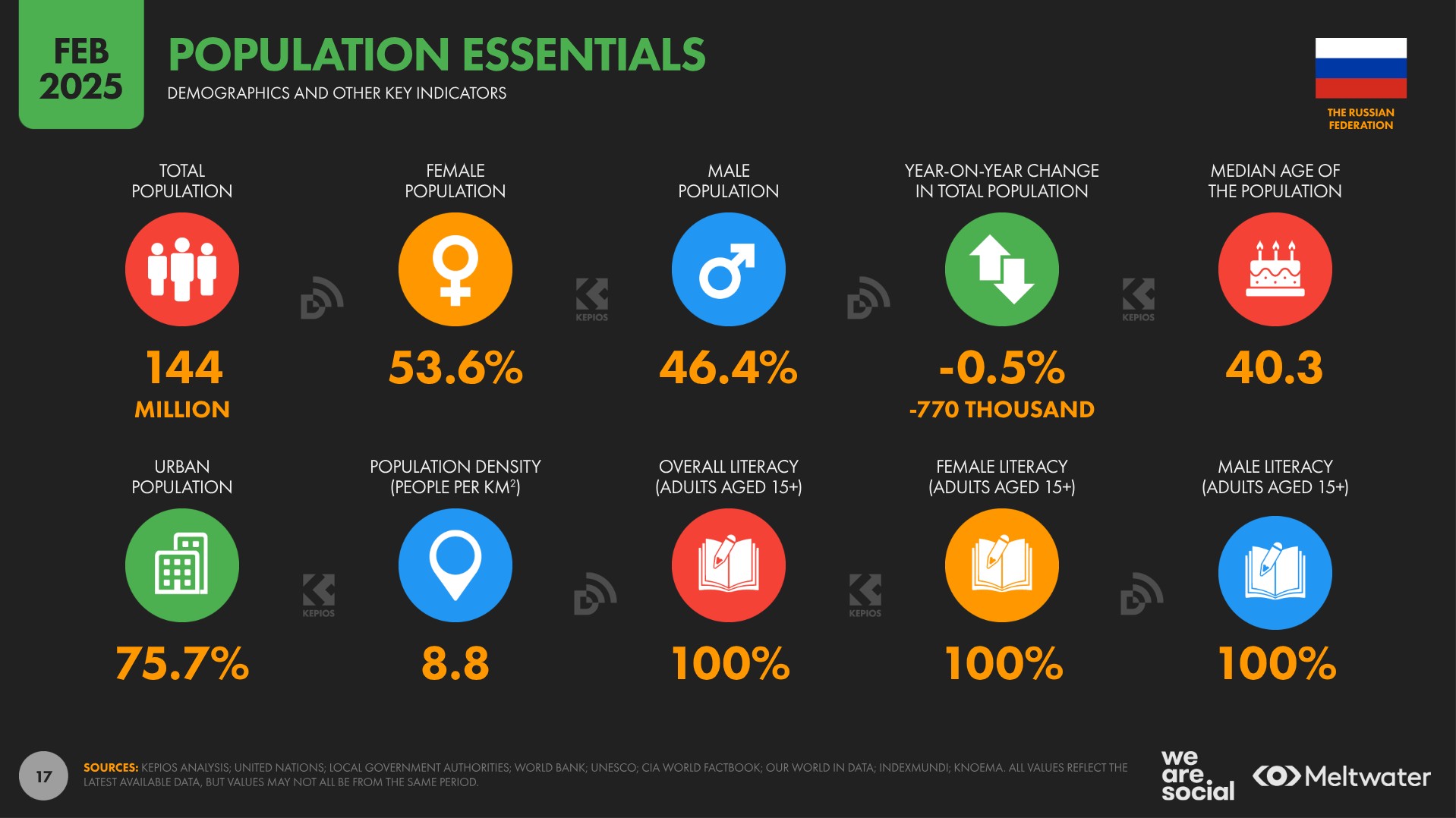
Russia is undoubtedly one of the most fascinating countries in the world. It is nearly 55 times larger than Poland, with 144 million inhabitants, of which more than 75% live in cities. Over half of the population is female (53.6%), and 46.4% are male. In 2025, Russia experienced a 0.5% decline in population, approximately 770 thousand people. This country is primarily known for its beautiful nature. It is home to the deepest lake in the world, several thousand-meter mountain peaks, and vast coniferous forests stretching for thousands of kilometers.
The official language of Russia is, of course, Russian, written in grazhdanka – a simplified form of Cyrillic. This fact undoubtedly influences the functioning of the e-commerce market in the country and, consequently, SEO.
E-commerce Market in Russia
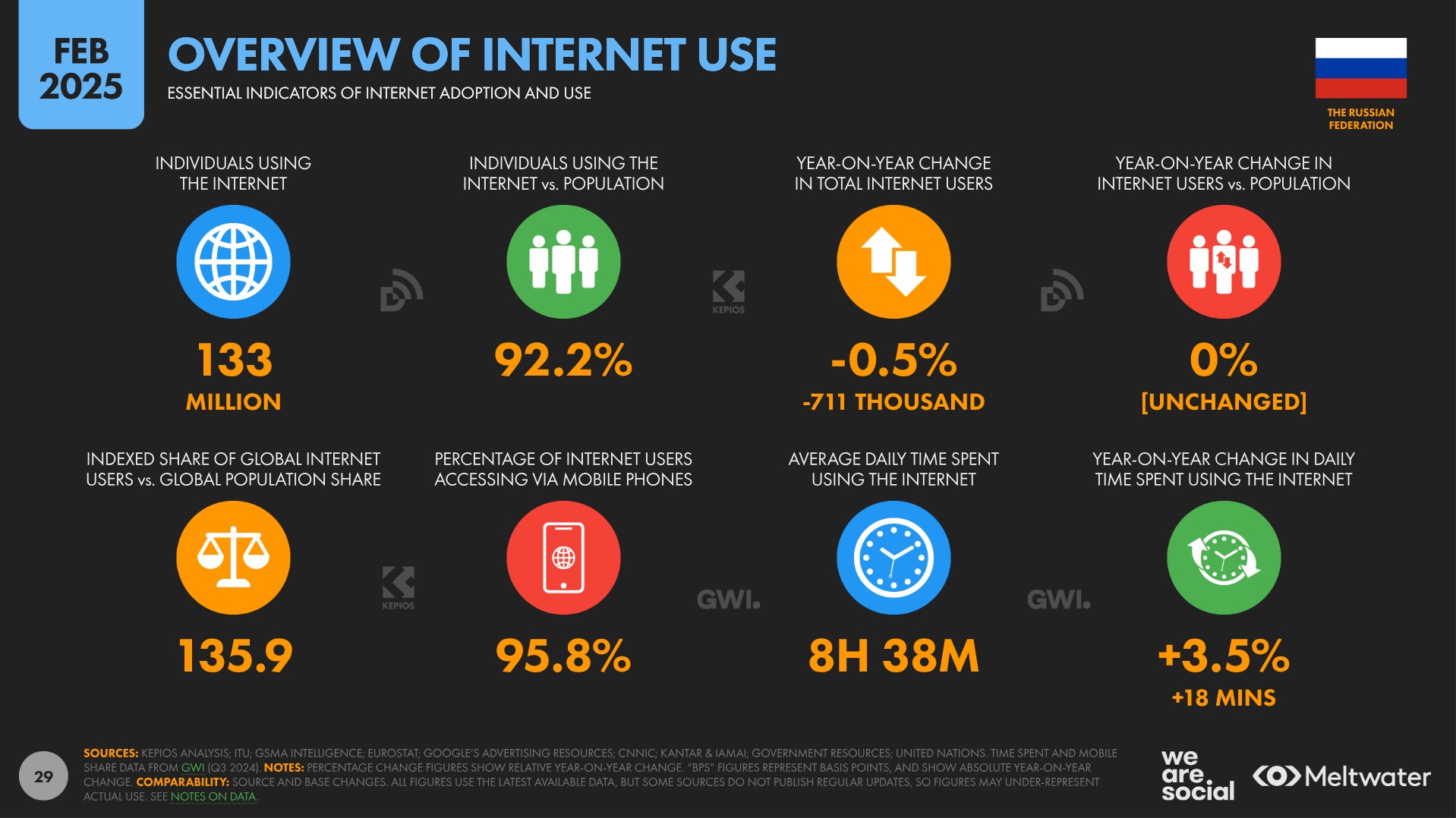
Business owners wanting to enter the Russian market should be pleased to know that the percentage of internet users in Russia is increasing every year – in 2025, 92.2% of residents use the internet, which is a 0.5% increase compared to 2024. It is also worth noting that 95.8% of internet users in Russia access the internet via mobile phones. In 2018, this percentage was 92.4%, so the growth over the last 7 years has been noticeable.
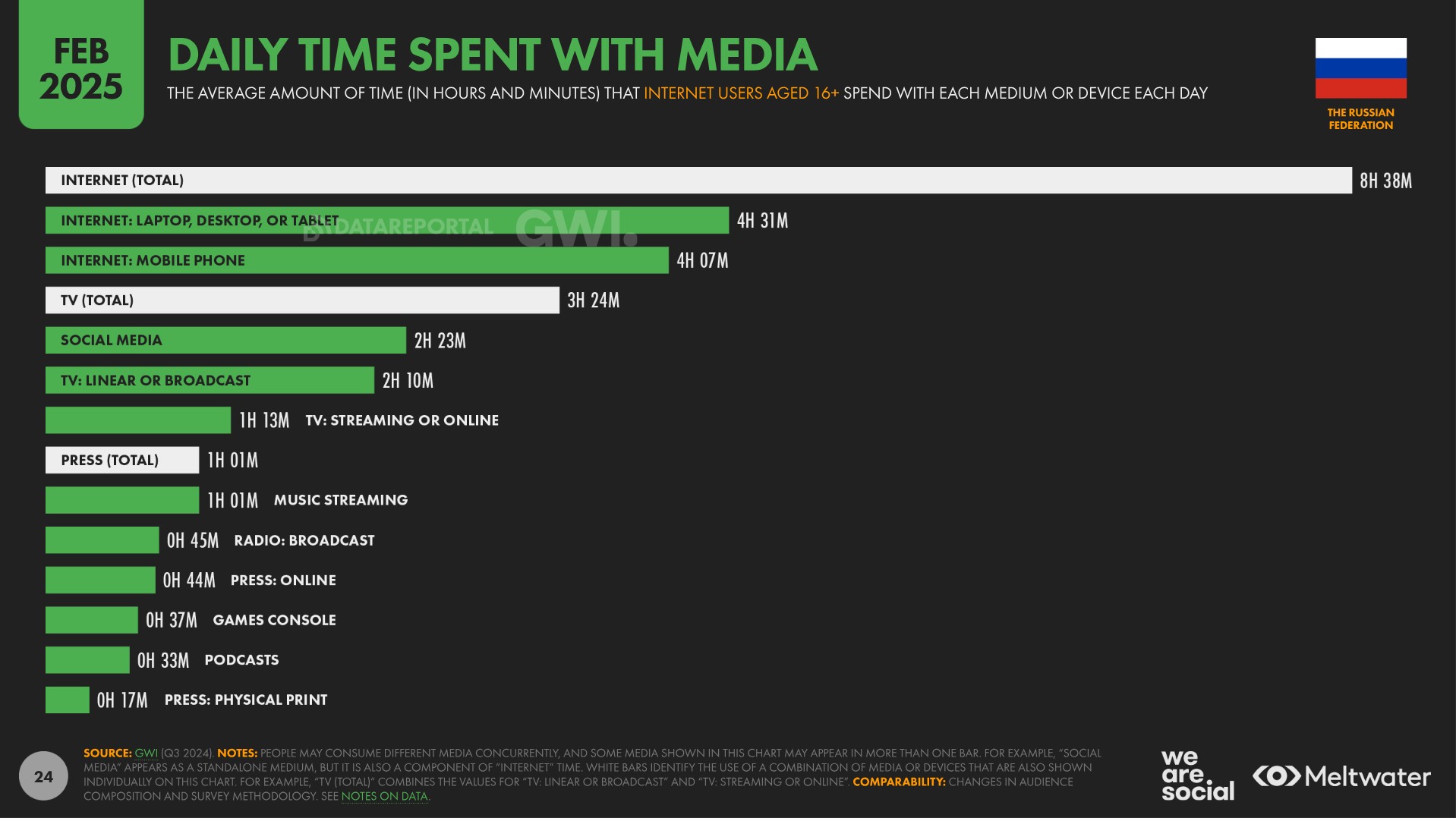
The average time spent online daily is 8 hours and 38 minutes, which is a 3.5% increase compared to 2024 (8 hours and 20 minutes). Russians are also increasingly shopping online – in 2015, 37% of Russia’s population (about 38 million people) opted for online shopping, while in 2018, this number had risen to 47% (nearly 50 million). This trend continues in 2025, with the number of internet users rising to 133 million, providing a strong impetus for further e-commerce development.
Facts About Russian Internet Users
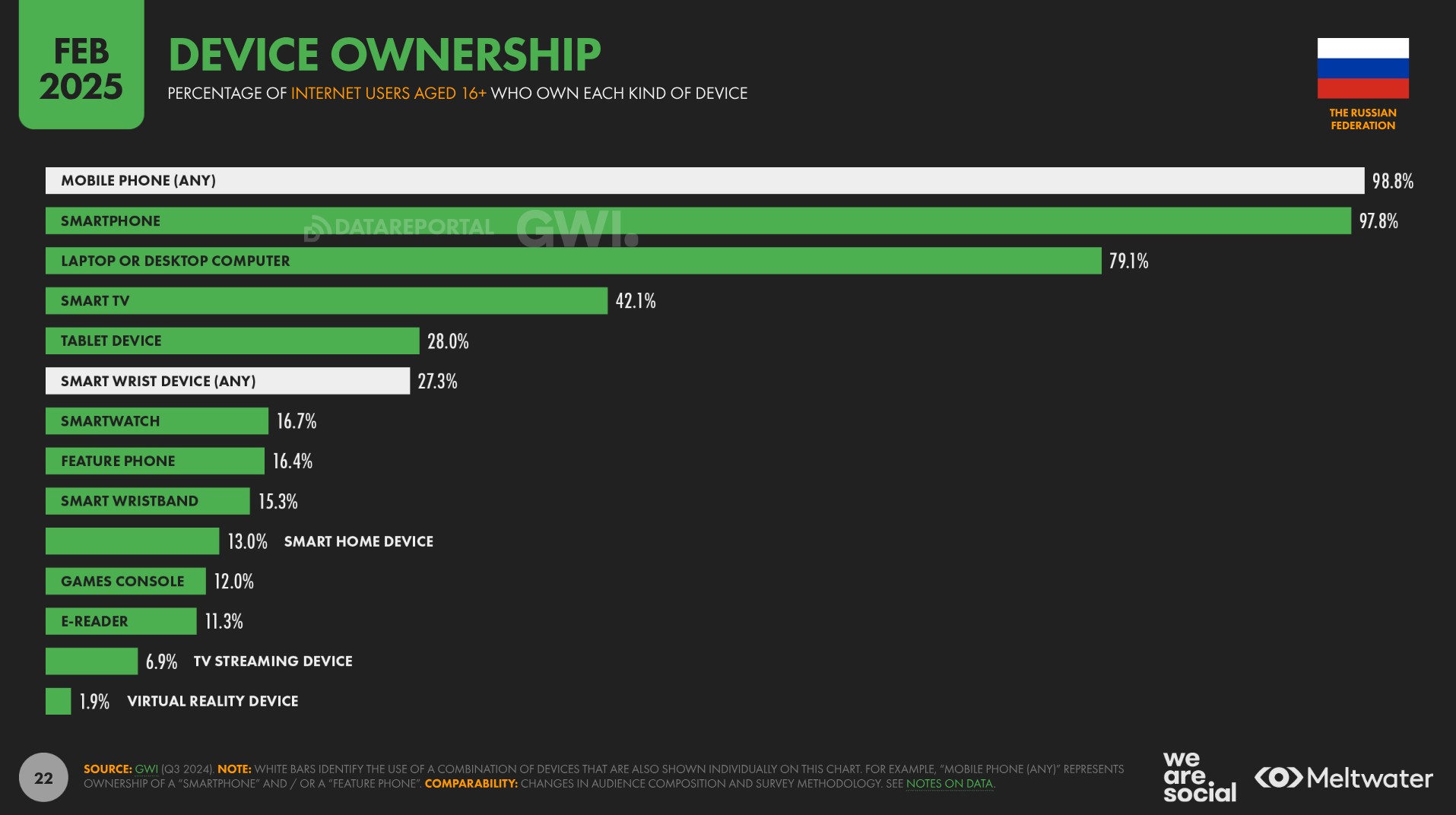
- Russians prefer using mobile phones, with 97.8% of internet users owning one, and 95.8% of them use smartphones to access the internet.
- Although desktop computers and laptops are also popular, 79.1% of internet users in Russia own these devices.
- Tablets are considerably less popular, with only 28% of users owning one.
- Statistics show that 92.2% of internet users in Russia use the internet daily, with the average time spent online being 8 hours and 38 minutes per day, a 3.5% increase from the previous year.

Why Do Russians Mostly Use the Internet?
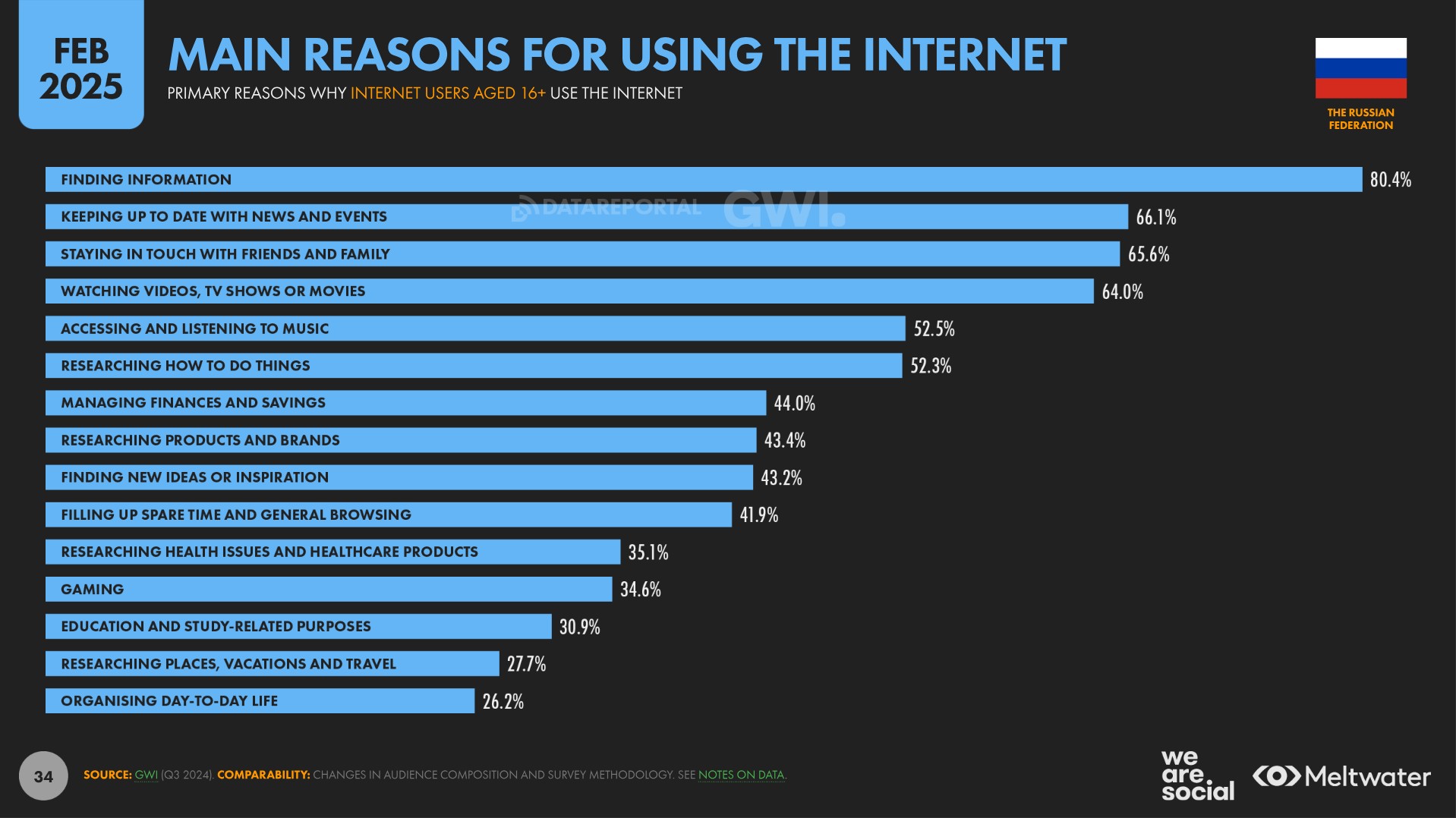
Russians use the internet to get information, which is the main reason for 80.4% of internet users. The second most common reason is staying up to date with news and events (66.1%), and keeping in touch with family and friends (65.6%). Additionally, a significant number of Russians (64.0%) use the internet to watch movies, TV shows, and programs. Online music streaming is popular among 52.5% of users, and seeking advice for various activities is also of interest to 52.3%. It is worth noting that the internet has also become the primary tool for managing finances and savings for 44% of users.
Most Popular Websites
Which online stores are most frequently chosen by Russians? The chart below shows the most visited websites in Russia in 2024.
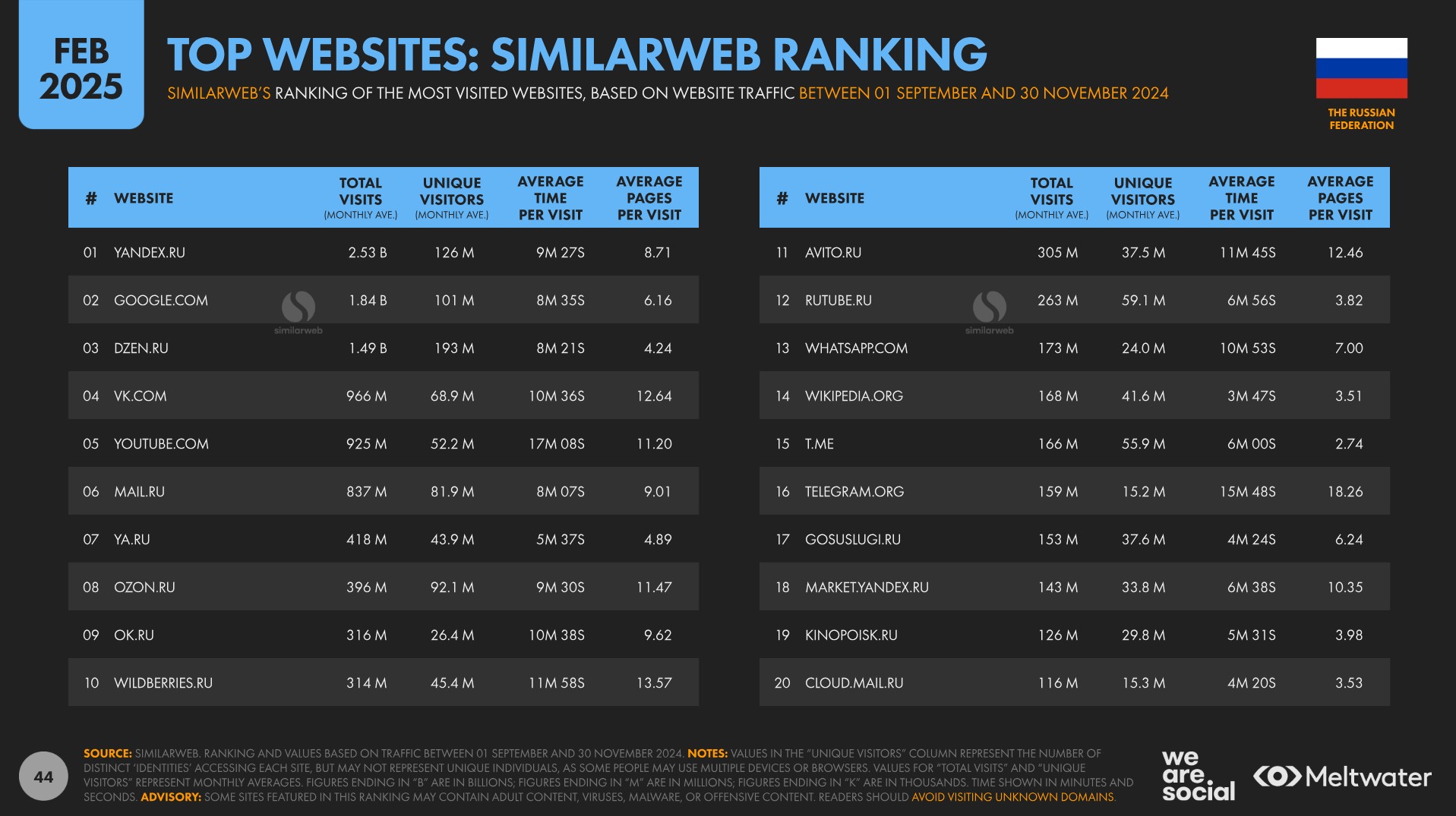
As can be inferred from the chart, Russians visit both domestic and foreign websites. Yandex.ru ranks first with 2.53 billion monthly visits, followed by Google.com (1.84 billion visits). Other popular websites in Russia include Dzen.ru, VK.com, YouTube.com, and Mail.ru.
As seen, Russians are increasingly choosing local service providers. The top websites also include Ozon.ru (396 million visits) and Wildberries.ru (314 million visits), which play a key role in e-commerce. While Russians haven’t abandoned international services, domestic platforms dominate in their daily use.
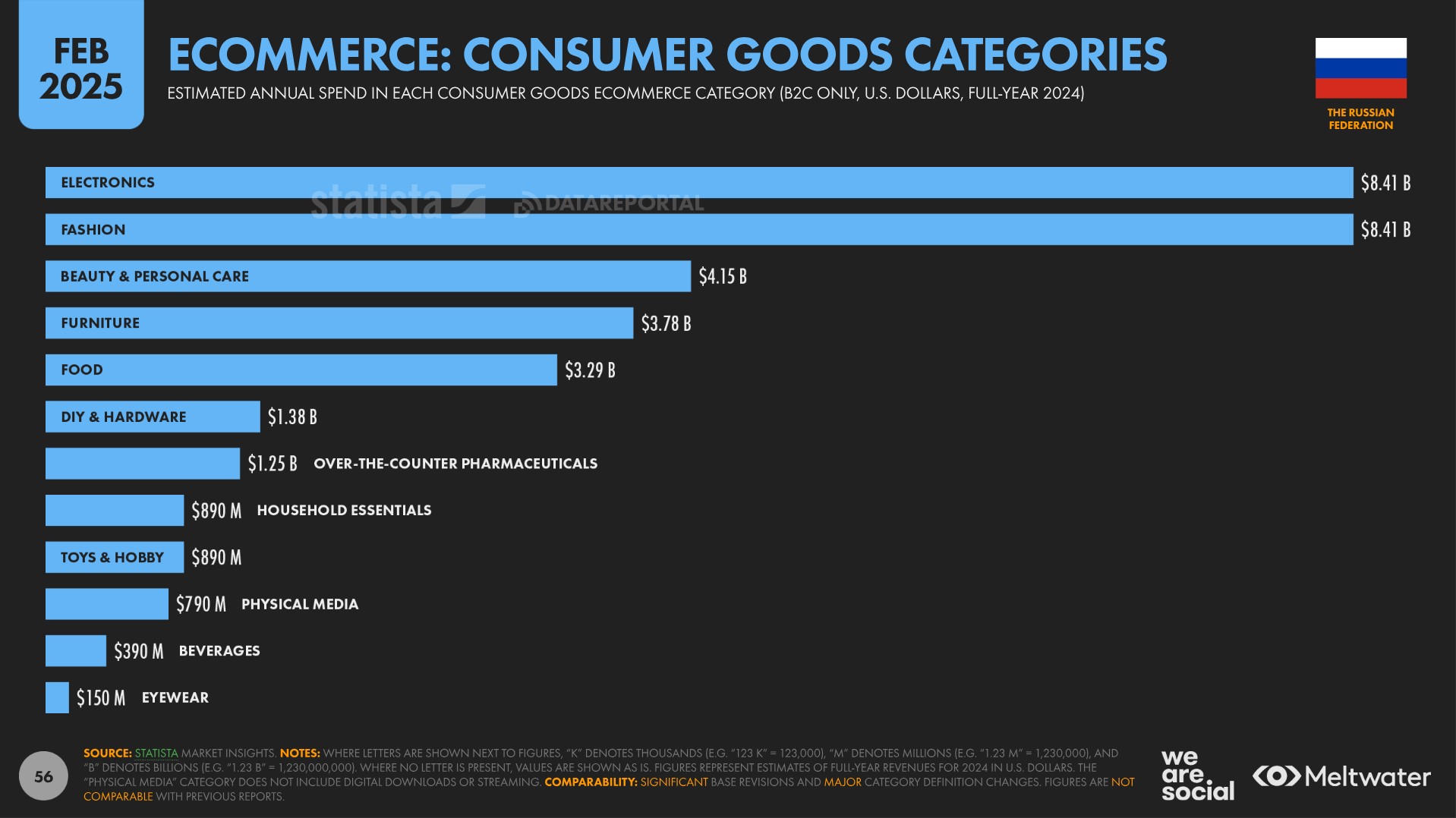
The chart above shows the products most commonly bought by Russians online in 2024. As seen, consumer electronics dominate, reaching $8.41 billion in sales. Next, clothing, also with $8.41 billion in sales. Other popular categories include cosmetics and personal care ($4.15 billion), furniture ($3.78 billion), and food ($3.29 billion). The least popular categories are beverages ($390 million) and glasses ($150 million).
Social Media
Interestingly, almost every other Russian uses social media. In 2025, this number stands at 78.3% of internet users. There is a noticeable growth trend in social media use – in 2018, 2 million new users joined! The vast majority of them use mobile devices, with 73.9% accessing social media on their phones.
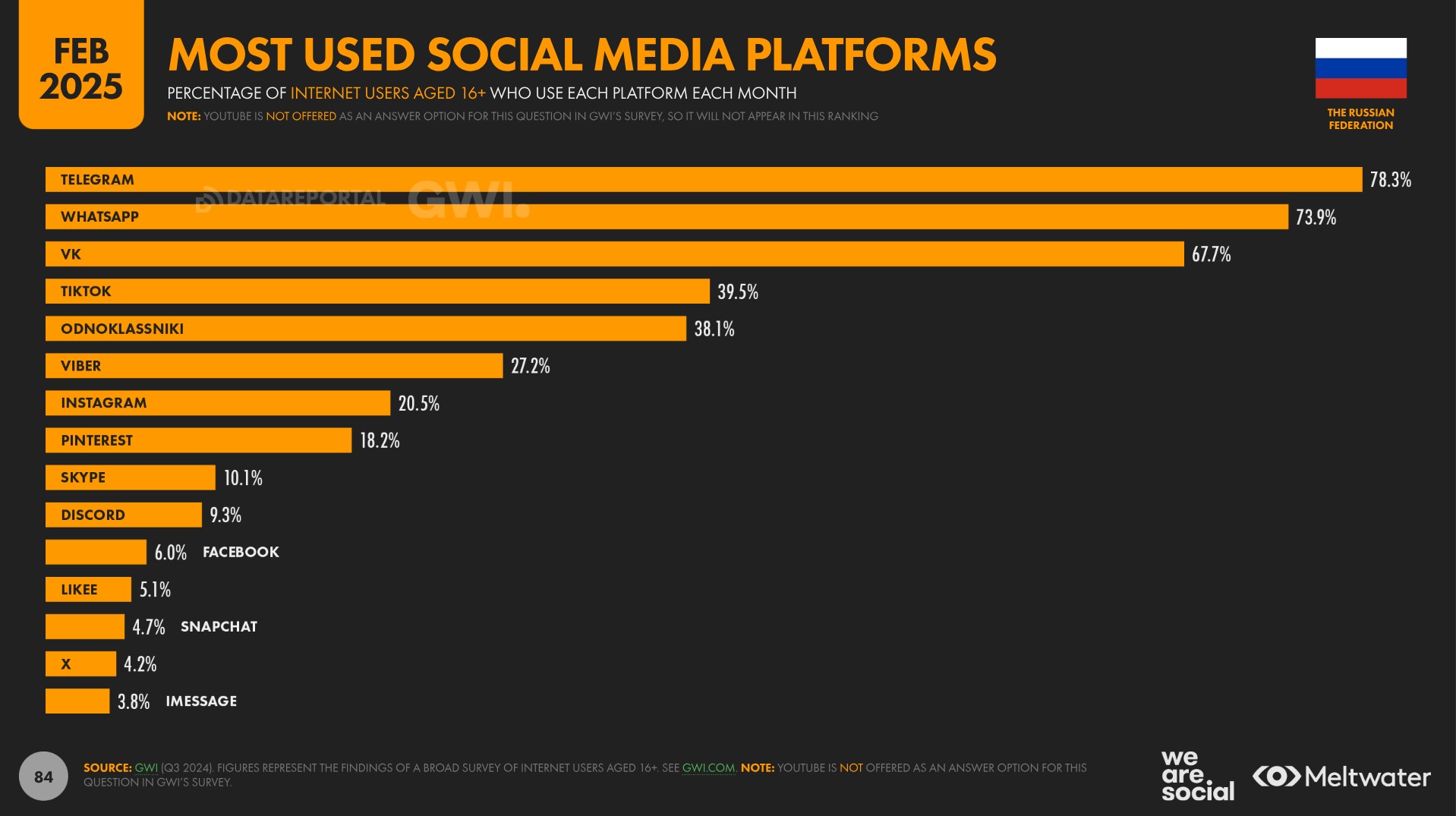
It is worth noting that Facebook is not the most popular social media platform in Russia – the local equivalent, VKontakte (vk.com), is preferred by 67.7% of internet users. Telegram (78.3%) and WhatsApp (73.9%) are also very popular.
Other hugely popular social media platforms include TikTok (39.5%), Odnoklassniki (38.1%), Viber (27.2%), and Instagram (20.5%). Russians aren’t very fond of platform X (4.2%) or Snapchat (4.7%). Thus, when planning to conquer the Russian market, e-commerce owners should consider advertising on Telegram, VKontakte, and WhatsApp.
Payment Methods in Russia
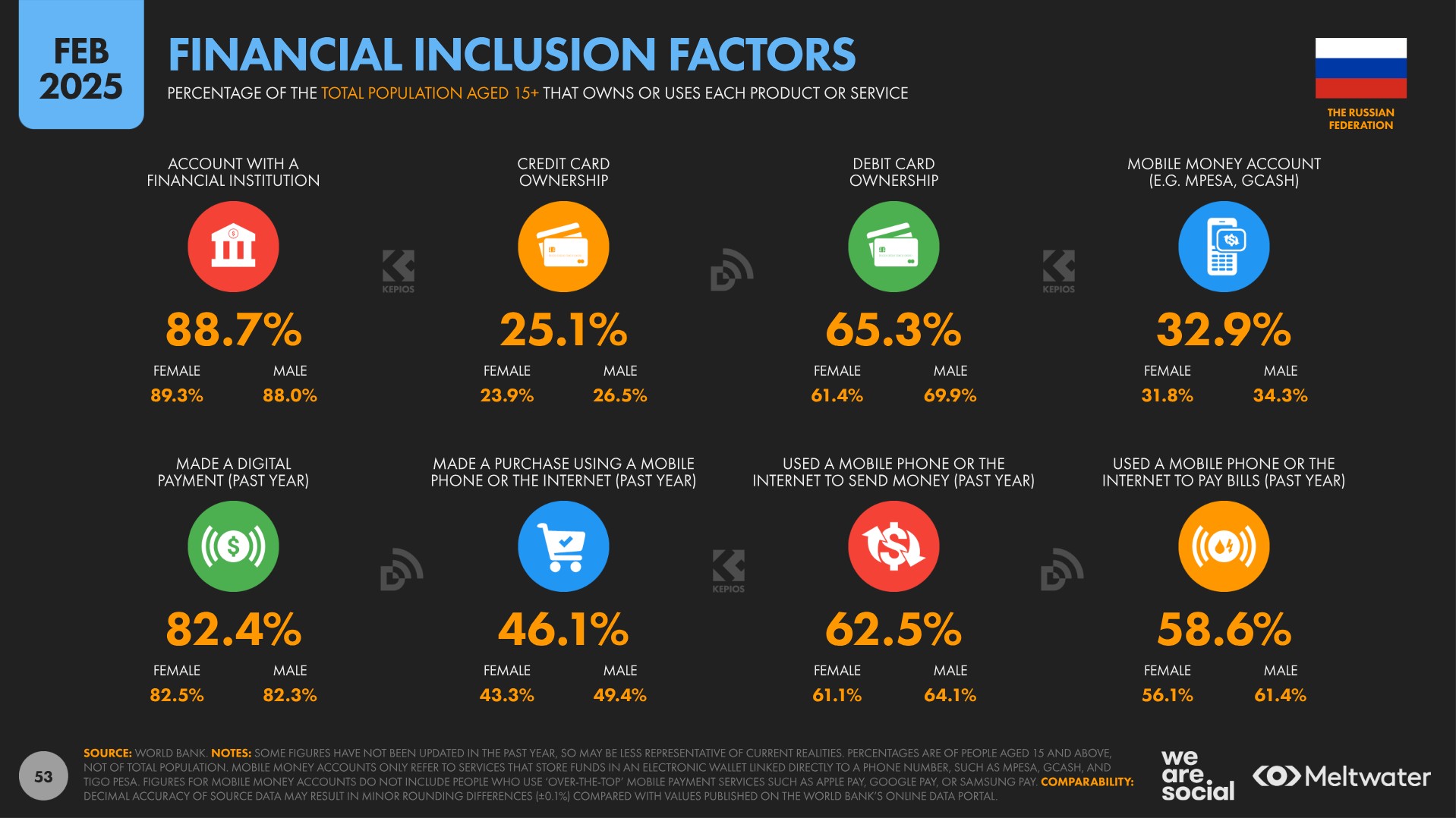
The chart above shows which payment methods were most frequently chosen by Russians in 2024. The most common method is having a financial account, with 88.7% of Russians (89.3% of women and 88.0% of men) using financial institution services. Additionally, 65.3% of the population owns a debit card (61.4% of women and 69.9% of men), and 25.1% own a credit card (23.9% of women and 26.5% of men).
Interestingly, 82.4% of Russians made at least one digital payment in the past year, and 46.1% of the country’s population made purchases using mobile phones or the internet. More than half the population (62.5%) has sent money via phone or the internet, and 58.6% used these methods to pay bills. Meanwhile, 32.9% of Russians own a mobile account to store funds, with men (34.3%) using it more frequently than women (31.8%).
Russian Internet Domains
The main internet domain in Russia is .ru, but is it the only one? It turns out, it’s not! Interestingly, the .su domain, introduced in 1990 and assigned to the Soviet Union, is still in use and continuously registered in Russia. Also worth mentioning is .рф – the world’s first Cyrillic domain, where country-specific websites are not written in the Latin alphabet.
SEO in Russia – What to Focus On?
If you want to expand your e-commerce business into the Russian market, you need to keep one basic issue in mind – Google doesn’t have a monopoly in Russia! Russian search engine Yandex also plays a significant role. Interestingly, while Google holds 24.41% market share, Yandex still dominates, generating 74.1% of all internet traffic in Russia.
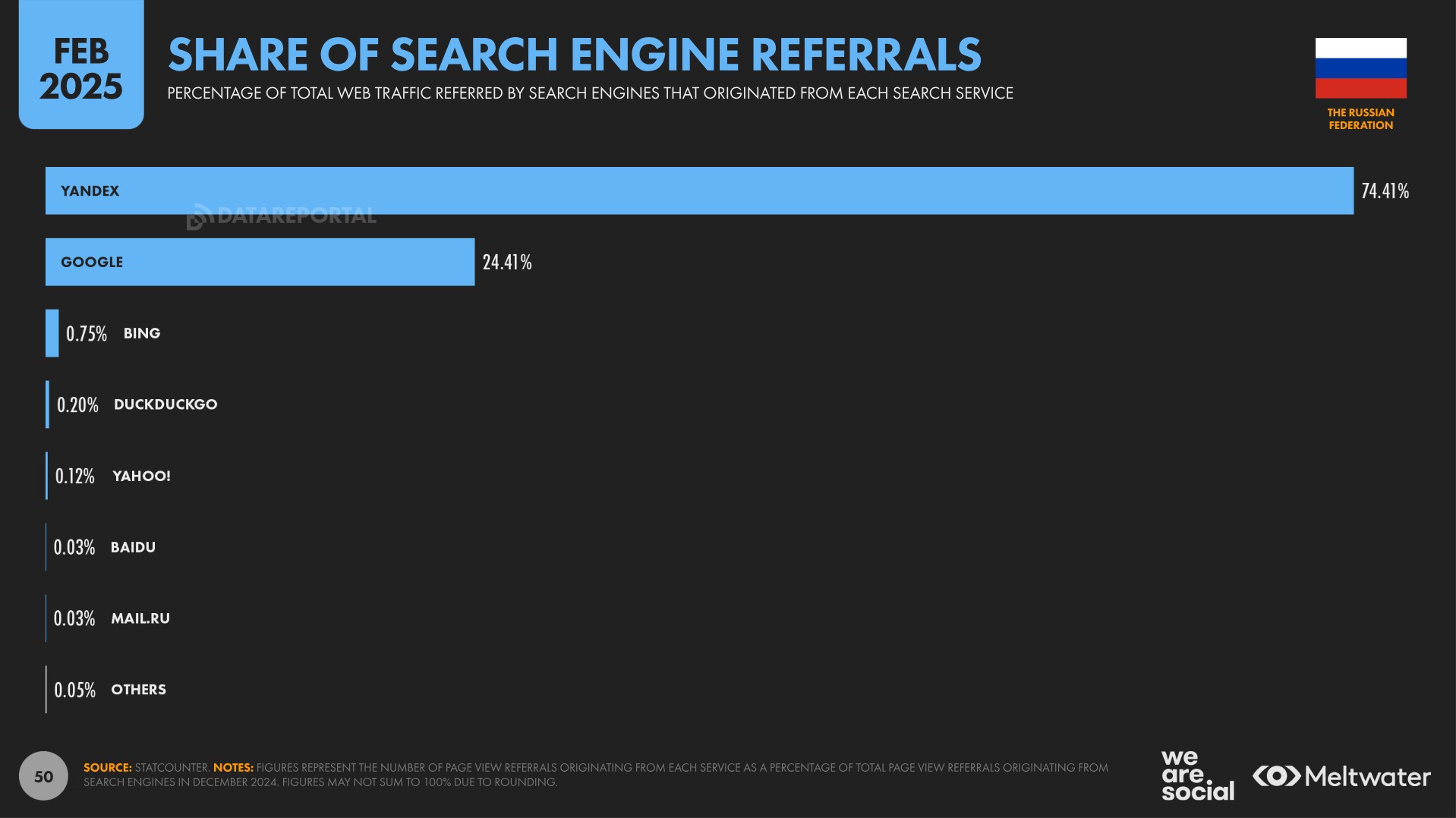
As seen, Yandex still has a huge influence on SEO in Russia, so it’s worth paying more attention to this search engine.

10 Factors That Affect Ranking in Yandex
The practices used for optimizing websites in Yandex are similar to those applied in Google. Yandex especially values:
- Content – There is probably no place on earth or search engine where the phrase “content is king” doesn’t matter. In Russian SEO, it’s also fundamental. The selection of keywords and their skillful integration into the website content is important, but the quality of this content is even more crucial.
- Technical Optimization – This refers to ensuring that the search engine bot can access and crawl the page content.
- Region – Yandex places great importance on local SEO, so it’s important to consider the region in which the query originates from within the Runet. This is the first place the search engine checks.
- Commercial Factors – To gain the trust of Yandex’s bots, you need to provide information about your company, payment methods, delivery methods, and prices. Comments and reviews from business partners or users also have a positive impact.
- Behavioral Factors – Yandex bots pay attention to how long users stay on the website and what actions they take. This is especially crucial for SEO for e-commerce websites in Russia.
- Navigation – Yandex, like Google, values simple, hierarchical structures that are not only easy for users but also for the search engine bots. This structure also significantly affects internal links and helps Yandex index the page.
- Appearance – This is not directly relevant for search engine bots, but it plays an important role in user behavioral perception of the website.
- Keyword Density – Yandex is very meticulous here. Keywords should not exceed 6% of the total text.
- Domain Age – Similar to Google, the older the site, the more Yandex trusts it.
- Backlinks – Yandex developed its own VITS index, which is a weighted citation index used to measure both the quantity and quality of backlinks.
Yandex Products That Support SEO in Russian
Most of Yandex’s products are similar to those offered by Google, but some are quite interesting. We’ve selected five of them that deserve special attention if you want to pursue SEO in Yandex:
Yandex Metrica (Google Analytics Equivalent)
This is a free tool used to analyze user traffic on websites. It works similarly to Google Analytics but offers additional features.
An innovative feature is WebVisor – a plugin that allows recording user behavior on the website. These recordings allow the website owner to optimize the site effectively.

Yandex Direct (Google Ads Equivalent)
When Google started profiting from sponsored link campaigns, Yandex created its own Google Ads equivalent – Yandex Direct. Similar to Google’s product, when starting a campaign, you can set the budget and location. Rates are mainly based on the selected region.

Yandex Money
This is an electronic wallet – you can open a completely free account and then transfer funds through various payment methods. With Yandex Money, you can easily make online payments, pay bills, and shop online. As mentioned earlier, this payment method is gaining popularity in Russia.

Yandex Market
This service allows users to compare prices and products from many online and offline stores. Customers can leave reviews and rate products based on various parameters. If you’re in retail and want to expand your business into Russia, this service is a must.

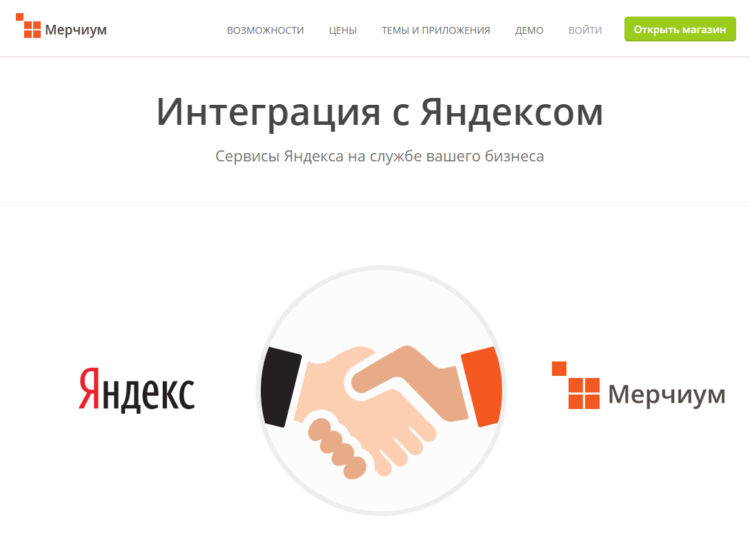
Yandex Merchium
This is a free platform that allows you to easily create an online store. It’s integrated with other Yandex products, so a store built on this platform is viewed favorably by search engine bots.
A Few Words About Google.ru
When doing SEO for websites in Russia, we cannot overlook Russian Google. This search engine has been used less frequently in Russia over the years, but recently, this trend has changed, and Google is gaining popularity. So what does this mean?
SEO efforts should target not only Yandex but also Google. A significant reason for the increasing number of Russian Google users is the widespread use of Android devices, which are the pioneers among Russian-speaking users, especially the younger ones.

Summary
Russia is a huge market where you can expand your business. Achieving success in the Russian internet space may be a bit more complicated, but it’s not impossible – it just takes a bit of creativity, content written in Cyrillic, and ingenuity. When entering the Russian market, it’s important to balance Yandex and Google, as these are the two most popular search engines in the country. Is it worth it? Definitely! The value that SEO in Russia brings is disproportionately high compared to the costs involved.
Read more about international SEO: International SEO