 d-tags




 Loading...
Update: October 2025
General Information about Ukraine
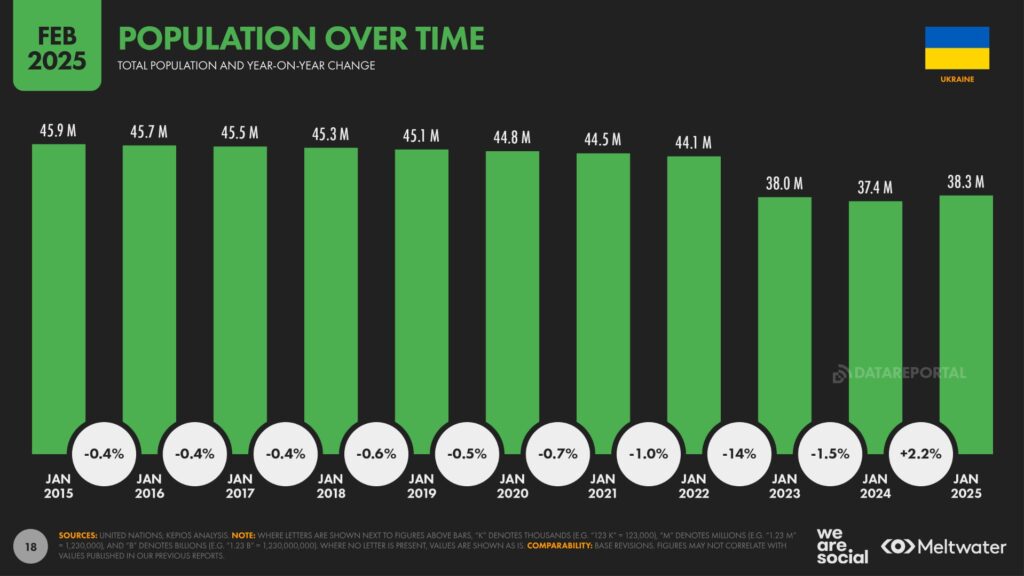
Modern Ukraine is a country that ranks second in Europe in terms of area, with only Russia ahead (17,098,242 km²). Ukraine’s area is 603,700 km². When it comes to population, the country is in sixth place in Europe, with a current population of 38.3 million people, indicating unfavorable demographic trends, as Ukraine had 52.2 million residents in 1993.
Ukraine has an exceptionally large potential in terms of natural resources and enormous opportunities for economic development. The country possesses a skilled workforce, but due to a high level of corruption and an insufficient level of transport infrastructure development, growth and economic development are not yet visible.
Ukraine’s E-commerce Market
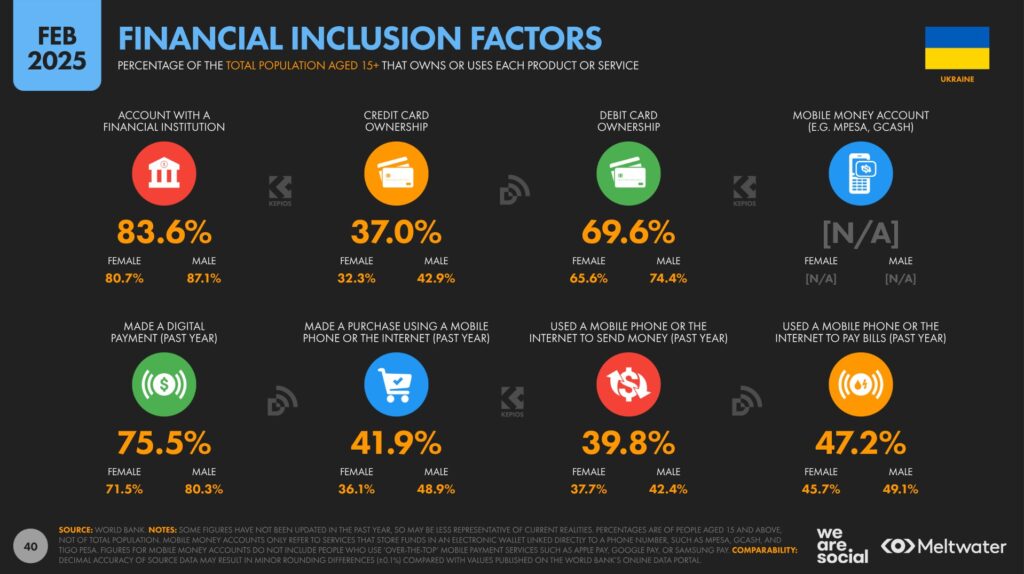
The e-commerce market in Ukraine continued to grow in 2024, reaching a value of 4.375 billion USD, representing an increase of 5-10% compared to the previous year. The number of internet users in the country grew to 29.64 million, which constitutes 79.2% of the population. This indicates a significant improvement in internet accessibility, although there is still room for further development in this area. In 2024, 80% of Ukrainians used the internet daily, an 8 percentage point increase compared to previous years. Additionally, the average e-commerce transaction value in December 2024 was 41.54 USD per day, showing steady growth in online shopping activity. In 2025, the value of the Ukrainian e-commerce market is expected to reach around 3.85 billion USD, reflecting growth compared to previous years, despite the challenges posed by the war.
In 2025, the e-commerce market is expected to continue growing by 10-15%. This growth is driven by the intensification of efforts by large players who are increasingly focusing on acquiring new customers and optimizing operational processes. In the coming years, a decline in the number of internet users is also expected, which may impact the number of online transactions, despite the continuous growth of the market. At the same time, competition in the e-commerce market will intensify, particularly among large online stores, which are aggressively increasing their market share.
The increase in internet users, particularly in 2024-2025, lays the foundation for the further growth of this segment of the e-commerce market in Ukraine.
Internet Users in Ukraine
In 2025, Ukraine had 31.5 million internet users, representing 82.4% of the population. Additionally, the number of active social media users was 21.6 million, or 56.4% of the total population. This development of internet and social media penetration provides a solid foundation for the further growth of the e-commerce sector.
Mobile shopping has become increasingly popular and currently accounts for about 42% of the e-commerce market, up from 39% in 2019. This trend indicates the growing role of mobile devices in the shopping process, which is particularly important for younger consumers who prefer shopping via smartphones.
Despite these positive trends, Ukraine faces economic challenges such as the devaluation of the hryvnia, which affects consumers’ purchasing power. As a result, consumers are becoming more price-sensitive, and purchases are more frequent but with smaller baskets, with a preference for cheaper products and promotions.
Most Popular Search Engines in Ukraine
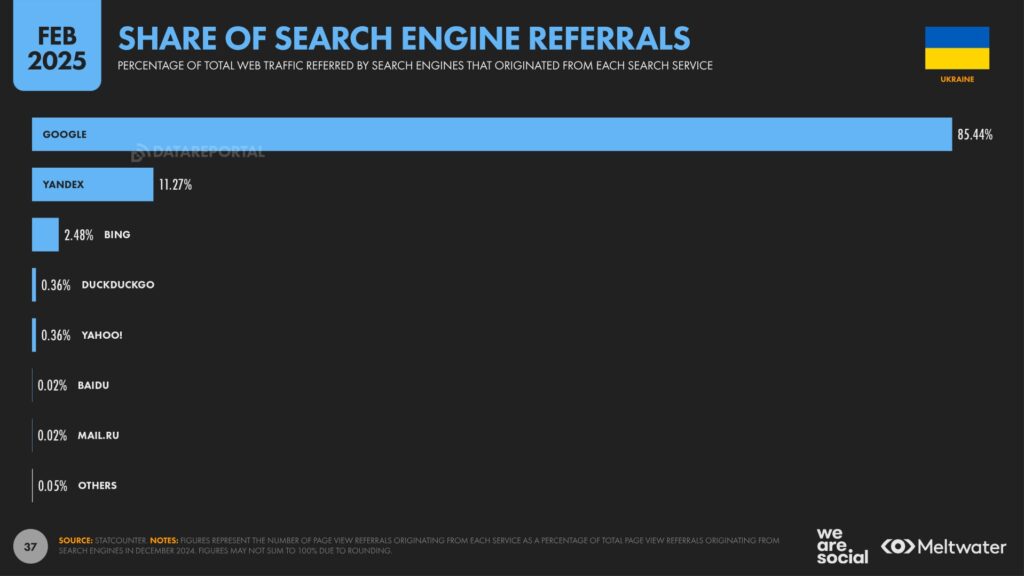
Google is the most popular search engine among Ukrainian internet users, used by 85.44% of them. In second place is the Russian search engine Yandex, which also offers a search engine. The third favorite portal in 2018 was Mail.ru, used by 9.58 million people. Currently, it is Bing with 2.48%.
Unfortunately, sanctions were imposed on both websites on May 15, 2017. However, this was not motivated by public pressure, although the political aspect played a significant role. The main reason was security and economics. The sanctions were aimed at preventing these companies from making money in the Ukrainian market.
- Yandex is considered one of the most expensive Russian internet companies, according to Forbes. It mainly competes with Google, particularly in the local search engine market, as well as in services similar to those offered by Google. The Ukrainian market represented 1-3% of the company’s profits.
 Source: https://www.similarweb.com/
- Mail.ru Group consists of social networks VKontakte, Odnoklassniki, and My World. According to the group, the number of users affected by Ukrainian sanctions was 25 million.
 Source: https://www.similarweb.com/
E-commerce Trends
In 2025, the e-commerce market in Ukraine continues to grow. The biggest players are platforms like Rozetka, which attracts 6.7 million users per month, and OLX.ua with 5.5 million visitors. Among foreign platforms, AliExpress and eBay dominate, with 1 in 5 internet users in Ukraine using them, representing over 4 million and 2.7 million Ukrainians, respectively. Rozetka, founded in 2006, initially specialized in consumer electronics but has expanded its offerings and is now the most popular online store in Ukraine.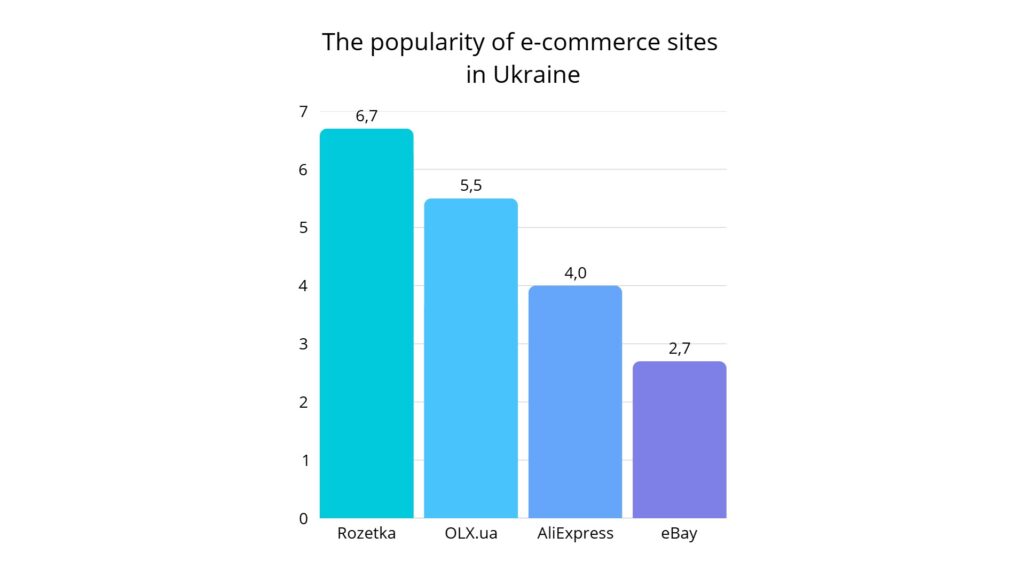
Forecasts suggest that by the end of 2025, the value of Ukraine’s e-commerce market will exceed 7 billion dollars, and the number of online platform users will grow by 18%. This growth is driven by changes in consumer preferences, with dominance in clothing, electronics, and health products. The most popular payment methods are credit cards, cash on delivery, and PayPal, and deliveries are increasingly handled by mobile apps. At the same time, as competition in the market grows, e-commerce in Ukraine is moving towards further international expansion, with technologies such as artificial intelligence starting to play a key role in personalizing the shopping experience.
Social Media
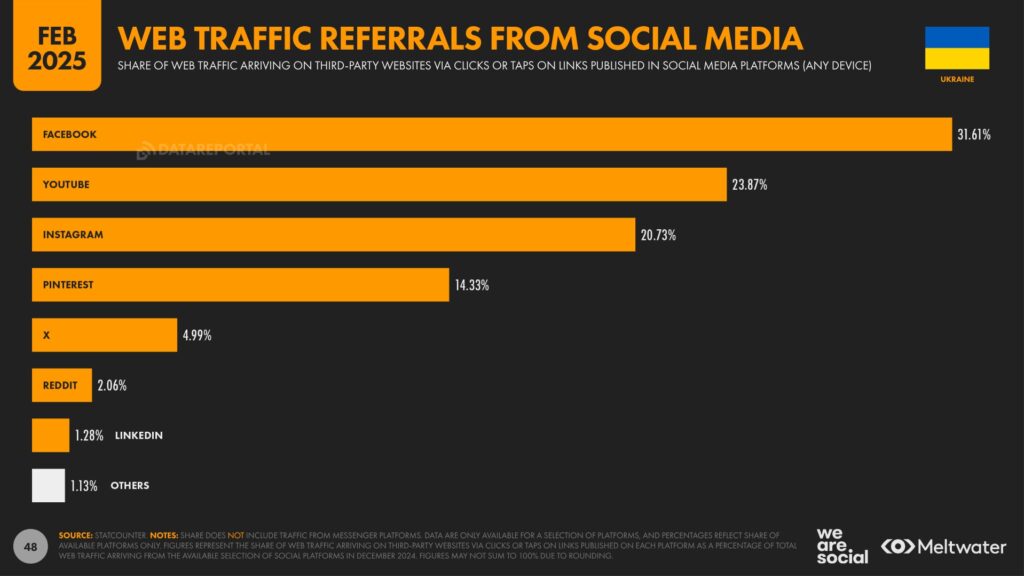
Ukrainian internet users also love social media. Most users (31.61%) use Facebook. In second place is YouTube (23.87%), and third is Instagram (20.73%). According to Statista.com research, over 30% of users do not use the internet at all.
SEO in Ukraine
Although optimizing websites for Google is becoming more popular, the Ukrainian market has a completely different approach to SEO that you should familiarize yourself with. This is mainly because Yandex remains a popular search engine in the Ukrainian and Russian-speaking market, and its algorithms differ slightly from those used by Google.
Yandex and Google consider ranking factors in different ways. To rank high in both search engines, you need to find several compromises, requiring a more advanced approach to SEO.
Traffic
In recent years, there has been a noticeable trend in the ranking of commercial websites in Google, but mainly in Yandex. Algorithms are increasingly prioritizing large websites over much smaller ones. This creates a vicious circle, as large companies gain even more traffic, while small ones do not improve their positions. 
Therefore, if you want to have a high position both in Yandex and Google, you should aim to increase overall traffic; the larger it is, the better your results will be in search. To increase traffic, it is recommended to:
- send newsletters,
- promote on social media,
- advertise in search engines.
Products Range
To make it into the top ten in Yandex search, you also need a vast product range in your online store – stores with a wide selection of products account for 90-98% of the top three search results.
It is also important that the site has a wide range of brands. If the store is single-brand, it has little chance of improving its results. The share of such stores in the top 30 in Yandex is only 5%, compared to about three times as many in Google.
Categories, Product Pages, or the Homepage?
In Yandex search, it is better to focus on category pages. About 80% of Yandex results are category pages, and only 15% are homepage results. The search engine often displays category pages, even if your query specifies a particular model. The correct result can only be achieved by adding a color or a specific size.
What should the category page contain:
- optimized product names,
- short product description,
- product images,
- prices,
- add to cart button,
- product filtering and sorting options,
- product comparison tool.
Backlinks
One of the strongest ranking factors in Yandex is incoming links. Pages in the top search results related to products in Yandex have around 3,200 incoming domains, while in Google it is about 2,850. Both the quantity of links and their entire profile matter. Their distribution is important, so not all should lead to the homepage. This will make your link profile more diverse.
Official Languages in Ukraine
According to the Ukrainian constitution, there is only one official language, which is Ukrainian. However, there is a regional language law that guarantees the right to use languages spoken by more than 10% of the population at the local level. The Russian language has been granted regional language status, which is most commonly used in eastern regions, where even most schools teach in Russian. The press, radio, television, and even the publishing market in eastern Ukraine operate in Russian. Therefore, it is advisable to adjust your websites and optimizations according to the dominant language in the respective region.
How does Ukrainian differ from Russian?
Ukrainian and Russian both belong to the East Slavic language family, derived from the Cyrillic script. They share a common alphabet, similar grammar, and a significant overlap in vocabulary. However, due to diverse cultures, these languages have diverged, and considerable differences can be found in their linguistic systems.
In Ukrainian, there are many words that sound very similar to Russian, mainly due to borrowings from the Soviet era. However, more than half of Ukrainian vocabulary overlaps with Polish, although similar-sounding words may mean something entirely different.
Examples of letters that look different in Russian but sound the same:
“Гг” – pronounced like the Polish “h”
“Ее” – pronounced like the Polish “Ee” and Russian “Ээ”
“Її” – Polish “JIji”
“Єє” – pronounced like Polish “JE/je” and Russian “Ее”
How does the Cyrillic script impact Google search rankings? What is UTF-8 encoding in Cyrillic URLs?
URL transliteration is a common problem when creating websites in a non-Latin alphabet. It is important to choose character-by-character mapping from a pre-prepared table or UTF-8 encoding. This is particularly important when a website has more than one language.
Here, it is worth choosing Yandex’s transliteration, which differs from the traditional one. When analyzing links, Yandex’s search engine pays special attention to website addresses. The role of the URL written in transliteration is significant.
Correct URLs increase the chances of reaching the top positions in the SERP. Websites with properly transliterated addresses are ranked higher by the search engine. Therefore, internet resources that follow the proper Yandex transliteration have an advantage over competitors. Yandex has also integrated a helpful bonus for sites using competent transliteration – highlighting the transliterated address. This choice is a powerful tool attracting visitors to the resource, ultimately increasing conversions.
Website Positioning in Ukraine – Summary
Ukraine has a very low internet penetration rate, only 49% of people. This is the lowest rate in Europe. The most popular search engines are Google, Yandex, and Mail.ru, even though sanctions have been imposed on the latter two.
To improve your visibility, focus on improving factors like:
- traffic,
- product range,
- optimizing category, homepage, and subpage content,
- increasing backlinks,
- social media promotion,
- regional language adaptation,
- paying attention to transliteration.
Learn more about international SEO here: International SEO