How do customers search for brands today, and what does this mean for your strategy?
d-tags
d-tags
Over the last few years, we have been participating in a digital revolution that is completely changing the way we think about search. Just a few years ago, we directed all our queries to Google and received the famous blue links in response. Then ChatGPT appeared and quickly gained popularity among users. Initially, we used it to assign simple tasks, such as preparing email content or writing creative birthday wishes. Now we ask it for recommendations on vacation destinations, running shoes, or the best mechanic in the area, and interestingly, we are increasingly following its recommendations.
Currently, we are discussing a more precise and contextual approach to searching. Google itself provides us with comprehensive and quick answers in the form of an AI Overview, but many users also search elsewhere.
You may encounter the idea that there is a lot of hype surrounding AI, and that it only accounts for about 1% of total search, while Google has around 89%. Yes, the data looks like that at the moment, but the growth dynamics of AI channels are something we should not ignore.
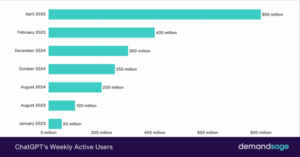
The scale of AI’s popularity is clearly visible in the chart below, which shows the number of active ChatGPT users every week. In February 2025, there were 400 million, while in April 2025, just two months later, there were as many as 800 million (1). This represents an expressive 100% increase in a very short period.
Source: demandsage
There is no question about the future – it is happening right now. This month, ChatGPT released a new module called ChatGPT Agent. What can it do for you? Almost anything online. Need a new outfit for an important event? Your agent will search for clothes for you and then purchase them on your behalf. Want to find a restaurant and book a table? No problem.
That is why it is so important for your business to be present in AI results. If you are not there, you are realistically losing the opportunity to acquire new customers and reach a wider audience. Your website must now be optimized not only for Google but also for LLM models, as well as for the accessibility of the site for AI agents.
Social media also has its share of the search market, especially among younger audiences. According to an eMarketer report, 46% of Gen Zers and 35% of Millennials choose social media as their go-to place for information (2). Why? The attractive visual form, the authenticity of other users, and the speed of content consumption speak in favor of TikTok and Instagram. Authentic content about your company is a must-have if you want to reach younger audiences (and not only!).
Why are AI models and social media gaining popularity as search engines? Because they save time, which is now the most valuable currency for many. Want to find attractions in Barcelona? Instead of typing a keyword into Google, visiting websites, and browsing photos, all you need is Instagram or TikTok, where you can view these places in video form and easily save them for later. Want to buy a new laptop? Instead of browsing dozens of online electronics stores, you ask ChatGPT, Gemini, or Perplexity for recommendations, and only then check the specific models you get in response.
Customers now use multiple channels. They ask for AI recommendations, search visually on YouTube or TikTok, and often only then check the answers they get on Google or visit brand websites directly. They no longer look for a list of links, but for a single, ready-made answer, which often already includes specific brands. Several stages shorten the purchase funnel, and if you are not in the AI answers, you will not be in the customer’s consciousness either.
This is not a temporary trend, but a changing process of consumer decision-making, which you, as a business owner, need to keep in mind.
| Stage | Channels | What the user does | What do you need |
| Exploration | AI (ChatGPT, Gemini), Social (TikTok, YT) | Asks questions, compares, and searches for information about the problem | AISO + Social SEO (structure, presence, mentions) |
| Verification | Google, Direct | Enters the brand name, checks its features, and deepens knowledge | Technical SEO + relevant content |
| Action | Website, Email, Ads | Converts | UX, CRO, SEM |
You need to be present wherever users ask questions, i.e., not only on Google, but also on AI and social media. How to plan your activities to respond to these changes?
This way, you will gain full coverage of various search paths at every stage of the sales funnel.
Although the AI revolution in the digital world can cause stress and uncertainty, one thing is sure: instead of ignoring the changes that are already happening, you need to take action! Basing your strategy on additional channels, such as Social SEO or AISO, is also an opportunity for smaller businesses. In Google, larger players with bigger budgets usually win, but in AI, what counts is the relevance of the content, precision, and attention to clarity, and anyone can take care of that.
Is everyone already buying through AI? Not yet, but as we mentioned, this channel is growing like no other. Now is the perfect time to enhance your visibility in AI and stay ahead of your competitors.
Sources: