E-commerce in Italy – what should marketers know about this market in 2026?

4min.

Comments:0

09 October 2025

E-commerce in Italy – what should marketers know about this market in 2026?d-tags
The Italian e-commerce market in 2025 is valued at €85.4 billion, and forecasts naturally show an upward trend. It is no surprise that more and more international brands are interested in expanding into this European market. What do global brands that want to start operating in Italy need to know?

4min.

Comments:0

09 October 2025

The Italian e-commerce market in a nutshell

To begin with, here are some key facts:

  • In Italy, as in most European countries, online commerce is dominated by smartphone purchases, which users make more often than on computers.
  • The most popular sectors are fashion (35% of the e-commerce market), followed by electronics (24%) and household goods (21%).
  • 39% of all e-commerce transactions are purchases from abroad, mainly from China, but not exclusively.
  • The e-commerce market in Italy consists of 25 million customers who spend an average of €2,500 per year on online purchases.
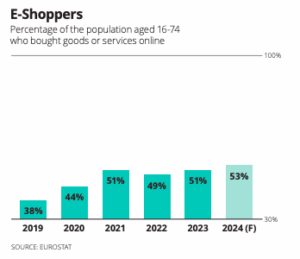
  • 53% of Italians aged 16 to 74 shop online.

e-commerce italy

Source: e-commerce.eu

Key trends in the Italian e-commerce market in 2026

Based on marketing reports, we have prepared a list of the most important trends that are worth adapting to your strategy on the Italian market:

  • Mobile optimization

As we mentioned earlier, Italians prefer to place orders on their smartphones, so optimizing the mobile version of your website is essential. If you want your e-commerce business to grow successfully in foreign markets, you need to optimize conversion and the mobile shopping path. UX and UI must be top-notch in this case! Transparency and intuitive navigation will be the key to success.

  • Brand trust 

Italians are a very skeptical nation by nature, especially when it comes to foreign, unfamiliar things. Therefore, it will be essential to build trust and relationships with potential customers. Brand communication must be adapted to Italian culture and customs. If a user notices that the website’s advertising content or description is grammatically incorrect, they are likely to be put off by the brand and leave the site. If possible, hire a native speaker who understands the Italian mentality to prepare your communication.

  • Sustainable development and ecology

According to research, as many as 69% of customers on the Italian market care about recycling packaging from parcels they receive, and 62% are willing to delay delivery for the sake of the environment. For global brands, it is essential to emphasize the ecological aspects of their activities in the Italian market and ensure environmentally sustainable delivery options.

  • Trust in local products

For an authentic Italian, Italian means good. Italians are particularly attached not only to their language and cuisine, but also to their products. If you run a large e-commerce business featuring Italian brands, consider this when planning your product display and placing Italian brands at the top of the list or view.
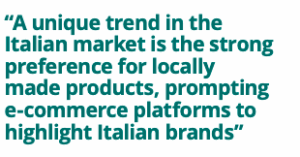
quote about e-commerce in italy

Quote: Roberto Liscia, Consorzio Netcomm CEO

Source: e-commerce.eu

Other trends worth mentioning include:

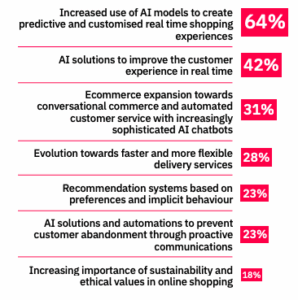
  • 64% of companies operating in Italy use AI models for personalization, and 42% to improve the user shopping experience.
  • 31% are working on developing conversational commerce, i.e., shopping with virtual chatbots and assistants.
  • 28% of businesses focus on providing faster, more flexible delivery methods.
ecommerce trends in italy

Source: ecommerceitalia.info

Online user behavior in Italy

Do Italian customers have their own preferences and specific online behaviors? The answer is yes, and understanding these factors will undoubtedly increase the effectiveness of e-commerce businesses in this market.

Firstly, 31.3% use voice search for shopping queries (1), ranking 5th worldwide. This means the website should be optimized for voice search.

The second issue is the trust, as mentioned above. Italian customers like to return to places they trust and are also keen to use marketplaces; therefore, if you are planning to operate in this market, building trust in your brand and tailoring your communication are your top priorities from the outset.

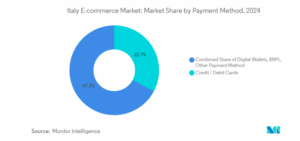
What about payment methods? Satispay, a solution similar to Polish Przelewy24, is gaining popularity in Italy. To keep up with your competitors, make sure you implement this payment method. The second option is BNPL, or Buy Now Pay Later. Deferred payments are currently chosen by 15.4% (2), but this is the fastest-growing option on the Italian market.

italy ecommerce payment method

Source: Mordor Intelligence

What else is essential to Italian users?

  • 36% indicate fast delivery as one of the most important factors influencing their purchase decision.
  • 34% choose ease of navigation and ease of purchase.
  • 33% mention a wide selection of products.

Seasonality in the Italian e-commerce market

Of course, some elements of seasonality will be familiar to all European countries – we are talking about Christmas, Black Friday, and Cyber Monday. In addition, Easter, the start of the summer holidays, and the period after New Year’s are also active shopping seasons in Italy, so it is worth considering this when planning marketing strategies and SEM campaigns.

Are Italian companies already investing in AI?

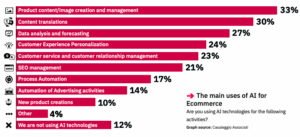
Larger e-commerce businesses are definitely already using AI in their operations, so if you want to compete with local companies, you definitely need to start working in this area. In a survey conducted by the Casaleggio Associati agency, only 12% of the e-commerce companies surveyed said they did not use AI. Others most often use artificial intelligence to create content, perform translations, analyze data, or personalize user experiences.

uses of ai in ecommerce

Source: Casaleggio Associati

Major players are also investing in AISO, or AI-focused positioning. Users are increasingly directing their purchase queries to AI models such as ChatGPT and Perplexity, so improving brand visibility in these tools can be highly profitable. Traffic from these tools has a high conversion rate, so it is definitely worth fighting for your visibility in the AI space.

The entry threshold for AISO is still relatively low – some competitors are certainly already investing in such activities, but smaller players may not yet be aware of this area. This could be your chance – start building your visibility in AI tools on the Italian market now!

Checklist for companies that want to start expanding into the Italian market

Communication and trust – these are the foundations for building relationships with Italian customers, and it is in this area that most foreign companies make mistakes. Linguistic correctness and communication tailored to Italian audiences are essential for success in the Italian market.

User behavior – ensure a simple purchasing path and provide fast, flexible delivery and payment methods, especially Satispay and deferred payments.

Optimize the mobile version of your website – most Italians shop online on their smartphones, so make sure it provides a good UX.

Sustainability and ecology – customers in Italy pay attention to environmental issues, so they use eco-friendly solutions whenever possible.

Optimization for voice search – Italians love to talk, even to voice assistants. Optimize your website for voice search. If you need help in this area, we are happy to assist!

AISO and the use of AI in business – build your visibility in AI models to acquire customers in a new channel. Also, take advantage of AI opportunities, especially for process optimization.

Summary

The Italian e-commerce market is not the easiest for foreign companies to operate in. To be successful in this area, brands must focus primarily on building trust and effective communication, including in advertising messages. The most important thing is to understand the preferences, culture, and behavior of Italian users, and then adapt the entire operations in the Italian market accordingly. 

Sources:

(1)https://www.ecommerceitalia.info/wp-content/uploads/2024/09/Report_Ecommerce_Italy_2025_ENG.pdf

(2) https://www.mordorintelligence.com/industry-reports/italy-ecommerce-market

https://landmarkglobal.com/eu/en/news-insights/top-10-essential-facts-about-italian-e-commerce-2025-edition/

https://ecommerce-europe.eu/wp-content/uploads/2024/10/CMI2024_Complete_light_v1.pdf

Author
Author
Giuseppe Sanfilippo

Business Growth Advisor

Giuseppe helps Delante’s clients increase traffic, improve visibility, and scale sales through tailored SEO, SEM, and AI SEO strategies. He combines analytical thinking with a deep understanding of business goals, quickly identifying challenges and turning data into measurable results. He manages leads from over 30 markets and drives Delante’s expansion in Italy.

Author
Author
Giuseppe Sanfilippo

Business Growth Advisor

Giuseppe helps Delante’s clients increase traffic, improve visibility, and scale sales through tailored SEO, SEM, and AI SEO strategies. He combines analytical thinking with a deep understanding of business goals, quickly identifying challenges and turning data into measurable results. He manages leads from over 30 markets and drives Delante’s expansion in Italy.