AISO in Real Estate: How to Win Clients With ChatGPT and AI

9min.

Comments:0

16 July 2026

AISO in Real Estate: How to Win Clients With ChatGPT and AId-tags
Imagine a potential client typing this question into ChatGPT: "Which real estate agency would you recommend for selling an apartment in Warsaw's Mokotów district?" Instead of a dozen links, they receive a ready answer with the names of specific agencies. They do not browse search results or compare ten offers; they choose from the companies the AI pointed to. If your agency is not among them, chances are you lost a client before they ever visited your website.

9min.

Comments:0

16 July 2026

Why AISO works

A growing number of users start their search for information with an AI conversation rather than a traditional search engine. This is especially true for high-value decisions such as buying or selling a property. Clients look there for recommendations, market analyses, and practical advice.

This is why AISO (AI Search Optimization) keeps gaining importance. AISO covers the work that increases a real estate agency’s visibility in answers generated by AI systems such as ChatGPT, Gemini, and Perplexity. In practice, it means creating valuable content, building an expert image, and strengthening brand recognition to raise the odds of appearing in AI answers.

In this article, you will learn why the real estate industry benefits from AISO in particular, which signals AI models consider when choosing sources, and how to increase your agency’s visibility in AI-generated answers step by step.

Why AI is changing how real estate agencies win clients

For years, competing for clients online came down mostly to earning top positions in Google. Today, AI systems are increasingly the first place potential clients take their questions.

Users ask, among other things:

  • How do I sell an apartment?
  • Is it worth buying an apartment in Krakow in 2026?
  • Which real estate agency do you recommend in Gdynia?

Unlike traditional search engines, language models do not return a list of links. Instead, they produce a complete answer, often naming specific companies, experts, or sources of information.

The scale of this shift in Poland is growing rapidly. According to data from Gemius and Polskie Badania Internetu (Polish Internet Research), 13 million Poles were already using language models every month in March 2026 (1), and 9.2 million did so at least once a week. ChatGPT alone reaches about 31% of Polish internet users (2).

Why the real estate industry has so much to gain from AISO

Buying or selling a property is one of the most important financial decisions of a lifetime. Clients rarely make it on impulse. They analyze the market, compare offers, seek advice, ask for recommendations, and check expert opinions.

Data from the more mature US market shows the scale of the shift best. According to an April 2026 report by Haute Residence and the PR agency 5WPR, 82% of real estate agents in the US now use AI in their work every day, up from 68% a year earlier and only about 15% in 2023. At the same time, real estate has the lowest rate of appearances in Google AI Overviews among the industries studied, at 0.14%, while healthcare reaches 13% and finance 4.2%. This gap between how intensively agents use AI and how visible they are in AI answers is exactly the space AISO fills. (3)

The same mechanism is already at work in other industries in Poland. An analysis by the On Board Think Kong agency, which examined the visibility of banks in answers from ChatGPT, Claude, Gemini, and Perplexity, showed that three brands (PKO BP, mBank, and ING Bank Śląski) collected more than half (52.7%) of all AI mentions in product categories such as mortgages and term deposits. The real estate industry can expect similar polarization, to the benefit of companies that start their AISO efforts earliest. (4)

This is why clients increasingly turn to AI systems with questions such as:

  • Is now a good time to buy an apartment?
  • How do I prepare an apartment for sale?
  • What should I pay attention to when signing a preliminary sales agreement?
  • Which real estate agency do you recommend in Lodz?

How AI selects companies and sources of information

No single, simple algorithm is responsible for AI model recommendations. Systems such as ChatGPT, Gemini, and Perplexity draw on the language model’s knowledge and, in many cases, on information they pull from the web while generating an answer. A whole set of signals determines brand visibility.

Keep in mind that each model generates answers differently, and not every answer draws on current data retrieved from the web.

1. Topical authority

What matters most is not the number of articles but how well you cover a specific topic. An agency specializing in the Warsaw market should create in-depth materials about districts, local prices, developments, and changes in that market. This is how you build what is known as topical authority. The 2026 PromptEye report, based on 180,000 data points about the visibility of hotels and travel agencies in AI models, confirms a similar pattern: 87% of subcategories had different leaders depending on the model, and substantive written content mattered most for visibility, not the number of social media followers. (5)

2. Brand recognition (entity recognition)

AI systems learn to recognize companies by analyzing your website along with industry articles, news portals, business directories, social media profiles, Google Business Profile listings, customer reviews, and expert quotes. The more often a brand appears in a credible context under a consistent name, the easier it is for AI models to identify it as a real entity and tie it to a specific specialization.

3. Experience and credibility (E-E-A-T)

Signals related to the author’s experience and the credibility of published information carry more and more weight. Have experts sign your articles, showcase your team’s experience, present specific projects, update your content, and display the dates of those updates.

Experts on the Polish real estate market confirm this direction. As Małgorzata Fibakiewicz of BNP Paribas Real Estate notes in an interview for the daily Rzeczpospolita, although artificial intelligence automates processes and delivers advanced analytics, the agent’s role as an advisor combining technology with a human approach is becoming even more important. AI visibility does not replace expertise; well-documented expert knowledge is what AI can pick up and cite. (6)

An AISO content strategy for your real estate agency

Publish local market reports

Focus on a market segment. Being the best source of knowledge about one city or district carries far more value. A good report can include the average price per square meter, price changes over recent months, the number of available listings, supply and demand trends, and expert commentary. Materials like these answer questions such as “Is it worth buying an apartment in Krakow?” or “Which district is growing the fastest?”

Create guides that solve specific problems

Instead of a general article about the real estate market, prepare a piece that answers one specific question. For example: how to prepare an apartment for sale, how to run a title check on a property, or what documents you need to sell a house. The more practical the content, the greater the chance AI will use it.

Build profiles of cities, districts, and neighborhoods

Knowing the local market is one of a real estate agency’s greatest strengths. In-depth guides covering public transit, schools, green spaces, safety, average prices, and planned developments often answer users’ questions about the best locations to buy property.

Publish case studies

Claims like “we have years of experience” carry less weight than precise examples. Describe how you sold an off-market apartment in three days, negotiated a higher price, or resolved a complicated legal issue. Materials like these build trust and strengthen E-E-A-T signals.

Expand your FAQ section

Instead of short, one-sentence answers, create sections that answer one specific question each, for example “Do I need a real estate agency?”. Detailed answers are much easier for AI models to use.

Write so AI can easily quote a passage

Every part of an article should hold value even when taken out of the context of the full text. This increases the chance that AI will use that passage when generating an answer.

The technical foundations of AISO

Even the best content will not bring the results you want if AI systems cannot correctly identify your company. Beyond content, take care of the technical elements that help AI models understand your brand.

Implement Schema.org structured data

Structured data helps search engines and AI systems understand what your company does. For a real estate agency, the types worth implementing first are LocalBusiness, RealEstateAgent, Organization, Person (for the experts on your team), FAQPage, Article, and BreadcrumbList.

Build out your About Us page

From an AISO standpoint, this is one of the most important pages on your site. It should include the full company name, founding year, specialization, service area, information about the team and its experience, and certifications. Keep the content specific and update it regularly.

Complete your Google Business Profile

Your profile should contain correct contact details, current business hours, photos, a description of your services, the right categories, and regularly published updates along with responses to customer reviews. For AI systems that use Google data, this is an important credibility signal.

Keep your business data consistent (NAP)

Your company name, address, and phone number should be identical on your website, in your Google Business Profile, on listing portals such as Otodom, Morizon, and Gratka (Poland’s leading property marketplaces), and on social media. Consistent data helps AI systems recognize your brand unambiguously and connect every mention to one entity.

Update your content regularly

Regularly updated content stands a better chance of appearing in generated answers. This matters most when the AI system draws on current sources while responding.

How to build brand recognition beyond your own website

Earn expert mentions

The most valuable signal is a publication that cites your company or its experts as a source of knowledge. Local news portals, podcasts, webinars, and market reports are all good options. Every publication of this kind strengthens brand recognition and builds authority in the eyes of AI systems.

Make this a priority. According to GEO (Generative Engine Optimization) analyses by Starmorph, traffic referred by AI answers grew 527% year over year, and its conversion rate is 4.4 to 5 times higher than classic organic search traffic. The data comes from the US market, but the direction is equally clear for Poland. (7)

Collect and nurture customer reviews

Reviews have been one of the pillars of local SEO for years, and much suggests they are also an important quality signal for AI systems. The models analyze more than the star rating; they also read the text of each review, including recurring mentions of service quality or a company’s specialization. Ask your clients for reviews regularly. Responding to every review is good practice.

Use video content

AI systems reach for video materials more and more often. When you publish on YouTube, take care of a clear title, a description, a transcript, and chapters. Market analyses, district overviews, tips for buyers, and answers to frequently asked questions all work well. One video can support SEO and AISO at the same time while building client trust.

How to measure the results of your AISO efforts

Unlike classic SEO, there is no single tool yet that shows brand visibility across all AI systems. The best approach is to track several indicators at once.

Test AI answers regularly

Once a month, ask the popular models the questions your potential clients might ask, for example “Which real estate agency do you recommend in Krakow?”. Check whether your company name appears, whether your website is cited, and whether the AI uses information that matches reality.

Analyze traffic in Google Analytics 4

It is difficult to determine exactly how many visits come from AI answers. You can, however, watch indirect signals such as the number of searches for your company name or visits to your expert articles.

Use Google Search Console

Monitor impressions, branded queries, and clicks on your expert articles. AISO and SEO complement each other, so growth in site authority often translates into greater visibility in AI answers as well.

Check citation sources

Some AI systems show which pages they used while generating an answer. Check regularly whether your reports, guides, or blog posts appear among the cited sources.

Ask clients how they found your company

One of the simplest methods is to ask a question during the first contact: “How did you hear about us?”. Answers such as ChatGPT, Gemini, Perplexity, and Copilot come up more and more often. Record this information in your CRM and analyze it over the long term.

Polish consumers increasingly turn to AI before they ever contact a real estate agency. According to a study by On Board Think Kong (April 2026, a sample of 830 Polish adults), the most common uses of AI before a purchase decision are comparing products or services (50.8% of responses), checking opinions, pros, and cons (48.0%), and looking for recommendations on what to choose (42.6%). The question “How did you hear about us?” should now always allow for “from ChatGPT” as a realistic answer. (8)

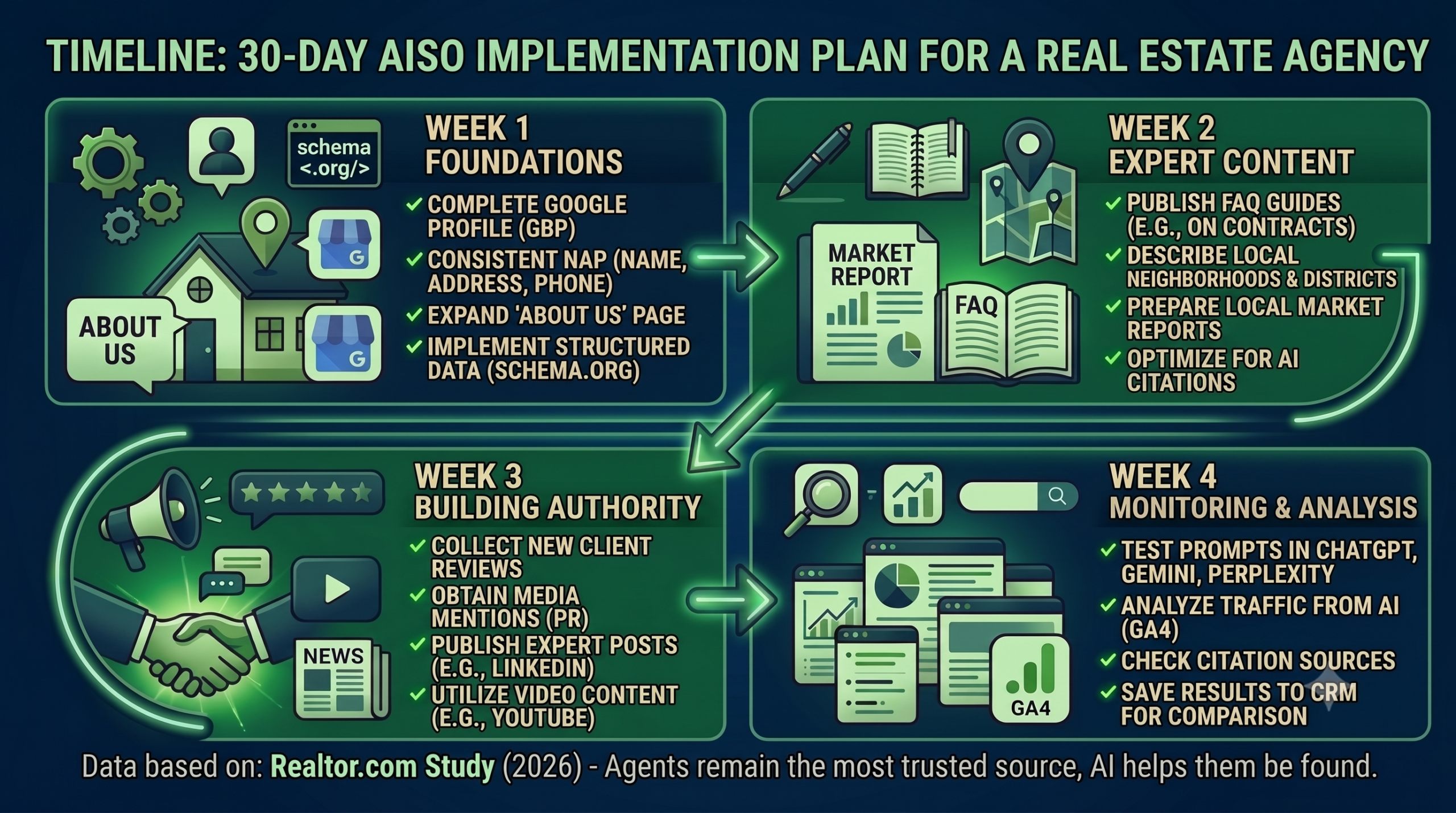
A 30-day AISO implementation plan for a real estate agency

If you are only starting out with AISO, do not try to implement everything at once. Working through the stages of a simple plan brings much better results.

Week 1: put the foundations in order

  • Complete your Google Business Profile.
  • Check the consistency of your company data (name, address, phone number) across all services.
  • Verify the contact details on your website.
  • Build out your About Us page.
  • Implement Schema.org structured data.

Week 2: prepare valuable content

  • Publish your first guide answering a specific client question.
  • Expand your FAQ section.
  • Prepare a profile of the city, district, or neighborhood you specialize in.
  • Plan a series of expert articles.

Week 3: build brand authority

  • Ask clients for new reviews.
  • Start working with a local news portal or an industry outlet.
  • Publish an expert post on LinkedIn.
  • Prepare your first video.

Week 4: start monitoring the results

  • Check the answers from ChatGPT, Gemini, and other AI systems.
  • Analyze traffic in Google Analytics 4.
  • Review your data in Google Search Console.
  • Save the results as a baseline for future measurements.

Summary

The way people search for information online is changing faster than ever before. More and more users expect one specific answer instead of a list of links, and AI systems are taking over the role of guide to knowledge.

For real estate agencies, this means a new opportunity to reach clients while they are still making their decision. Companies that consistently develop an expert image, publish valuable content, and care for brand recognition across many sources raise their chances of appearing in AI-generated answers.

AI does not eliminate the agent’s role. According to a Realtor.com study, 82% of Americans already use AI tools to gather information about real estate, yet agents remain the most trusted source of market knowledge. AISO does not replace the agent’s work; it increases the chance that the agent who gets found is you. (9)

AISO – Positioning in AI Tools

Build visibility where your potential customers are already looking

Learn more!
Michał Grzyb
Michał Grzyb SEO & AI Specialist

Author
Michał Grzyb - Junior SEO Specialist
Author
Michał Grzyb

SEO & AI Specialist

Graduate of Management at the Cracow University of Economics. His interest in internet marketing and SEO began during his studies and led him to start working at Delante in August 2022. Expert in building visibility in traditional search engines and AI models. Privately a lover of physical activity in any form and good food.

Author
Michał Grzyb - Junior SEO Specialist
Author
Michał Grzyb

SEO & AI Specialist

Graduate of Management at the Cracow University of Economics. His interest in internet marketing and SEO began during his studies and led him to start working at Delante in August 2022. Expert in building visibility in traditional search engines and AI models. Privately a lover of physical activity in any form and good food.

FAQ

What is the difference between AISO and SEO?

SEO focuses on earning top positions in Google search results, where users decide for themselves which link to click. AISO is responsible for brand visibility in answers generated directly by AI systems such as ChatGPT and Gemini, where the user receives a ready recommendation instead of browsing a list of links. The two strategies complement each other rather than compete.

Will AISO replace SEO?

No. A strong SEO base, meaning domain authority, content quality, and structured data, is the foundation that AI visibility also builds on. Language models rely largely on the same credibility signals as search engines, which is why both approaches should be treated as one coherent strategy.

How long does it take to see results from AISO?

It is a long-term process, similar to SEO. Results compound over time as brand authority grows along with the number of credible mentions online. You can start noticing the first changes in visibility after several months of regular work, but a lasting position as an expert source takes much longer to build.

Can a small, local real estate agency benefit from AISO too?

Yes, and often more easily than large, nationwide companies. AI models reward detailed, expert content in a narrow niche. An agency specializing in one district or city can build stronger topical authority in that area than a big player covering the entire market.

How do I check whether my company already appears in AI answers?

The simplest way is to test it yourself: ask ChatGPT, Gemini, or Perplexity the questions your potential client might ask (for example, “which real estate agency do you recommend in [your city]?”) and check whether the answer includes your company name or a link to your website. Do this regularly, for example, once a month, to track changes over time.

Do I need a new website to implement AISO?

Not necessarily. In most cases, it is enough to expand your existing site with valuable content, add Schema.org structured data, and keep your company information consistent across the web. A new website is needed only when the current one has serious technical limitations.