The frame of SEO in Poland
The Language
You may have already painted a sketchy picture of an average Polish user. They may strike you as people of habit. And there seems to be some truth in that. Polish society is generally a homogenous one – in terms of language, but also in a series of diverse social features. One important conclusion that follows here, is that when building an initial set of keywords to have something to start your Polish SEO process with, they should be primarily in Polish. Apart maybe from the IT industry, where English penetration in their everyday life is unique against the general picture, Polish search engine users use Polish Google typing Polish keywords. That is the very first argument for, if not hiring an entire Polish SEO agency, getting yourself at least a Polish-handy copywriter, or a better yet, SEO consultant.
Two important (however, not the only ones) features of Polish language that contribute a world-spread opinion that it’s a nightmare to learn, are diacritics and declension.
The diacritics of the Polish language
Diacritics are symbols that modify the letters from the Latin alphabet. They are an integral part of the language, with no apologies. These are: an additional accent symbol ć, ń, ó, ś, ź; the overdot (ż); a tail (ą, ę); or the stroke (ł). The additional symbols modify the sound of the basic letter, and they are required for the correct orthography of the text. For spoken language, they are a must, as Polish is quite infused with these.
As for the impact on polish SEO, the presence of orthographical norms concerning the diacritics makes it more difficult to create lists of keywords for search engine. For instance, a Polish word for a vascular system is układ krążenia – so, as you can see, there 3 diacritics. Does Google override those differences and consider words spelled with and without diacritics synonyms? There is evidence suggesting that it does not. If a keyword is spelled correctly, there’s a good chance that the user using the query is a local, speaking the tongue as their native.
Declension and Polish language
In English, you may use the word “dog” in order to simply denote an object – a dog. And if you want to say, that you want to give a bone to a dog, it’s still correct to simply use the name of the species – “dog”. In Polish, the case is different. Depending on what sort of state of the facts is expressed by the sentence, a different suffix needs to be added, sometimes modifying the basic word significantly. A dog is “pies”, but when I want to give a bone to a dog, it’s “psu” – moreover, if “there is a dog”, it’s “pies”, but when “there’s no dog”, it’s “psa”. Tough, isn’t it?
Declension impacts SEO services a lot – mostly keyword creation. A single product or service name can have many keywords that match it. Moreover, simple juxtaposition of the basic (nominative) word forms simply will not do. Maybe for search engine users, but for optimizing – certainly not. For instance, should you want to optimize a landing page for “dog food”, trying to optimize it just like that (in Polish, “jedzenie pies”) will probably result in dubbing your page automatically-made and Google will give you penalty. Even going to a bit more subtle “food for dog” will not be correct, unless you use the right grammatical case (“jedzenie dla psa” but not “jedzenie dla pies”). Using correct preposition will probably confuse you, too, as there’s no preposition so versatile as English “for” – there are many words instead, usage of which is tied to specific rules, which are full of exceptions, anyway.

Keyword generation is additionally complicated by the synonyms, a situation known, however, to any person proficient in English.
The language complexity described only superficially above, makes it almost a natural consequence, that Polish SEO users use long-tail queries on a daily basis. Many products or services have complex proper names – unless the name’s simply taken from English or other languages quite straightforwardly. Add the fact that Polish Google users often use full queries in the form of question, as if asking the search engine HOW TOs – how to install something somewhere, or purchase a product in a certain way, and so on. All these things combined, the result is pretty clear. If you’re thinking of launching SEO process that targets Poland, prepare your long-tail strategy well. And, once more time, get a Polish native speaker ( or a whole SEO agency) on board to deal with all the diacritics, declension, and full sentence construction subtleties that, at the end of the day, will have a huge impact of the efficiency of your SEO process.
The access
Riding the tube in Poland (only one city to do that there, though) shows you this – smartphone in every hand. And that’s something to consider when trying to come up with an efficient Polish SEO strategy. Almost 65% of the daily usage goes to mobile these days, however, mostly smartphones. Tablets are relatively rarely used – less than 1% of the internet resources usage is linked to that device. The desktop is the rest of 34% of the market.

http://gs.statcounter.com/platform-market-share/desktop-mobile-tablet/poland
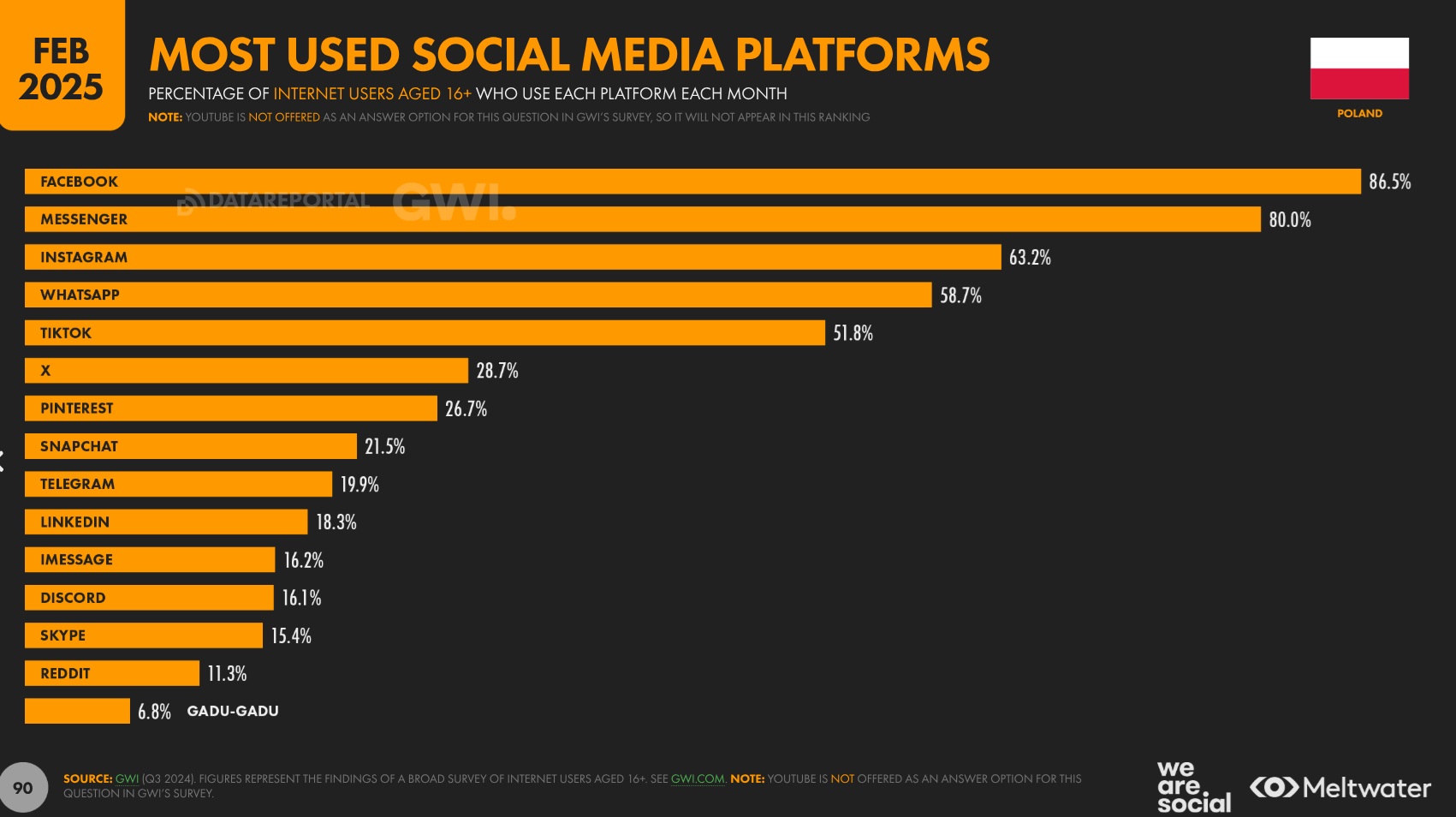
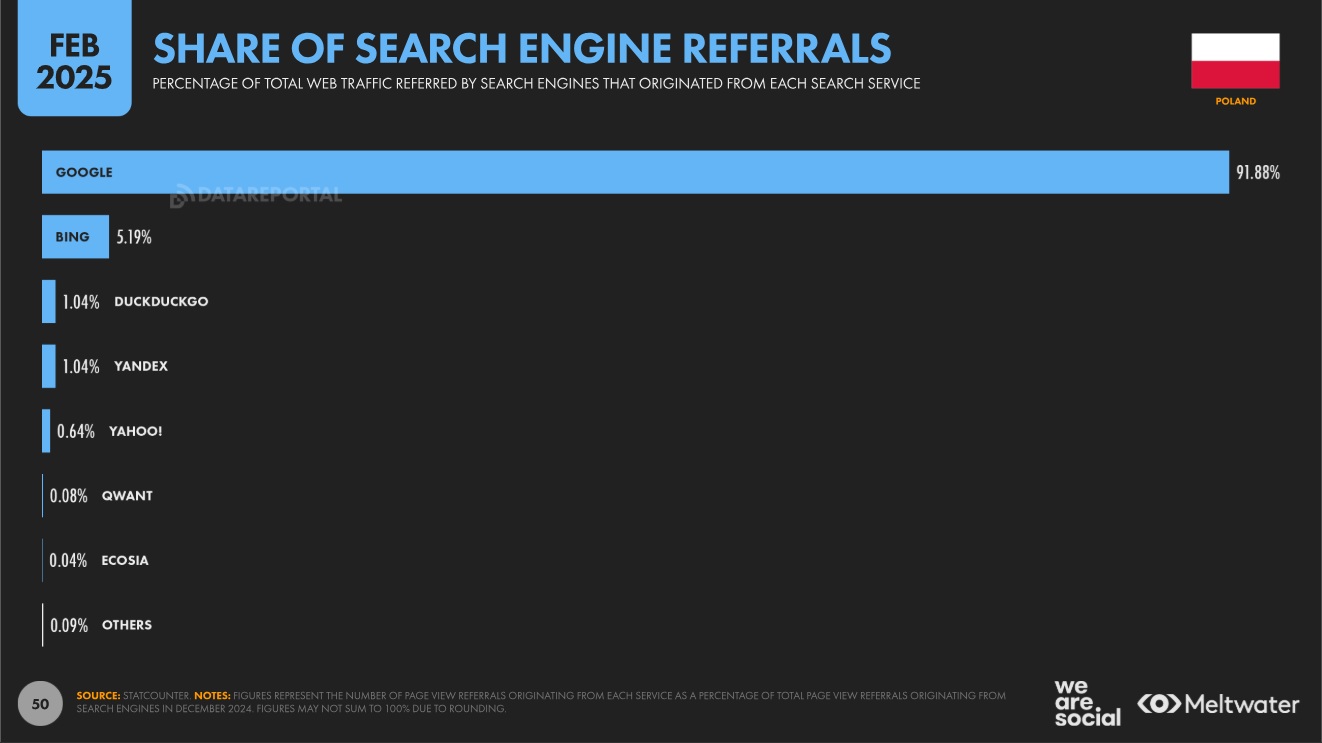
There are certain consequences – having a responsive, mobile-friendly website is a must-have. Run this official Google test measuring how mobile-friendly your website is. Read the official guidelines for mobile sites’ webmasters, too. Taking care of that brings two things important in Polish internet usage – huge Google search engine prevalence, and the nation’s inclination to access the online resources with their smartphones.
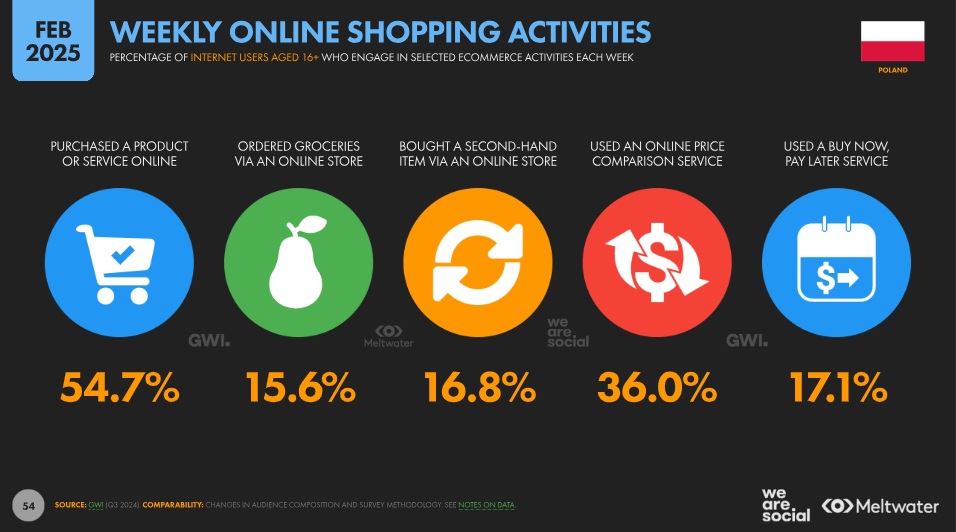
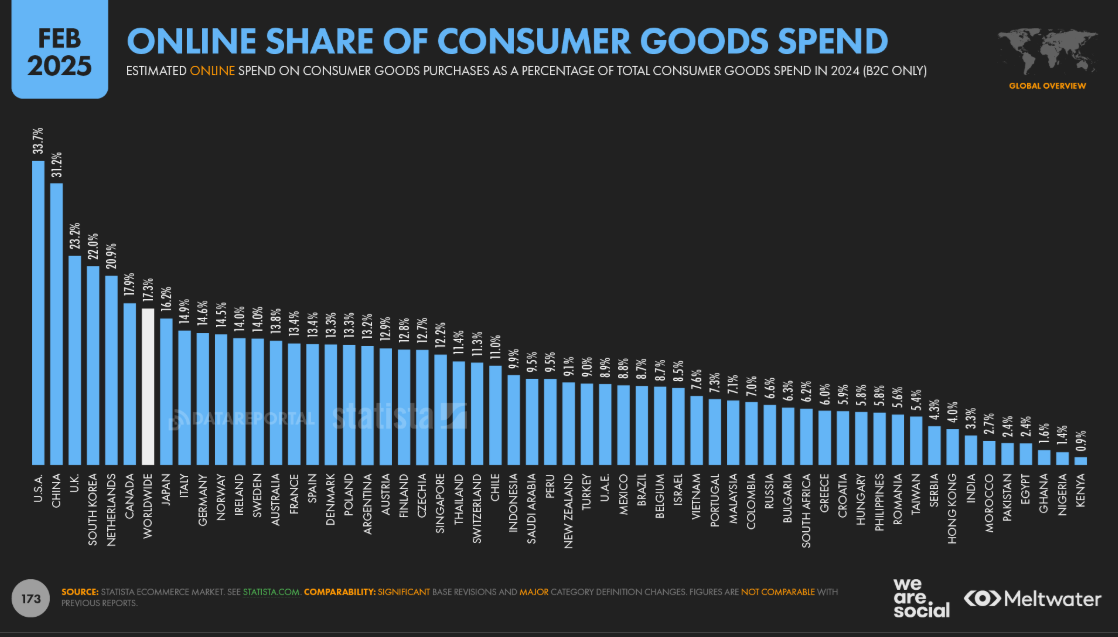
Internet penetration is on average level – in 2016 the rate was 72.4% of the entire population (source). Some call that good, but if assessed against some other Eastern European countries, it’s higher than Ukraine (52%), but close to penetration rate in… Belarus (71.11%), quite close, but still behind Lithuania (74.38%), Czech Republic (76.48%), Slovakia (80.48%) or… Russia (76.41%) – but still distant to Germany (89.65%) and pretty much any country to the West from it (all data are taken from this Wikipedia entry). Those data clearly show that there is a strong online market in Poland
On top of that, the word is that understanding of Search Engine Optimization among the Polish CEOs or executive boards is still relatively low. Therefore, this mix results in relatively good internet penetration, promising mobile marketing opportunities, and perhaps competition that will not make you all that difficult to rank high in Google. If that’s not an opportunity, I have no idea what is.
Moreover, if you have a budget for that, building your own app to secure customers’ loyalty works, too, if the digital product in question, brings value in its own respect. It may not be SEO strictly speaking but surely can work wonders when it comes to online marketing.
Selected Polish SEO process elements
SEO in Poland is divided into three main areas: on-site SEO, off-site SEO and content. This is the division you’ll most likely find when working with a Polish SEO agency.
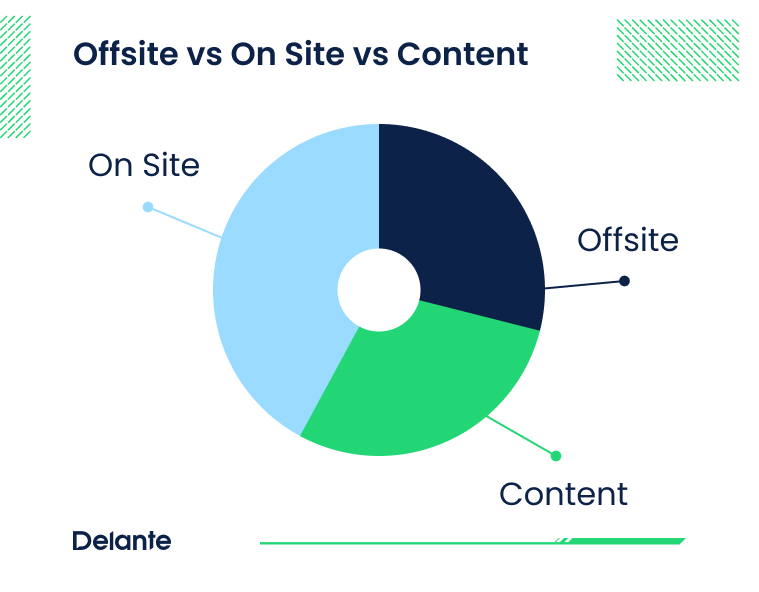
When it comes to reporting, te case is a bit different – it may depend on the agency you work with. At Delante, we focus on three main metrics: impressions, clicks and conversions.
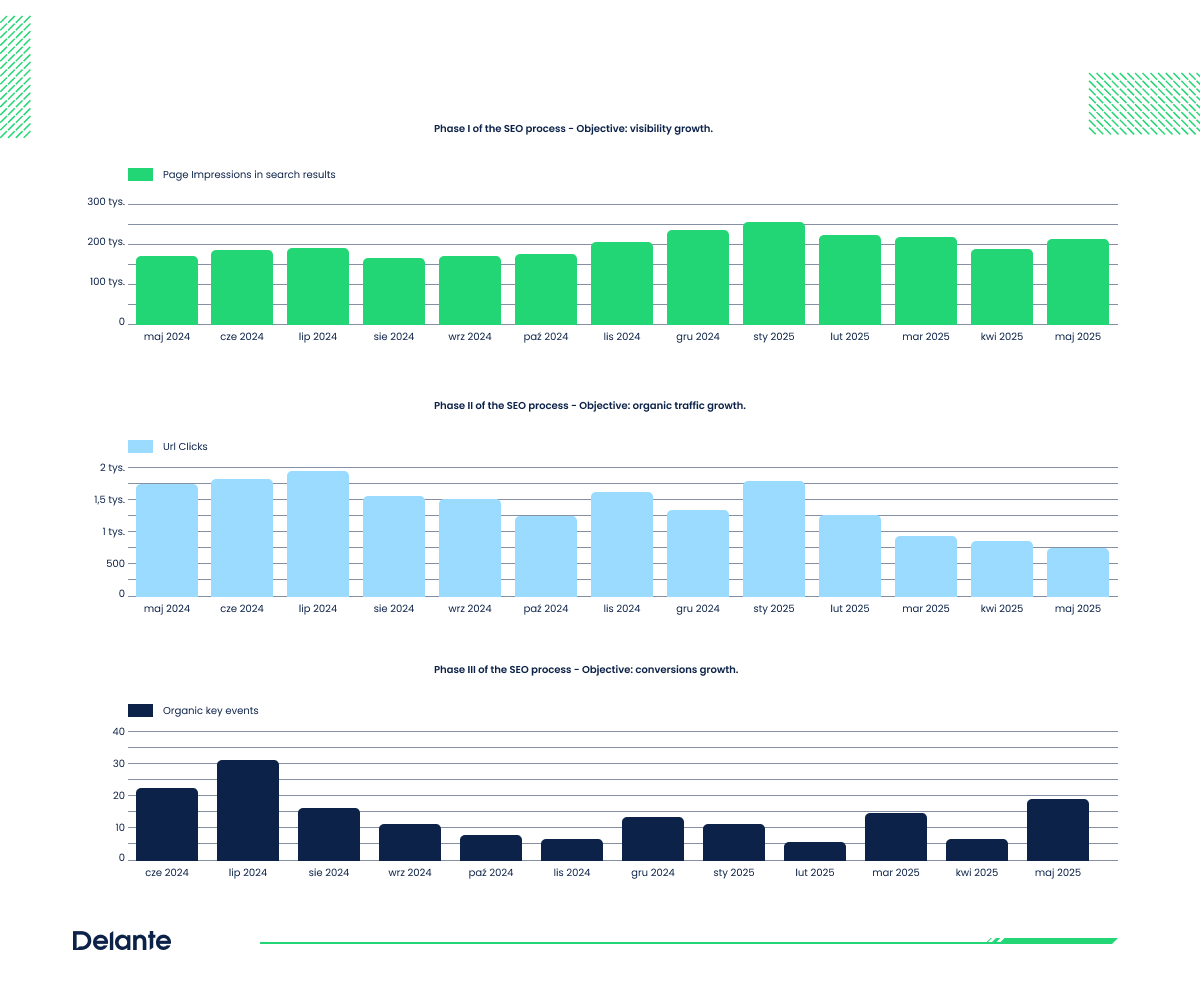
Let’s dive a bit deeper into the Polish SEO landscape and discuss the elements that constitute an SEO process – not just the main areas, but also some deeper efforts that you need to undertake.
On-site optimization in Polish SEO
A thorough SEO audit should be definitely be the beginning of your SEO in Poland. As the technical knowledge is on a high level, you’ll need to ensure your website is top-notch when it comes to performance and optimizations. An audit will give you insights into its current state: help localize bottlenecks and areas for improvements. Naturally, you should follow up by implementing the recommendations from the audit, as correct on-page SEO is able to work wonders in a Polish online setting, taking a website from a bottomless pit of 10+ SERP pages to the TOP10. Don’t forget therefore the tags: title, H1, H2, alt image descriptions, reasonable use of <strong> and <em>, not to get busted as a keyword-stuffer.

Directory Submission in Polish SEO
Directory Submissions used to be one of the cornerstones of Polish SEO – now, after several updates that took place from 2013, they still remain to be a pillar, albeit a bit shaky one. In Poland, contrary to what’s been observed in, say, UK or Germany, getting your entry to an online directory of business websites is relatively easy. In fact, most of them are overtly SEO-focused – such as the (in)famous SEOKatalog template.
Another Polish Directory Submission feature is that getting the very basic entry there is relatively cheap – the cost is about 1 EUR. However, most of the directories do not accept entries written in anything else than quality Polish. Only a few will welcome your English-written business description, and if you’re thinking of Google-Translating your copy, there’s a chance that you’ll be denied by the moderation. So, again – prepare for polish content marketing activities.
These two reasons for directory submissions – them being easy and budget-friendly – resulted a couple of years ago in a widespread SEO practice of submitting links and descriptions to dozens of directories, one after another. Nowadays to blindly tap into this M.O. is to ask for trouble – your rankings may, instead of going up, go down, as many of the shining SEO stars of the yesteryear have been dubbed by Google as link farms.
Therefore, when it comes to directories, in order for the submissions to comprise a legitimate Polish SEO process, the catalogs need to be of quality. In order to determine, whether the directory you’re dealing with is a quality one, first and foremost check if it’s indexed in Google.

If an attempt to find the directory on the 1st SERP page using the home page’s title, this means Google has given the site a penalty. Also, the update frequency matters, too – the freshest the update is, the better. Look for information, whether the submissions are human-reviewed and/or edited, too. Don’t trust a directory, unless it’s the humans that decide whether a link should be included there, or not.
The content in Polish SEO
Directory Submissions have lost a huge part of their importance in SEO services, while other ways of SEO copywriting have been trending for some time. The methods are:
- Sponsored articles – are articles written by a pro copywriter, rich in valuable content, of preferably 0% duplicate content, maybe apart of the occasional Steve Jobs quote, published in a respected portal including a link to your website. The purpose is to tap into a stream of undoubtedly valuable content and include a link to your site as an extra to a quality piece of content. However covert this type of online marketing is, sponsored articles should always be marked as such.
- Blogs – writing your own blog with frequent, regular, quality entries full of technical knowledge and vivid interaction with the readers helps you build your brand – not only the customers’ eyes but Google’s, too. As your blog becomes a more trusted source of content, the more valuable it will be in links you include in your entries to your SEO process. Interestingly enough, even in 2025 there are still industries where blogs are used rarely – if this happens in your industry, you have a relatively easy way to climb up the SERPs.
- Guest posting – this method makes use of an existing blog network; by getting either a valued blogger to post on your own blog or your piece to be published in someone else’s, you sort grant the trademark as quality assurance. The content is therefore interpreted as quality by Google, and hence the mandatory link will do your Polish SEO much good.
In all of the methods suggested above, content quality is job one now. As Google gets more semantic, refining its algorithms to determine whether website content is human-authored and therefore worthy of ranking higher, sensible investment in SEO is tantamount and implies, investments in quality content.
SEO in Poland – Local SEO
With a strong mobile device presence, explorations of cities with smartphones serving as guides and directories of offers, products, and services are something you need to expect. This points out clearly to local SEO as being your chance of entering the Polish online market fast. To make sure that your website is optimized in terms of local SEO, check out the near-perfect checklist from Prague’s GFluence: