At Delante, we prepare brands to enter ChatGPT Ads from the perspective of strategy, data, creative assets, and measurement. So when tests and availability are expanded, your company does not start from scratch, but with a ready-to-use plan and a well-structured execution framework.
Readiness to scale alongside the development and global rollout of ChatGPT Ads
A new channel with low competitive saturation at the testing stage
Precise message alignment with the context of the conversation
Advertising based on user intent, not just keywords
Brand presence within real user questions and problems
Building an expert brand image in an AI-driven environment
Synergy with SEO, Google Ads, and informational content

SEM & Analytics Specialist







Ads in ChatGPT are a new user acquisition channel announced by OpenAI, where the advertising format is intended to be separated from the response and displayed within the context of the conversation. OpenAI has announced the start of tests for Free and “Go” users in the US, while at the same time emphasizing privacy protection and the independence of responses from advertising.
This means that effectiveness in this channel will rely less on “capturing clicks” and more on alignment with user intent and the real usefulness of the offer.
In traditional advertising systems, the user “searches” and the ad competes in an auction. In ChatGPT, the user “converses”, asks follow-up questions, compares options, and expects recommendations that help them make a decision. OpenAI indicates that the first formats are expected to appear at the bottom of responses as clearly labeled sponsored content related to the context of the conversation. This shifts the focus away from CPC bids alone toward the quality of fit with the user’s problem and the consistency of the communication.
For brands that want to capture demand earlier in the funnel, when users are in the research and comparison phase, as well as for companies that already invest in Google Ads, Meta Ads, or marketplaces and are looking for a new high-intent channel.
This solution is particularly well suited to categories where the purchase decision requires explanation, comparison, and trust, such as:
We build a strategy around a format that OpenAI describes as separated from responses, contextual, and transparent to users in terms of “why am I seeing this?”. We design intent scenarios, conversation themes, and touchpoints with the offer.
We map user questions to decision-making stages. Instead of copying a search-based campaign structure, we design messages that address real objections and needs, and then guide users to the appropriate landing page.
We create content sets that work effectively in a conversational interface. Short, clear value propositions, transparent conditions, and trust-building elements are key, as OpenAI strongly emphasizes user trust as the foundation of ad monetization.
We organize analytics in a way that allows us to measure the impact of the new channel, even when user journeys are more “assistive” and multi-touch. We define conversions, attribution models, and reporting standards.
OpenAI indicates restrictions for sensitive and regulated topics, as well as no ads next to content related to mental health or politics, plus exclusions for minors. That is why already at the strategy stage we assess industry, communication, and compliance risks.
We gather business goals, margins, product priorities, legal constraints, and customer data. We verify what already works in Google Ads and SEO, as these signals are often the best starting point for intent mapping.
We build an “intent map”, defining which conversations lead to which products, services, and landing pages. We set KPIs for each stage, not just the final sale.
We create creatives, recommend landing page improvements, and finalize analytics implementation.
As OpenAI emphasizes testing and the evolution of ad formats, we plan an iterative workflow. Test, feedback, refinement, scaling.
No. According to OpenAI communications, tests currently apply only to the US. Tests have been announced for Free and “Go” users. However, if you are targeting users in the US, it is worth planning this type of campaign as early as possible.
Tests may cover adult Free and “Go” users in the US. Plus, Pro, Business, Enterprise, and Edu accounts are expected to remain ad-free. This somewhat limits effectiveness for campaigns targeting highly technical or enterprise-level audiences, where higher-tier plans are more common. On the other hand, over 80% of ChatGPT users use the Free version.
OpenAI declares that ads will not influence responses and that the ad format will be separated and clearly labeled.
OpenAI describes the first formats as ads shown at the bottom of responses, when a contextually relevant sponsored offer appears, with the option to check why the ad is shown and to hide it.
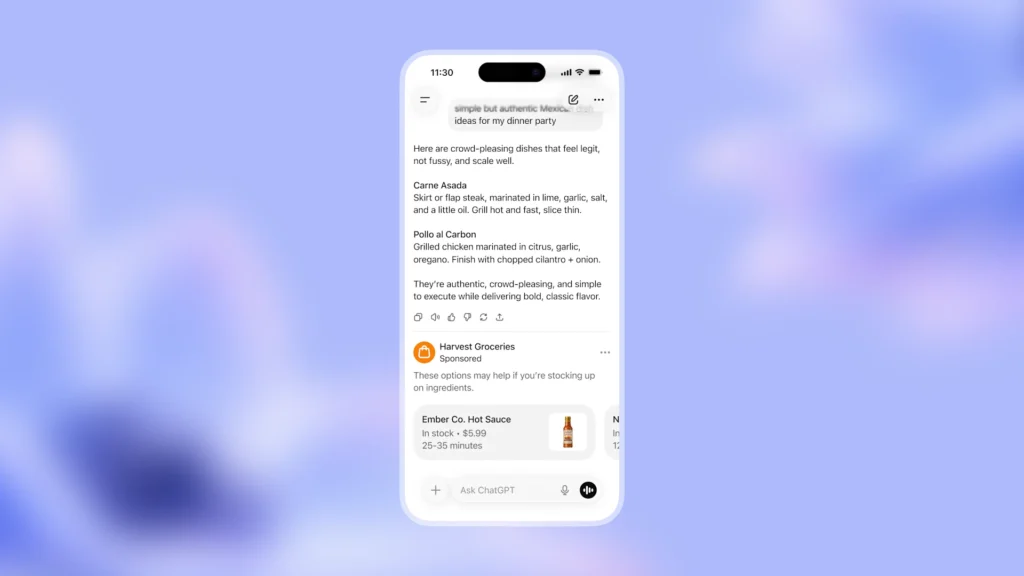
Źródło grafiki: https://openai.com/index/our-approach-to-advertising-and-expanding-access/
If you wait until the full rollout, competitors will already be past the first learning iterations of the channel. The best moment to prepare is when you can structure intent, refine the offer, and deliver solid analytics. External analyses emphasize that cost pressure and user scale may make advertising a natural direction for monetization. The faster you build readiness, the faster you can move into effective testing.