Author


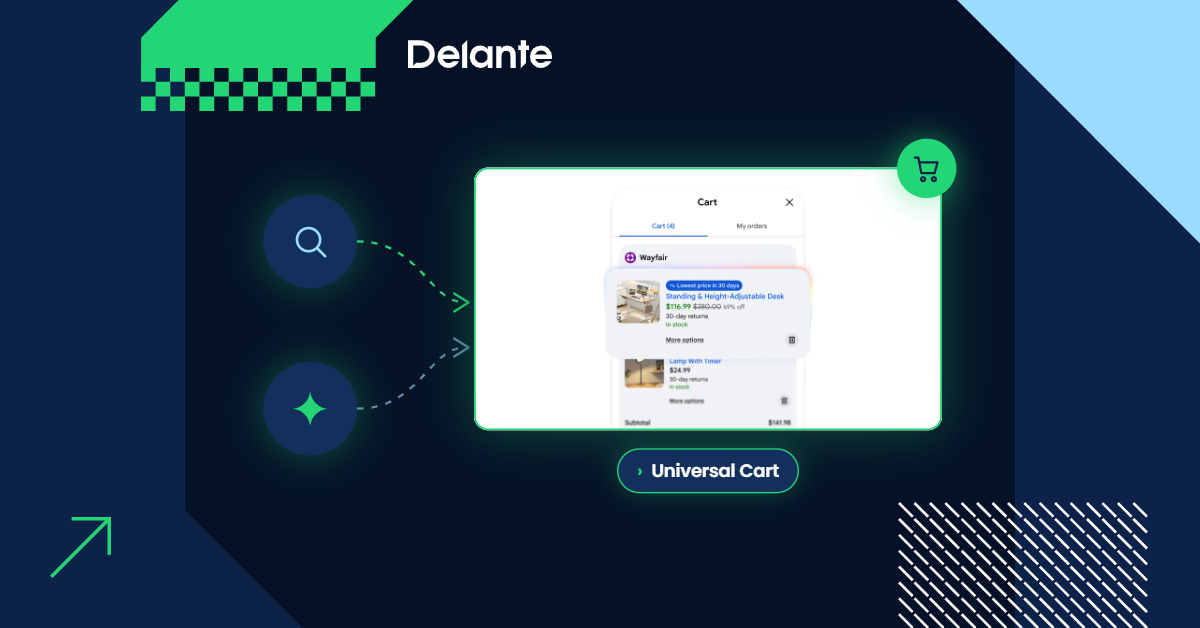
Google has officially launched Universal Cart, a new shopping feature that allows users to save products from multiple retailers in a single cart across Google Search and the Gemini app. Announced on October 15, 2026, the feature is rolling out in the United States, bringing product discovery, price tracking, and purchasing closer together within Google’s ecosystem. For e-commerce businesses, the launch marks another important development in AI-powered shopping and agentic commerce.
Google Universal Cart is a shared shopping cart designed to work across Google’s shopping and AI-powered experiences.
Users can discover products through Google Search or Gemini, add them to a single cart, and return to their saved items later without having to repeat their searches.
Importantly, products in Universal Cart can come from different retailers.
For example, someone could discover a pair of running shoes through Google AI Mode, save a skincare product recommended by Gemini, and manage both items in one place.
Universal Cart introduces several shopping capabilities:
The experience builds on Google’s Shopping Graph, which Google says contains more than 60 billion product listings that are continuously updated.
As of October 15, 2026, Universal Cart is rolling out in the United States through Google Search and the Gemini app.
Google has previously discussed expanding the shared shopping experience to other products, including YouTube and Gmail. However, broader availability across those services has not been confirmed as part of the initial launch.
Google first introduced its vision for Universal Cart during Google I/O on May 19, 2026.
At the time, the company presented a shopping experience designed to connect product discovery and purchasing across its services.
The announcement was part of Google’s broader strategy for agentic commerce, where AI systems help users complete tasks throughout the shopping journey.
The key development on October 15 is that Universal Cart is now being made available to users in the United States.
This marks the transition from a product announcement to a live shopping feature integrated into Google Search and Gemini.
Google has not announced when Universal Cart will become available in Europe or other international markets.
Universal Cart brings several stages of the online shopping journey into a shared Google experience.
Users can search for products in Google Search, explore recommendations in AI Mode, or ask Gemini for help finding items that match their requirements.
For example, they might ask for a comparison of laptops within a specific budget, taking into account performance, battery life, and customer reviews.
Selected items can be added to Universal Cart, even when they come from different online stores.
Users can return to these products later without having to revisit every retailer separately.
Google can monitor saved products and notify users about relevant price changes or restocks.
The system can also help identify available promotional codes and selected benefits associated with payment methods stored in Google Wallet.
When users are ready to buy, eligible purchases can be completed through supported Google Pay checkout experiences.
Alternatively, shoppers can proceed to the retailer’s website to complete their orders.
Google has identified brands such as Nike, Sephora, Target, Ulta Beauty, Walmart, Wayfair, and selected Shopify merchants among retailers supporting streamlined shopping experiences.
Retailers remain the sellers of record and are responsible for customer service and order fulfillment. Universal Cart simplifies the shopping experience without replacing every function of an online store.
Universal Cart is connected to Google’s broader development of the Universal Commerce Protocol (UCP), an open standard designed to support AI-driven commerce.
UCP aims to simplify communication between AI agents, commerce platforms, merchants, and payment providers.
In a traditional e-commerce journey, customers typically move between search engines, product comparison websites, individual stores, and payment systems.
With agentic commerce, some of these steps can be supported or coordinated by AI-powered systems.
Universal Cart is one consumer-facing example of how Google is bringing shopping discovery and purchasing processes closer together.
However, the launch does not mean every online store automatically supports UCP-based transactions.
Access to checkout features and integrations depends on merchant eligibility, technical compatibility, and supported commerce systems.
Universal Cart could influence how customers discover products and move from initial research to purchase.
Traditionally, a major objective of e-commerce SEO has been to attract users from Google Search to product pages and category listings.
With Universal Cart, some activities that previously happened on retailers’ websites, such as saving products and comparing offers, may increasingly take place within Google’s ecosystem.
From Delante’s perspective, three areas deserve particular attention.
Google relies on product information to display shopping listings, compare offers, and provide up-to-date prices and availability.
E-commerce businesses should prioritize:
These elements already contribute to effective product visibility across Google’s shopping experiences.
However, Google has not announced a separate set of SEO ranking factors specifically for Universal Cart.
When users can save products directly from Google Search or Gemini, their first meaningful interaction with a retailer’s offer may happen before they visit the store.
This makes accurate, comprehensive, and accessible product information increasingly important.
Businesses should think about how their products are represented across search, shopping listings, and AI-generated experiences.
The objective is to make it easier for potential customers to discover relevant offers and understand their value, regardless of where the shopping journey begins.
If a user discovers a product, saves it through Universal Cart, and later completes an eligible purchase through Google’s checkout experience, some of those interactions may happen outside the retailer’s website.
This could make it more difficult to evaluate the full impact of organic product discovery using website sessions alone.
However, there is currently no evidence that Universal Cart will necessarily reduce organic traffic or conversions for online retailers.
Its actual impact on clicks, revenue, and customer behavior will require further measurement.
The integration of shopping functionality into Search and Gemini signals an expansion of AI-powered search beyond answering questions and recommending products.
AI systems can increasingly support several stages of the customer journey, from identifying needs and comparing options to saving items and facilitating purchases.
For brands, this creates important questions about AI search visibility:
This is where AI Search Optimization (AISO) becomes particularly relevant.
AISO strategies should consider not only whether a brand appears in AI-generated responses, but also how accurately its products and services are described and how effectively that information supports customer decisions.
Still, appearing in more AI-generated recommendations does not automatically guarantee more purchases or higher revenue.
The relationship between AI visibility, Universal Cart interactions, and sales performance will need to be evaluated using real-world data.
Measurement is one of the most important questions for retailers as Google develops more integrated shopping experiences.
In a traditional e-commerce journey, users visit a retailer’s website and complete actions that can be tracked through analytics tools such as Google Analytics 4.
With Universal Cart, some shopping interactions may take place outside the retailer’s website.
This raises questions about how businesses will measure:
At launch, Google has not provided a comprehensive public explanation of how every Universal Cart interaction will appear in standard GA4 reports.
From Delante’s perspective, retailers participating in supported integrations should validate reporting across their commerce platforms, Google Merchant Center, Google Ads, and GA4.
It will be particularly important to distinguish purchases completed on a retailer’s website from those processed through supported Google checkout experiences.
Universal Cart is currently rolling out in the United States.
Google has not announced an official launch date for Europe or other international markets.
However, international retailers can already focus on improvements that support both existing shopping visibility and future AI-powered commerce experiences.
We recommend prioritizing:
For retailers operating in the US, it is also worth checking whether their platforms and payment configurations support Google’s new shopping integrations.
The launch of Universal Cart is another step toward agentic commerce, where AI helps users move beyond product research and complete more of their shopping tasks.
Google is connecting Search, Gemini, Shopping Graph, Google Wallet, and Universal Commerce Protocol to support this direction.
The company has also outlined plans to expand the shopping experience to additional products within its ecosystem.
For now, there is no confirmed timeline for an international rollout or sufficient performance data to determine the effect on retailers’ website traffic and sales.
The broader direction is clear: AI-powered search and e-commerce are becoming more closely connected.
Businesses should continue investing in a strategy that brings together e-commerce SEO, accurate product data, AI Search Optimization, and reliable revenue measurement.