Author


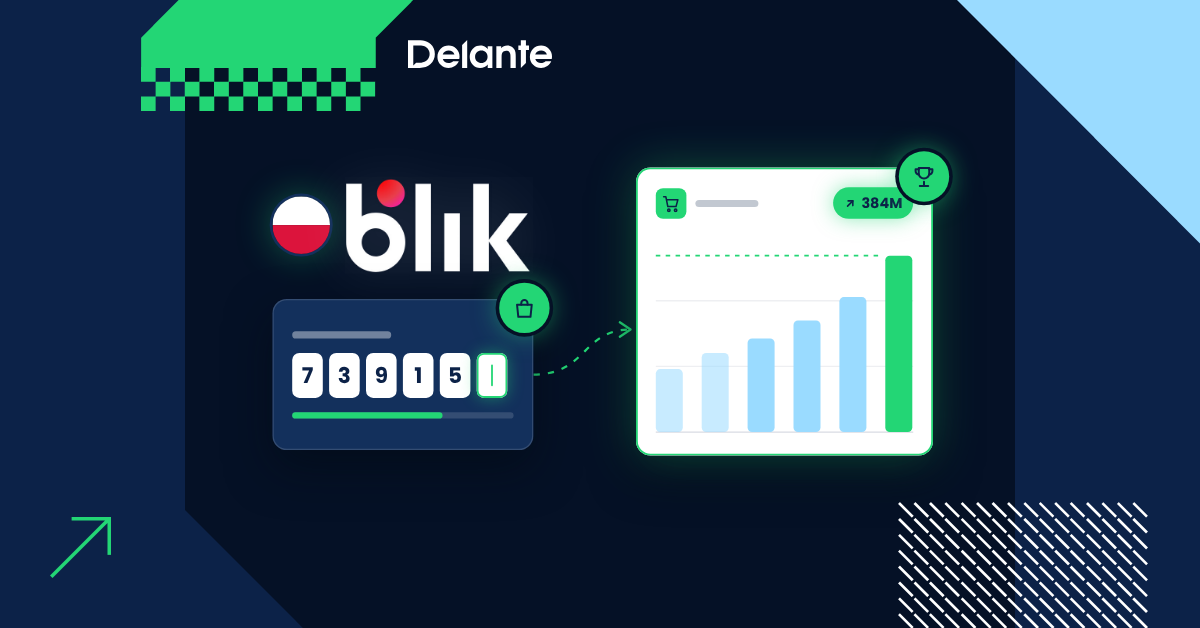
Poland’s mobile payment system BLIK processed 384.3 million online transactions worth PLN 64 billion (€14.48 billion) in Q3 2026, according to figures released on November 4 by Polish Payment Standard. Online payments increased 10% in volume and 18% in value year over year, while the system reached 21.9 million active users. BLIK is also expanding internationally through Stripe and testing payments completed by AI shopping agents. For international e-commerce businesses, the developments highlight two growing priorities: localized checkout experiences and preparing payment infrastructure for Agentic Commerce.
| Metric | Q3 2026 | YoY Change |
| Total BLIK transactions | 822 million | +10% |
| Total transaction value | PLN 131.8 billion (€29.80 billion) | +17% |
| Online transactions | 384.3 million | +10% |
| Online transaction value | PLN 64 billion (€14.48 billion) | +18% |
| Average online transaction | PLN 167 (€37.80) | — |
| Recurring payments | 2.9 million | More than doubled |
| Active users | 21.9 million | As of September 30 |
Source: BLIK / Polish Payment Standard, November 4, 2026. Euro equivalents are those reported by BLIK.
The most important developments are:
What does this mean for online retailers? Businesses selling internationally should evaluate whether their checkout supports the payment methods customers expect in each target market. At the same time, AI-assisted transactions are creating new requirements for payment authorization, security, and technical integration.
Importantly, BLIK’s figures describe transactions processed through its own payment network. They do not measure the total growth of Poland’s e-commerce market or prove that adding BLIK automatically increases conversion rates.
BLIK is a Polish mobile payment system developed by Polish Payment Standard (Polski Standard Płatności).
It allows eligible users to make online and in-store payments through participating banking applications. Depending on the transaction type, payments can be authorized using a generated code, a banking app, or supported contactless functionality.
Unlike a conventional card-based checkout experience, BLIK is closely connected to the user’s mobile banking environment.
It has become an important payment method in Poland, and the latest figures illustrate its scale.
Between July and September 2026, users completed 822 million BLIK transactions worth PLN 131.8 billion.
That represents an average of 8.9 million transactions per day, or more than 100 per second.
For businesses operating outside Poland, these figures are particularly relevant when planning cross-border expansion.
A checkout experience designed around the most familiar payment methods in one country may not match consumer expectations in another.
For example, a US or UK retailer entering the Polish market should not assume that offering international payment cards alone will provide the most suitable checkout experience for every customer.
The appropriate combination of payment methods should reflect local preferences, payment provider availability, device usage, and actual customer behavior.
E-commerce remained BLIK’s largest channel by transaction volume in Q3 2026.
Users completed 384.3 million online payments worth PLN 64 billion.
The number of online transactions increased 10% compared with the same period in 2025, while their total value grew 18%.
The average online payment reached PLN 167, equivalent to approximately €37.80 in BLIK’s report.
This difference between transaction volume and value growth suggests that the average amount paid online through BLIK increased.
However, it does not necessarily mean that individual Polish consumers made 18% more purchases or that the entire e-commerce market grew by the same amount.
There are several important distinctions:
Nevertheless, the data provides a useful indication of how important mobile payments have become within Poland’s online shopping ecosystem.
One of the most relevant developments for international retailers is BLIK’s expanded partnership with Stripe.
In September 2026, BLIK became part of Stripe’s dynamic payment methods.
According to Polish Payment Standard, eligible online merchants in more than 30 countries can automatically offer BLIK to Polish customers without implementing a separate BLIK integration.
This could reduce technical barriers for businesses selling into Poland.
Previously, an international retailer might have needed additional payment arrangements to support locally preferred payment methods.
With dynamic payment methods, the available checkout options can be adapted according to the payment provider’s eligibility rules and the customer’s circumstances.
However, the announcement does not mean BLIK has become a universal payment method for consumers in all 30-plus countries.
The distinction is important: international merchants gain a way to offer BLIK to eligible Polish customers, rather than BLIK becoming automatically available to every customer worldwide.
For cross-border e-commerce, this is a practical example of payment localization.
A retailer may invest in international SEO, localized product content, and region-specific advertising campaigns, but customers still need a suitable way to complete their purchases.
If a payment method is unfamiliar, unavailable, or difficult to use, the checkout can become an unnecessary obstacle.
Payment selection is one of the final stages of the customer journey.
By the time customers reach checkout, businesses may have already invested in attracting them through SEO, paid search, social media, or AI-powered discovery.
A conversion can still be lost if the payment experience creates friction.
Potential obstacles include unexpected payment restrictions, confusing instructions, failed authorization, unnecessary form fields, or difficulty switching between a browser and banking application.
For mobile payments, the experience can be especially sensitive to technical issues.
Retailers should evaluate whether customers can:
These considerations apply beyond BLIK.
They are relevant to businesses offering digital wallets, bank transfers, local payment systems, and other alternative payment methods.
However, adding more payment options does not automatically improve conversion rates.
The most useful approach is to measure the actual checkout completion rate and payment success rate for different methods and markets.
BLIK’s growth is not limited to one-time payments.
The company reported 2.9 million recurring transactions in Q3 2026, more than twice the number recorded a year earlier.
Recurring payments are particularly relevant to subscription-based business models.
These may include streaming services, software subscriptions, membership programs, and recurring product deliveries.
For retailers, the importance of recurring payments goes beyond reducing friction during the initial checkout.
Subscription businesses also need to manage payment continuity, failed renewals, customer retention, and the long-term value of each customer.
On October 28, 2026, BLIK announced the availability of its recurring payment functionality for Netflix subscribers in Poland.
This illustrates how local payment methods can extend into recurring digital services.
For international subscription businesses considering the Polish market, local payment preferences may therefore matter for both customer acquisition and retention.
Another major development is BLIK’s involvement in Agentic Commerce.
On September 9, 2026, BLIK announced that an AI agent had independently completed a purchase using its payment system in a pilot project.
The test involved Polish e-commerce brand Your KAYA, subscription technology company Juo, and payment provider PayU.
The transaction was worth PLN 19.99.
The AI agent purchased a specific hand cream once the selected product variant returned to stock.
The process began with a user interacting with an AI assistant on the retailer’s website.
The customer wanted to purchase a product that was temporarily unavailable.
Rather than repeatedly checking the store manually, the user instructed the AI agent to monitor availability and make the purchase when the item returned.
The customer also authorized the payment arrangement in advance.
This involved entering a six-digit BLIK code and confirming the authorization through a banking application.
Once the product became available, the agent added it to the cart and completed the transaction.
The user did not need to perform another action at the moment of checkout.
This is a particularly important distinction.
The AI agent acted autonomously during checkout, but only within the conditions previously authorized by the customer.
The pilot does not mean that AI agents have unrestricted access to users’ bank accounts.
Nor does it establish that this functionality is now available to all BLIK users or online merchants.
It demonstrates a specific payment authorization model tested by the participating companies.
Agentic Commerce is an e-commerce model in which AI agents actively participate in the shopping process.
Depending on their capabilities and the permissions granted by users, agents may search for products, compare offers, check availability, make recommendations, or initiate transactions.
The traditional online shopping journey typically requires the customer to perform each step manually:
Search → Product page → Cart → Checkout → Payment
In Agentic Commerce, some of these tasks may be handled by an authorized AI agent.
This creates new requirements for retailers.
Product information must be understandable to automated systems, but that is only one part of the process.
Stores may also need to support secure interactions involving orders, customer authorization, payment status, fulfillment, and returns.
The BLIK pilot is especially relevant because it demonstrates how payment authorization could work when a transaction is completed at a later time.
The customer approved the conditions in advance, and the agent subsequently performed the authorized action.
That raises practical questions about spending limits, consent management, payment security, auditability, and the conditions under which an agent is permitted to complete a purchase.
These are important considerations for any retailer preparing for AI-assisted transactions.
BLIK’s pilot is not the only recent example of AI-powered shopping infrastructure evolving in Europe.
On November 3, 2026, Zalando announced Zalando Extended, a planned shopping experience that will allow customers to purchase products from external retailers without leaving the Zalando app.
The company intends to introduce AI-assisted checkout in 2027, beginning with a pilot partnership involving Westwing.
Read our analysis: Zalando Introduces Zalando Extended: AI Shopping Agent to Buy From Other Online Stores in 2027.
The two developments focus on different parts of the purchasing journey.
Zalando is developing an AI-powered shopping experience that connects customers with products from external stores.
BLIK is exploring how authorized payment transactions can be completed by an AI agent.
They are separate projects, not components of one shared integration.
Together, however, they illustrate how Agentic Commerce involves more than conversational product recommendations.
It requires cooperation between product discovery systems, online retailers, payment providers, and the infrastructure that processes orders.
For international brands, BLIK’s results and AI payment pilot highlight two changes taking place simultaneously.
First, retailers need to make the conventional checkout experience as accessible and reliable as possible.
Second, they need to prepare for future shopping journeys in which customers may delegate selected tasks to AI systems.
International SEO and paid advertising help companies reach customers in new countries.
However, generating traffic is only one part of entering a market.
Businesses also need to consider local payment expectations, delivery options, customer support, pricing presentation, and post-purchase processes.
BLIK’s international expansion through Stripe offers a useful example.
A retailer based outside Poland may be able to provide a familiar Polish payment method without developing a separate integration.
That does not guarantee improved conversion performance, but it creates an opportunity to reduce a potential purchasing barrier.
A successful search campaign may generate relevant visitors who ultimately abandon checkout.
If a company evaluates performance based only on sessions or product page engagement, it may overlook problems occurring at the payment stage.
For retailers, it is useful to monitor:
These metrics help distinguish customer acquisition issues from technical or usability problems within the checkout.
Because BLIK is connected to mobile banking, its growth reinforces the importance of a reliable mobile checkout.
Retailers need to consider what happens when customers move between a browser, an online store, and a banking application.
Poorly handled redirects, lost checkout sessions, and unclear payment statuses can create unnecessary friction.
This is not only a payment provider issue.
The store’s frontend, backend, analytics configuration, and order management system also influence the experience.
For businesses investing in SEO or paid campaigns, these technical details can affect the value generated by acquired traffic.
An AI agent may need to understand a product, verify its availability, check purchasing conditions, and interact with the store’s order process.
That requires accurate product data and suitable technical infrastructure.
Delante explores these challenges in How to Adapt Your Store Architecture to Agentic Commerce.
Relevant preparation areas include structured data, product identifiers, machine-readable interfaces, technical accessibility, and reliable information about stock and delivery.
However, technical readiness for product discovery does not automatically mean a store supports agent-completed payments.
Payment authorization and secure transaction execution require additional capabilities.
Traditional e-commerce analytics typically focuses on sessions, conversion rates, transactions, and revenue.
As AI agents begin participating in shopping, businesses may need to distinguish between several types of outcomes.
These include revenue from users referred by AI platforms, purchases influenced by AI recommendations, transactions assisted by AI agents, and transactions actually completed by agents.
The distinctions are important because not every AI interaction results in a direct website visit.
In our article How to Measure Visibility and Sales in Agentic Commerce: New KPIs for E-commerce, we explain how retailers can approach these emerging measurement challenges.
The objective should be to understand AI’s actual commercial contribution without attributing transactions to a system that cannot be reliably identified.
At Delante, we have also investigated technical readiness for AI shopping agents.
In a study of 15 Polish electronics and home appliance retailers, we used our proprietary Agentic Ready Checker to evaluate selected aspects of website accessibility and machine-readable product information.
The average Agentic Ready Score was approximately 33 out of 100.
The research identified substantial differences between stores in areas such as technical access, structured data, content clarity, and machine-readable interfaces.
You can learn more about the methodology in our Agentic Ready Score definition.
The score is a proprietary Delante metric, not an industry certification or a direct assessment of payment integration capabilities.
Nevertheless, the research highlights a broader challenge: many retailers still have opportunities to improve how automated systems access and interpret their product offers.
As AI-assisted shopping evolves, these technical foundations may become increasingly important.
BLIK’s results do not mean every e-commerce business should immediately adopt a new payment provider or build its own AI shopping agent.
A more useful approach is to review the existing checkout experience while preparing for emerging transaction models.
If your business sells internationally, evaluate which payment methods are relevant to customers in each target market.
For merchants serving Polish consumers, review whether BLIK is available through the current payment provider and whether it is appropriate for the business.
Identify where users leave the purchasing process.
Distinguish between cart abandonment, checkout abandonment, and failed payment attempts.
Each may require a different solution.
Check the entire purchase journey on smartphones.
Pay particular attention to payment authorization, redirects, session continuity, return navigation, and order confirmation.
Verify that analytics and order management systems accurately record successful purchases.
Review whether duplicate transactions, missing events, or incorrect payment statuses could distort reporting.
If your company operates a subscription model, evaluate recurring payment methods and their availability in relevant markets.
Consider payment continuity, failed renewals, and customer retention alongside initial conversions.
Review product data accuracy, structured data, technical accessibility, and potential integration requirements.
Treat agent-completed payments as a separate capability that requires appropriate authorization and security controls.
BLIK completed Q3 2026 with 822 million transactions, including 384.3 million online payments.
The figures demonstrate the scale of a local payment system that is also developing international merchant access through Stripe.
At the same time, the company’s September AI payment pilot shows how some purchasing tasks may eventually be delegated to authorized AI agents.
These developments should not be confused.
The transaction volumes describe BLIK’s existing payment business, while the AI-agent transaction was a limited pilot rather than a widely available commercial service.
For international retailers, the broader takeaway is that payment infrastructure is becoming part of a changing digital commerce landscape.
The future checkout may need to serve two types of participants: customers completing purchases themselves and authorized AI agents acting on customers’ behalf.
In both cases, reliable payment processing, clear authorization, accessible product information, and measurable conversion performance will remain essential.
At Delante, we help international retailers improve search visibility, technical performance, and the accessibility of product information across traditional and AI-powered shopping environments.
We combine SEO, AISO, and technical expertise to identify barriers that may prevent customers or AI systems from discovering and using your offers effectively.
If you want to evaluate your website’s readiness for AI-powered shopping, explore our AI Search Optimization services and technical guide to Agentic Commerce.
Contact Delante to discuss your international e-commerce strategy.