Author


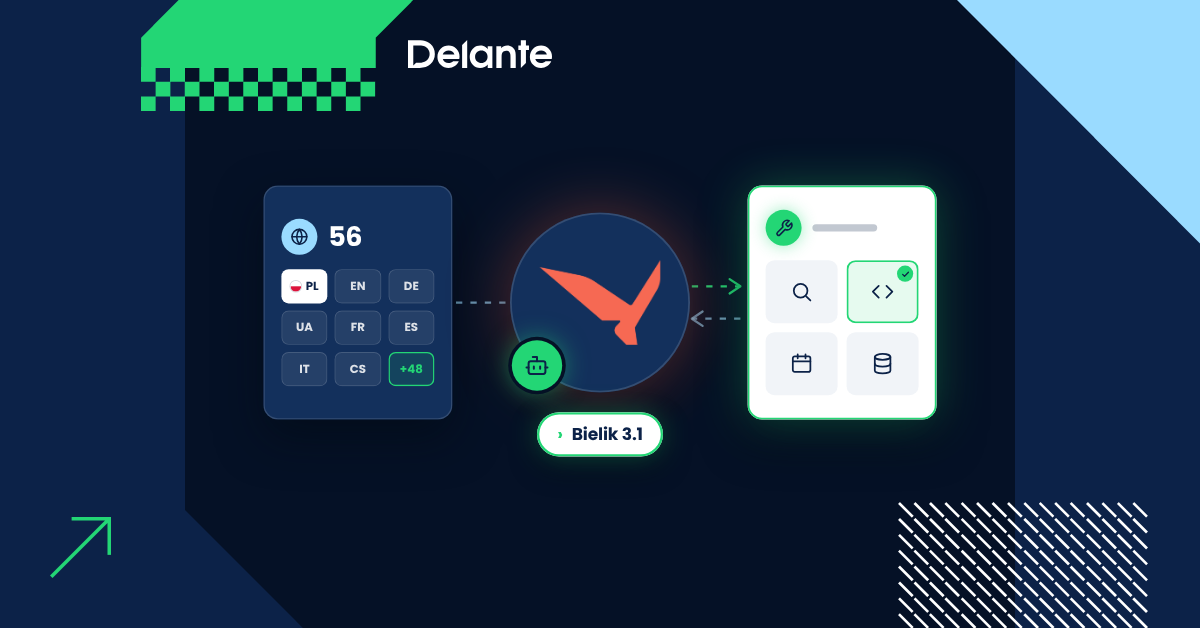
Polish AI developers SpeakLeash and ACK Cyfronet AGH released Bielik 11B v3.1 on November 10, 2026, expanding the open-weight language model from 32 to 56 supported languages and introducing stronger capabilities for AI agents. The 11-billion-parameter model can now call external tools, produce structured outputs, and use reasoning to complete multi-step tasks. The developers also introduced Bielik DFlash, designed to accelerate response generation, and Bielik-One, a family of specialized decision models. For international businesses, the release highlights the growing potential of European AI models for multilingual operations, workflow automation, and AI-powered commerce.
| Feature | Bielik 3.1 |
| Release date | November 10, 2026 |
| Developer | SpeakLeash and ACK Cyfronet AGH |
| Model size | 11 billion parameters |
| Supported languages | 56, up from 32 |
| Additional training | 500 billion tokens |
| Agentic capabilities | Tool calling, structured output, reasoning |
| Agent benchmark improvement | +16–45 percentage points vs. Bielik 3.0 |
| License | Apache 2.0 |
| Model availability | Hugging Face |
Sources: Official Bielik AI announcement and SpeakLeash model documentation. Benchmark improvements are reported by the developers and have not been independently verified by Delante.
The most important developments are:
For businesses operating internationally, the release creates another option to evaluate when selecting AI infrastructure.
However, support for 56 languages does not guarantee equal performance across them, and tool-calling capabilities alone do not make an AI system reliable enough for unsupervised business operations.
Bielik is an open-weight language model family developed through the Polish SpeakLeash initiative in cooperation with ACK Cyfronet AGH, a high-performance computing center at AGH University of Krakow.
The project initially focused on improving language model capabilities for Polish and other European languages.
Bielik 11B v3.1 represents a broader step toward multilingual AI systems capable of interacting with external software.
The latest model was developed using Polish computing infrastructure, including the Athena and Helios supercomputers and resources associated with Gaia AI Factory.
According to the official model documentation, training involved:
These stages were intended to improve language comprehension, instruction following, tool use, and reasoning.
Unlike a standalone commercial chatbot product, Bielik can be downloaded and integrated into compatible applications.
This distinction matters for companies considering their own AI infrastructure.
An organization can evaluate whether to use the model as part of an internally controlled application, rather than relying exclusively on a third-party hosted AI assistant.
However, hosting and maintaining a model still requires suitable computing resources, engineering expertise, security measures, and ongoing evaluation.
One of the headline improvements in Bielik 3.1 is expanded language coverage.
The previous version supported 32 languages.
The new release supports 56, including every official language of the European Union.
According to SpeakLeash, additional coverage includes languages such as Arabic, Chinese, Japanese, Korean, Armenian, Azerbaijani, and Georgian.
For international businesses, multilingual capabilities can support a wide range of operational tasks.
For example, a company serving customers across Europe may need to process product descriptions, customer requests, technical documentation, and market research in several languages.
Traditionally, these tasks can involve separate tools, translation workflows, and manual quality checks.
A multilingual language model may help automate selected steps.
Potential applications include:
However, businesses should not assume that a model performs equally well in all 56 languages.
SpeakLeash reported improvements over Bielik 3.0 in two multilingual benchmarks.
| Benchmark | Reported Improvement | What It Measures |
| Belebele | +8 percentage points | Reading comprehension across languages |
| INCLUDE | +5 percentage points | Multilingual knowledge and reasoning |
These results suggest progress in the model’s multilingual capabilities.
They are not equivalent to independent validation across every supported language and business application.
For example, strong reading comprehension results do not automatically guarantee accurate extraction of specialized legal, medical, or technical information.
A retailer operating in Germany, France, Spain, and Poland should test the model using representative data from each market before integrating it into production workflows.
The most significant development may be the model’s ability to participate in multi-step workflows.
SpeakLeash highlights three mechanisms that work together.
Function calling allows the model to generate requests to approved external functions.
A business application might provide tools that retrieve product data, check inventory, search a database, or produce an internal report.
For example, a customer service assistant could receive a request to check whether a product is available in a particular warehouse.
Instead of inventing an answer, the model could select a function designed to retrieve inventory information.
However, the model does not automatically receive access to business systems.
The application must define which tools are available, validate the arguments, execute permitted actions, and manage access rights.
Structured output allows a model to organize information into formats suitable for further processing.
This can be useful when AI-generated results need to become inputs for another system.
For example, an e-commerce data analysis workflow could return:
A structured result is easier for software to validate and process than a long paragraph of natural-language text.
However, businesses must still verify output formats and values before using them in automated decisions.
Bielik 3.1 also introduces stronger reasoning capabilities for workflows involving tools.
Rather than generating a single response, an AI application may require the model to execute a sequence of steps.
For example:
These workflows resemble the architecture of AI agent systems.
However, tool use does not automatically make a model a fully autonomous or reliable agent.
The success of an agent depends on the model, the quality of its instructions, tool integration, permissions, exception handling, and validation.
SpeakLeash tested Bielik 3.1 using τ²-bench, a benchmark designed to evaluate AI systems in scenarios requiring tool use and multi-step task completion.
The benchmark includes simulated workflows from industries such as retail, telecommunications, and aviation.
A model may need to retrieve information, follow business rules, select appropriate tools, and successfully complete a request.
According to the developers, Bielik 3.1 achieved results 16 to 45 percentage points higher than Bielik 3.0, depending on the scenario.
This is a substantial reported improvement within the Bielik model family.
However, the results should be interpreted carefully.
The benchmark does not prove that Bielik 3.1 outperforms OpenAI, Anthropic, Google, or other model providers.
Nor does it establish that the model can complete every real-world workflow reliably.
For businesses evaluating agentic AI, the most meaningful assessment should involve their own tasks, tools, datasets, and operational constraints.
Alongside the main Bielik 3.1 release, SpeakLeash introduced Bielik-One, a family of four specialized decision models.
These models target a different category of problems from traditional text generation.
Rather than producing lengthy responses, they analyze information and classify it according to predefined categories or criteria.
Potential uses include:
For example, an international e-commerce company may receive customer inquiries in several languages.
A classification model could help identify whether each message concerns delivery, returns, product information, or a payment issue.
Based on predefined confidence thresholds, the application could automatically route straightforward requests and send uncertain cases to a human reviewer.
This is particularly relevant to organizations processing large volumes of repetitive information.
The business value comes not from generating more text but from reducing manual classification work while maintaining suitable oversight.
The third part of the announcement is Bielik DFlash.
It is a lightweight draft model designed to work alongside Bielik 11B v3.1.
The approach uses a technique called speculative decoding.
In simple terms, the smaller model proposes sequences of output tokens, while the main model verifies them.
This can reduce the amount of work required from the larger model during text generation.
The potential benefit is faster response generation.
For businesses, latency can be an important factor in applications such as:
However, the actual performance improvement depends on the serving environment, hardware, workload, and implementation.
DFlash is not intended to operate as a separate general-purpose chatbot. It is a supporting model used in a compatible inference setup.
The model is available through the official SpeakLeash Hugging Face repository.
Yes.
The main Bielik-11B-v3.1-Instruct model is distributed under the Apache 2.0 license, which permits commercial use subject to the license terms.
The model weights and technical documentation are available on Hugging Face.
Explore Bielik 11B v3.1 Instruct on Hugging Face.
Businesses can evaluate deployment through compatible model-serving frameworks.
However, an open-weight model should not be confused with a fully managed commercial AI platform.
Organizations remain responsible for infrastructure, operating costs, data governance, system integration, and appropriate security controls.
The model card also identifies important limitations.
According to SpeakLeash, Bielik 3.1 may produce factually inaccurate, biased, or inappropriate responses and does not include built-in moderation safeguards.
This is particularly important for applications that involve customer data, business-critical decisions, or automated actions.
Tool-call parameters should be validated, and sensitive operations should require appropriate permissions.
For many businesses, the most useful starting point will be a limited pilot rather than an immediate large-scale deployment.
The release is relevant to SEO and AI Search Optimization, but not because Bielik itself changes Google’s ranking systems.
Bielik 3.1 is a language model that businesses can use to build applications and internal tools.
It is not a confirmed new ranking factor or a direct method of gaining visibility in ChatGPT, Gemini, Google AI Overviews, or Perplexity.
Its potential value lies in supporting the workflows used to research, optimize, and maintain websites.
International SEO involves working with different languages, search behaviors, technical configurations, and customer expectations.
A multilingual model can potentially support the analysis of localized product information, technical documentation, and website content.
For example, it may help identify missing product attributes across English, German, French, and Polish versions of an e-commerce website.
However, local search intent and cultural context still require dedicated research.
The ability to understand a language does not mean a model automatically understands every market’s competitive landscape or consumer behavior.
SEO audits often identify large numbers of technical and content-related problems.
Some are easy to classify using deterministic rules.
Others require additional context.
Bielik-One and the main model’s structured output capabilities may be worth evaluating for tasks such as categorizing audit findings, extracting details from product pages, and preparing prioritized reports.
Any potential benefit should be measured against existing automation and model alternatives.
The objective should be to improve accuracy or efficiency, not introduce AI into processes where simpler tools already perform better.
Function calling creates opportunities to connect language models with internal data sources and tools.
An AI assistant could retrieve information from approved systems, analyze it, and prepare a report according to predefined criteria.
This may be useful for research, content operations, and technical analysis.
But agentic systems require reliable permissions and validation, particularly when they can modify data or trigger external actions.
For businesses, successful automation is measured by completed tasks, error rates, processing time, and cost—not by whether the model can describe what it intends to do.
The growing number of multilingual and agent-capable models also creates a more diverse AI ecosystem.
Brands increasingly need to consider how their information is represented across multiple AI-powered environments.
This is the focus of AI Search Optimization (AISO).
At Delante, AISO involves evaluating brand presence, citations, recommendations, technical accessibility, and the business outcomes associated with AI-powered discovery.
Bielik’s release is relevant to the development of the wider AI ecosystem, but there is no evidence that optimizing specifically for Bielik 3.1 will automatically improve visibility in other AI systems.
Businesses should evaluate each platform according to its actual capabilities and user adoption.
Another potential area of application is Agentic Commerce.
Agentic Commerce refers to shopping experiences in which AI agents actively participate in product discovery, comparison, selection, and, in some cases, purchasing actions.
To complete these tasks, an agent may need to use external tools to access product catalogs, retrieve availability, compare offers, or interact with approved transaction systems.
Bielik 3.1’s tool-calling and reasoning capabilities make it a potential model to evaluate within these types of applications.
However, the release does not establish that Bielik can independently complete real-world shopping transactions across arbitrary retailers.
For an AI shopping workflow to function, the relevant websites and systems must provide suitable access to product information and permitted actions.
In our article How to Adapt Your Store Architecture to Agentic Commerce, we explain the technical foundations of AI-accessible e-commerce.
These include:
Even a capable AI model cannot reliably purchase a product if the necessary information or transaction functionality is unavailable.
This is why AI agent development and e-commerce technical readiness must progress together.
Delante has also conducted research into the technical readiness of online stores for agent-based interactions.
In our study of 15 Polish electronics and home appliance retailers, the average Agentic Ready Score was approximately 33 out of 100.
The assessment considered selected aspects of technical accessibility, structured data, content readability, and machine-readable interfaces.
The score is calculated using Delante’s proprietary Agentic Ready Checker.
It is not an industry-wide certification or a direct test of whether a website can support autonomous checkout.
Read more in our Agentic Ready Score definition.
The findings nevertheless illustrate a broader challenge: many websites still have opportunities to improve how automated systems discover and interpret their content.
As models such as Bielik become more capable of using tools, the quality and accessibility of business data may become increasingly important.
For companies exploring multilingual AI systems or workflow automation, Bielik 3.1 is worth considering as a candidate for evaluation.
However, choosing a model should be based on measurable requirements rather than release announcements alone.
A practical evaluation should compare Bielik with the models or automation systems already in use.
| Evaluation Area | What to Measure |
| Multilingual quality | Accuracy on representative tasks in each target language |
| Tool calling | Correct tool selection and valid arguments |
| Multi-step workflows | Successful task completion rate |
| Structured output | Schema validity and data accuracy |
| Speed | Response latency and throughput |
| Cost | Total cost per completed task |
| Reliability | Error rates and recovery behavior |
| Security | Access control, validation, and safety requirements |
Businesses should also test failure scenarios.
For example, what happens when a product is unavailable, an API returns an error, or a user asks the agent to perform an unauthorized action?
A model that performs well on straightforward tasks may still be unsuitable for workflows involving sensitive data or high-impact decisions.
Bielik 3.1 is a notable development in the European AI ecosystem.
The release expands multilingual capabilities while adding features relevant to tool-using AI systems.
The broader model family now includes specialized classification models and inference acceleration technology.
These developments may create additional options for organizations that want greater control over their AI infrastructure.
However, independent testing will be essential to establish how Bielik compares with other models on quality, cost, speed, and reliability.
The most important development is not simply that a Polish AI model now supports 56 languages. It is that a European open-weight model is becoming more capable of participating in real business workflows.
For international businesses, the opportunity is to test whether that capability delivers measurable operational benefits.
And for e-commerce companies, the wider shift toward tool-using AI reinforces the importance of accurate product information, technical accessibility, and readiness for AI-powered interactions.
As AI systems become more capable of researching information and interacting with digital services, businesses need to ensure that their websites and product data are accessible, accurate, and easy to interpret.
At Delante, we combine international SEO, AI Search Optimization, and technical development to help brands prepare for evolving AI-driven customer journeys.
Explore our AISO services and guide to preparing websites for AI agents to learn how your business can improve its visibility and technical readiness.