Author


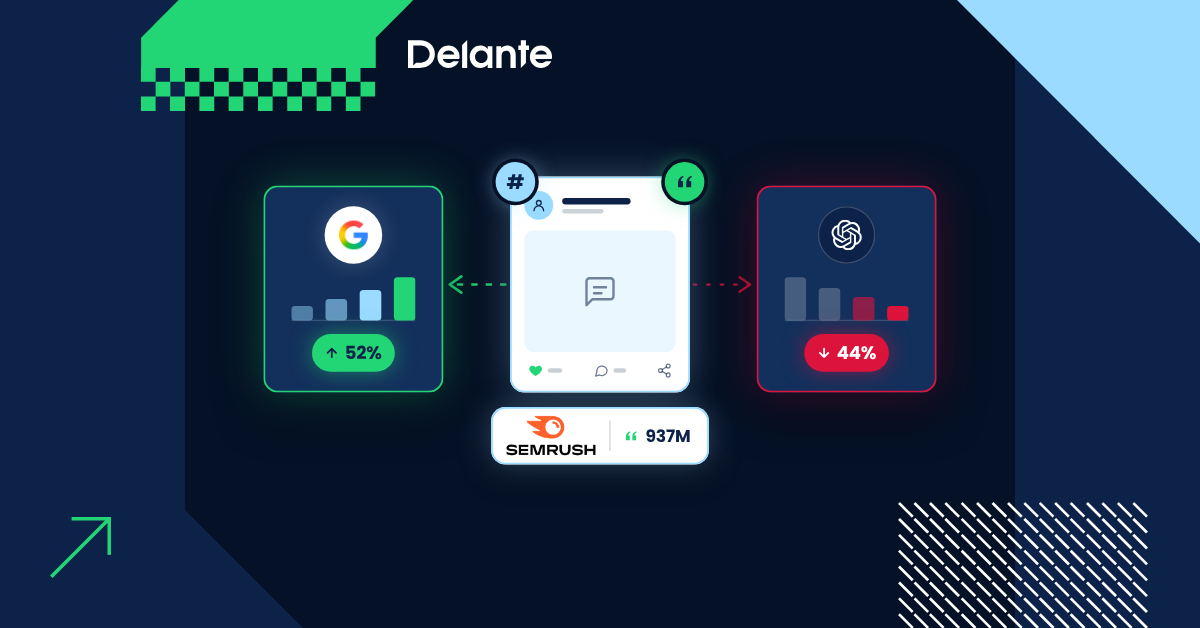
Google’s AI platforms increased citations to social media and user-generated content websites by 52%, while ChatGPT reduced citations to the same group of domains by 44%, according to a Semrush study published on November 23, 2026. The research analyzed approximately 937 million citations from 18 social media and user-generated content (UGC) domains between January and August 2026. YouTube dominated the tracked sources in Google AI Overviews, while Reddit accounted for nearly 52% of the tracked UGC citations in ChatGPT. For international brands, the findings highlight a growing challenge: building visibility across AI platforms requires different sources, content strategies, and performance metrics.
Source: Semrush, November 23, 2026. Data covers US-based research from January through August 2026.
An important distinction: these percentages describe changes in citation counts for a selected group of domains, not changes in the share of all AI citations.
The research does not prove that Google or ChatGPT uses social media more or less often relative to every other available source.
It also does not establish whether those citations generated brand recommendations, website visits, or sales.
The most valuable takeaway for businesses is that there is no universal Digital Footprint strategy that works equally well across every AI platform.
Semrush examined how 18 popular social media and UGC domains appeared as cited sources across four AI-powered environments:
The tracked websites included YouTube, Reddit, Facebook, Instagram, LinkedIn, TikTok, Pinterest, Medium, Substack, Quora, and other social and publishing platforms.
The research covered US prompt data collected between January and August 2026.
The total dataset included approximately:
| AI Platform | Citations Analyzed |
| Google AI Overviews | 528.3 million |
| Google AI Mode | 263.6 million |
| ChatGPT | 125.1 million |
| Google Gemini | 20.3 million |
| Total | 937.3 million |
These figures represent citations to the selected group of 18 domains.
They are not the total number of citations generated by each AI platform.
Semrush also grouped citations by domain rather than verifying whether every individual page contained user-generated content.
For example, a citation to YouTube does not necessarily establish that an AI system processed the complete video.
This distinction matters when interpreting the results for marketing strategy.
Between January and August 2026, the number of citations to the tracked social media and UGC websites increased across all three Google AI environments.
ChatGPT showed the opposite trend.
| AI Platform | Change in Monthly UGC Citations |
| Google AI Overviews | +63% |
| Google AI Mode | +32% |
| Google Gemini | +84% |
| Google AI combined | +52% |
| ChatGPT | −44% |
Changes compare January with August 2026 and concern the 18 tracked domains.
For Google AI products combined, monthly citations grew from 75.8 million to 115.5 million.
ChatGPT’s monthly citation count increased initially, reaching approximately 21.2 million in February, before declining to 10.1 million in August.
These findings suggest that the platforms’ source citation patterns evolved differently during the study period.
However, the data does not establish why.
Possible factors could include changes in retrieval systems, available content, or the composition of monitored queries.
The study does not isolate the effect of individual algorithm updates.
For businesses, the practical implication is clear: a platform that performs well as an AI citation source in Google may not play the same role in ChatGPT.
The differences become particularly interesting when examining individual platforms.
Across the eight-month research period, YouTube received approximately 238 million citations in Google AI Overviews.
That represented 45% of all citations to the 18 tracked UGC domains in this environment.
YouTube also led Google AI Mode, with approximately 79.9 million citations.
This suggests that YouTube is an important source within the categories of content Semrush analyzed.
For businesses producing product demonstrations, tutorials, comparisons, or expert videos, that may create opportunities to increase their presence in sources used by Google AI.
However, a citation to YouTube is not necessarily a citation to a company’s own video.
It might refer to an independent review, creator commentary, or other material discussing the brand.
Being active on YouTube does not guarantee inclusion in AI Overviews.
The relevant question is whether videos related to your industry actually appear in AI-generated answers for your customers’ search queries.
For ChatGPT, Reddit was the leading source within the tracked group.
The platform accounted for approximately 64.6 million citations, representing nearly 52% of citations to the analyzed UGC domains.
Facebook ranked second, followed by YouTube.
This highlights the potential importance of community discussions, product experiences, and user opinions in the information ChatGPT cites.
However, one important caveat cannot be overlooked.
Reddit did not account for 52% of all ChatGPT citations.
That share applies only to the 18 domains included in the research.
And despite its leading position, Reddit’s monthly citation count in ChatGPT also declined by more than 20% during the study period.
Businesses should therefore avoid assuming that Reddit is a guaranteed or permanently dominant source of AI visibility.
TikTok was one of the most notable exceptions to the broader divergence between Google AI and ChatGPT.
Its monthly citation counts increased across all four environments.
| AI Platform | TikTok Citation Growth |
| Google AI Overviews | +224% |
| Google AI Mode | +146% |
| Google Gemini | +294% |
| ChatGPT | +313% |
Although these percentages are substantial, absolute citation volumes tell a more nuanced story.
In ChatGPT, TikTok citations rose from approximately 45,500 to 188,000 per month.
That is significant growth, but TikTok remained much smaller than Reddit in the analyzed data.
Similarly, TikTok’s increase does not mean that every industry should immediately prioritize short-form video.
A fashion or beauty brand may find that short-form visual content frequently appears in relevant AI-generated answers.
A B2B software provider could see a very different pattern involving industry publications, technical documentation, professional communities, or expert-led discussions.
This is why content investment decisions should be guided by industry-specific research rather than headline growth percentages alone.
Other websites showed striking differences between AI environments.
Pinterest’s monthly citations increased by 131% in Google AI Overviews, while falling by 92% in ChatGPT.
Medium followed a similar, although less dramatic, pattern:
Substack was comparatively stable.
Its citations increased across Google’s three AI products, while declining by only 9% in ChatGPT.
The lesson is not that one publishing platform is universally superior to another.
Instead, the research demonstrates how much source visibility can vary depending on the AI system being measured.
A declining trend in ChatGPT citations is not sufficient evidence to stop investing in a platform that may still be relevant to Google AI or to your actual customers.
One of the most important sections of the Semrush research concerns traffic.
In August 2026, AI referrals represented only a small share of visits to the tracked UGC websites.
| Traffic Source | Share of Sessions |
| Direct traffic | 76.7% |
| Organic search | 15.8% |
| AI assistants | 0.14% |
| Google AI Mode | 0.02% |
Source: Semrush. The AI assistant referral figure and Google AI Mode figure describe separate traffic categories reported in the study.
These numbers apply to the analyzed social and UGC websites, not to all websites or industries.
They also cannot be used to calculate a citation click-through rate because the citation and referral analyses cover different products and datasets.
Nevertheless, the distinction is crucial for businesses.
Being cited by an AI system is not the same as receiving website traffic.
A user might see a Reddit discussion cited in an AI-generated answer, read the summary, and never open Reddit.
Similarly, a product review on YouTube might inform how an AI system describes a product without creating a visit to the video.
For brands, this raises another question: can third-party content contribute to visibility or product consideration even when users never visit the original source?
Potentially, yes.
But the Semrush research does not measure the resulting brand awareness, conversions, or sales.
Those outcomes require separate analysis.
The study reinforces an important principle: a brand’s presence in AI search depends on more than its own website.
External publications, product reviews, video content, community discussions, and expert commentary can all be relevant to how a brand is represented online.
However, the right combination will differ between AI platforms, industries, and markets.
A strategy designed to improve visibility in Google AI Overviews may prioritize different external sources than a strategy focused on ChatGPT.
For example, YouTube could be an important source for product research queries in Google AI.
Reddit might be prominent in ChatGPT answers about software comparisons or user experiences.
LinkedIn, trade publications, and specialist websites may be more relevant to certain B2B industries.
These are possibilities to investigate, not universal rules.
At Delante, our approach to AI Search Optimization includes analyzing the sources that AI systems reference when discussing a brand, its competitors, and the wider category.
The objective is to identify where the brand needs stronger representation rather than simply maximizing its presence across every available social platform.
A digital footprint extends beyond company-owned social media profiles.
It also includes independent media coverage, expert articles, customer experiences, industry research, and external references.
These assets can contribute to the wider information environment available to AI systems.
In our article Link Building in the AI Era: Why It’s No Longer Just About Links, But About Brand Credibility, we explain why off-site SEO increasingly involves brand credibility and meaningful mentions, not just backlink acquisition.
That does not mean every external mention will be used by an AI model.
The important factors to investigate include relevance, credibility, context, and whether the source actually appears in the AI responses your customers see.
The Semrush study is about citations to domains.
For a brand, that is only one part of AI visibility.
It is useful to distinguish between three outcomes:
Citation: An AI system identifies a website or page as a source.
Mention: The brand appears in the generated response.
Recommendation: The AI system presents the brand or product as a relevant option for the user’s needs.
These events can overlap, but they are not interchangeable.
For example, ChatGPT could cite a Reddit discussion comparing several software providers without recommending any one of them.
A brand could also be mentioned in the answer without its own website being cited.
Therefore, a successful AISO strategy should measure more than citation volume.
Our guide to measuring AI visibility beyond rankings and traffic explains how metrics such as Presence Rate, Share of Voice, citations, and brand-related outcomes can be used together.
One of the biggest limitations of the research is geographic scope.
The dataset covers the United States.
It does not establish that users in Germany, the United Kingdom, France, Poland, or other markets receive the same distribution of AI citations.
Local communities, language preferences, content availability, and popular platforms may all differ.
An international business should therefore examine AI responses separately across its priority markets.
A US-focused Reddit strategy may not deliver the same results for a brand targeting another country.
Likewise, an English-language YouTube channel may not address the questions customers ask in German, French, or Spanish.
Localization needs to extend beyond translating website content.
It should also consider where customers discuss products and which sources AI systems cite in each market.
An example of the broader value of combining SEO, content, and external presence comes from our work with BusTravel Iceland.
In this project, Delante implemented an integrated SEO and AISO strategy involving technical improvements, content optimization, off-site activities, and ongoing visibility monitoring.
After approximately five months, the project recorded:
| AI Visibility Metric | Result |
| Brand Score | +15% |
| Share of Voice | 1.98% → 7.25% |
| Average AI position | 5.5 → 2.5 |
The brand also appeared more frequently in AI-generated answers, while its own website became one of the most commonly cited sources for priority prompts.
Read the full BusTravel Iceland SEO & AISO case study.
This was a separate Delante project, not part of the Semrush study.
Its results cannot be attributed to YouTube, Reddit, or any single social media platform.
The case illustrates why a coordinated strategy combining website optimization, external visibility, and measurement can be more useful than treating one channel as the entire solution.
Rather than selecting social platforms first, businesses should start with the questions their customers ask.
A practical process involves six steps.
Choose representative questions related to products, services, competitors, and purchase decisions.
Include branded and non-branded queries.
For an international company, prepare market-specific question sets.
Analyze the same topics in ChatGPT, Google AI Overviews, AI Mode, and Gemini, where available.
Record which brands appear and which domains are cited.
Avoid treating the platforms as one combined search environment.
Identify whether the responses frequently reference:
Focus on sources that appear in your actual category rather than assuming overall citation leaders are equally important everywhere.
Check whether existing third-party content presents your brand accurately.
Look for outdated product details, missing comparisons, unanswered customer questions, and incorrect claims.
Where appropriate, consider educational content, expert contributions, independent reviews, or creator collaborations.
The goal should be to improve the availability of reliable information, not manufacture misleading discussions or artificial endorsements.
Monitor brand mentions, source citations, recommendations, and Share of Voice.
Use consistent question sets and repeated observations to account for variability in AI-generated answers.
A single citation snapshot is not enough to establish a trend.
Combine AI monitoring with available analytics data.
Look for changes in AI referral traffic, qualified leads, conversions, and revenue.
Keep in mind that attribution is not always straightforward.
In an earlier Delante analysis, we identified changes in how ChatGPT referral traffic was recorded in Google Analytics 4.
This illustrates why apparent changes in AI traffic should be validated before they are interpreted as real gains or losses.
Semrush’s research demonstrates how quickly the source landscape can change.
During the eight months analyzed, Google’s AI products increased citations to selected social and UGC domains, while ChatGPT moved in the opposite direction.
It is not yet clear whether those trends continued beyond August 2026.
The study also does not establish that higher citation volumes will result in more traffic or sales.
For marketing teams, the most important lesson is not that YouTube is universally better than Reddit, or that ChatGPT has stopped using social media.
It is that different AI systems may rely on very different sources when presenting information to users.
That makes platform-specific Digital Footprint analysis an increasingly important part of international SEO and AISO.
Brands should invest in the sources that matter to their audiences and regularly evaluate how those sources appear in AI-powered answers.
At Delante, we help international businesses understand how their brands appear in ChatGPT, Google AI, Gemini, Perplexity, and other AI-powered search environments.
We analyze brand mentions, citations, recommendations, source diversity, and visibility against competitors.
Our approach combines SEO, AISO, content strategy, and off-site activities to strengthen brand presence in relevant sources.
Explore our AI Search Optimization services or AI Visibility Monitoring & Traffic Report to discover how your brand is represented in AI-generated answers.